Jitendra Singh: Cabinet clears Rs 10,000 cr ATF support for airlines
Synopsis
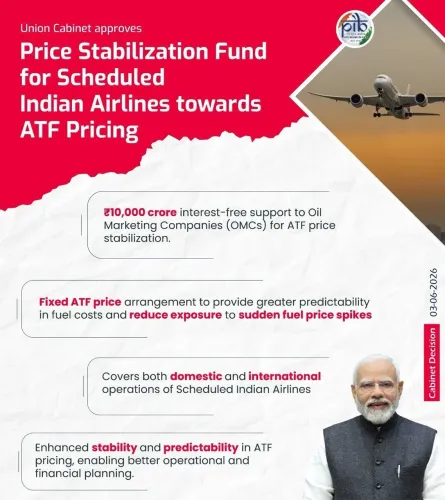
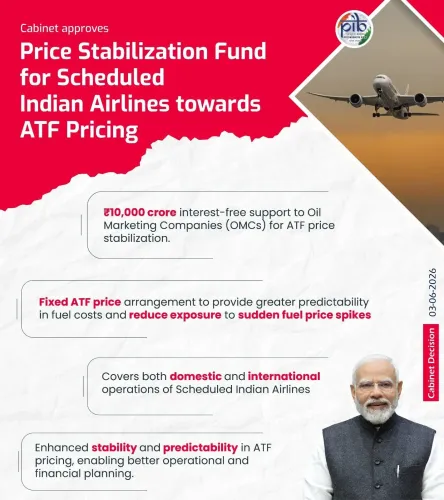
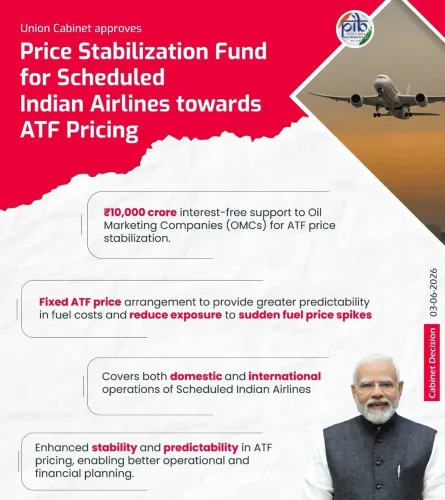
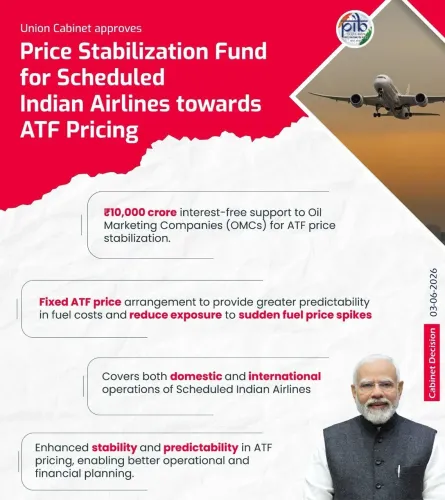
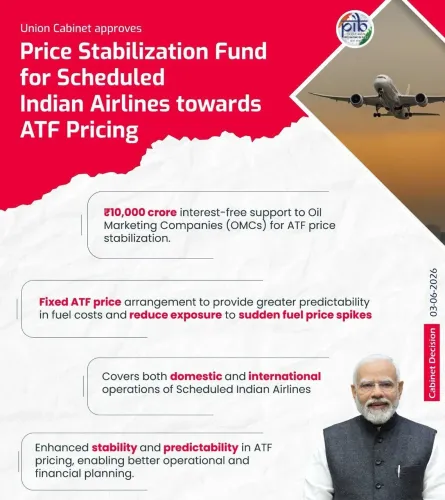
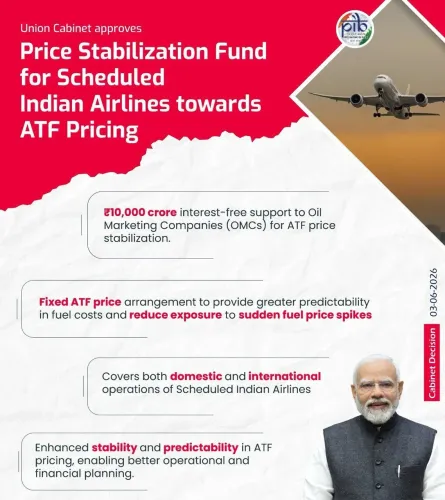
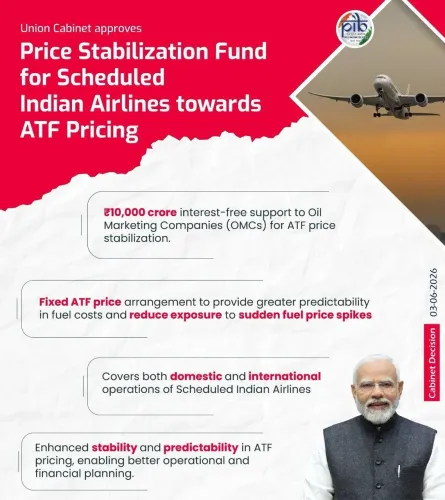
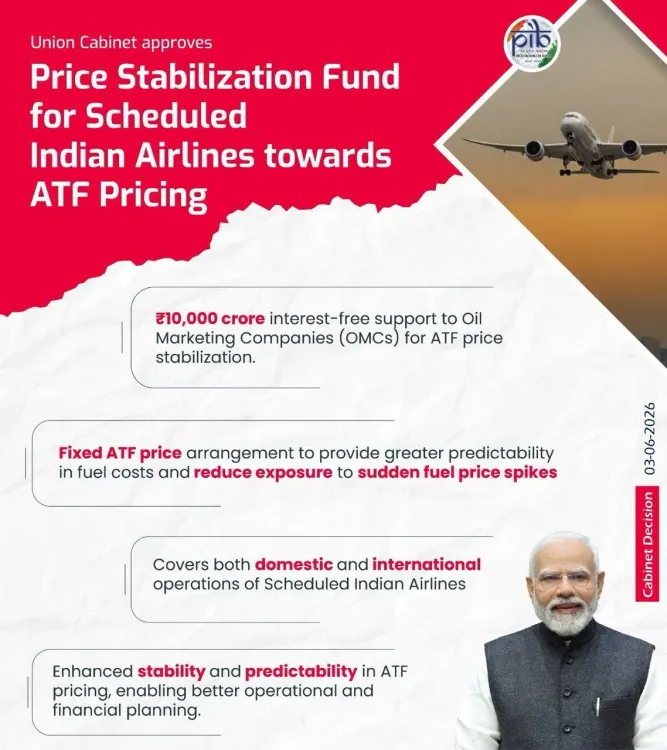
The Union Cabinet has cleared a one-time budgetary support of up to Rs 10,000 crore for Oil Marketing Companies to fund ATF price stabilisation for Scheduled Indian Airlines on domestic and international operations, Union Minister Dr. Jitendra Singh announced on X, framing it as targeted relief for a fuel-intensive sector exposed to global crude volatility.
Key Takeaways
Union Cabinet approves one-time budgetary support not exceeding Rs 10,000 crore for OMCs.
Funds are earmarked for ATF price stabilisation for Scheduled Indian Airlines.
Both domestic and international operations of eligible carriers are covered.
Decision announced by Union Minister Dr.
Jitendra Singh on X, tagged #CabinetDecisions .
Support is routed via OMCs such as IOC, BPCL and HPCL , the country's main ATF suppliers.
Move continues a pattern of time-bound fiscal cushions for strategic transport sectors.
Union Science and Technology Minister Dr. Jitendra Singh on Wednesday, June 3, 2026 announced that the Union Cabinet, chaired by Prime Minister Narendra Modi, has approved a one-time budgetary support not exceeding Rs 10,000 crore for Oil Marketing Companies (OMCs) to provide Aviation Turbine Fuel (ATF) price stabilisation support to Scheduled Indian Airlines. The measure covers both domestic and international operations of eligible carriers, and is positioned as a targeted cushion for a fuel-intensive sector exposed to global crude swings.
In his post tagged #CabinetDecisions, the minister wrote that the 'Cabinet under PM Sh @NarendraModi approves one-time budgetary support not exceeding Rs.10,000 crore for Oil Marketing Companies (OMCs) to provide ATF price stabilisation support to Scheduled Indian Airlines for their domestic and international operations'. The announcement, made through his official X handle, signals a direct fiscal channel from the Centre to OMCs, which will in turn pass through the stabilisation benefit to airlines.
Context
ATF typically accounts for a substantial share of an airline's operating cost, and Indian carriers have long flagged the volatility of jet fuel prices as a structural pressure point. Scheduled Indian Airlines — the set of DGCA-licensed carriers operating scheduled domestic and international services — are the designated beneficiaries of the pass-through.
The state-owned Oil Marketing Companies, principally Indian Oil Corporation, Bharat Petroleum Corporation Limited and Hindustan Petroleum Corporation Limited, are the country's dominant ATF suppliers at major airports. The one-time support is routed through them rather than disbursed directly to airlines, retaining the Centre's standard practice of using OMCs as the conduit for fuel-linked interventions.
Policy backdrop
The decision sits within a broader arc of targeted, time-bound fiscal transfers used by successive Cabinets to shield strategic transport sectors from external price shocks while keeping the overall fiscal deficit glide path intact. In 2017, the UDAN regional connectivity scheme introduced viability gap funding and tax concessions to seed airline operations on underserved routes — a precedent for using calibrated public support to sustain civil aviation.
The current intervention is narrower in design: it is explicitly one-time, capped at Rs 10,000 crore, and tied to ATF price stabilisation rather than route economics. By framing the outlay as support to OMCs, the Centre keeps the transfer within the energy-sector accounting envelope while the relief flows downstream to carriers.
Stakeholders and impact
For Scheduled Indian Airlines, the stabilisation support could ease a key input-cost variable at a time when capacity expansion, fleet induction and international route launches are accelerating across the industry. The inclusion of international operations is notable, as Indian carriers compete with Gulf and Southeast Asian rivals on long-haul pricing, where fuel differentials directly shape yields.
For OMCs, the budgetary support cushions the working-capital implications of administering an ATF stabilisation mechanism. For air passengers, the indirect expectation is that steadier ATF pricing helps moderate fare volatility on trunk and metro routes, though the final pass-through will depend on the roll-out design.
What's next
Attention now turns to the operational architecture of the stabilisation mechanism — how OMCs will calibrate ATF pricing for scheduled carriers, the reference benchmarks used, and the period over which the Rs 10,000 crore envelope will be drawn down. The aviation ministry and the petroleum ministry are expected to issue the implementing framework.
The measure is also likely to surface in parliamentary scrutiny during the upcoming session, with questions probable on eligibility, disbursement triggers and audit oversight. If the stabilisation holds ATF costs in a tighter band, it could meaningfully reshape near-term unit economics for Indian aviation and reinforce the Centre's stated objective of preserving both domestic connectivity and the international competitiveness of Indian carriers.
Point of View
000 crore as a one-time outlay, the Centre preserves its fiscal discipline narrative while signalling support for a sector central to connectivity and trade. Including international operations is a competitive signal, given the pricing pressure Indian carriers face on long-haul routes. The real test will be the design of the pass-through and whether the stabilisation translates into steadier fares.
NationPress
21 Sept 2026
Frequently Asked Questions
What did the Cabinet approve for Indian airlines?
The Union Cabinet approved a one-time budgetary support not exceeding Rs 10,000 crore for Oil Marketing Companies to provide ATF price stabilisation support to Scheduled Indian Airlines for their domestic and international operations.
Who announced the Rs 10,000 crore ATF support decision?
Union Science and Technology Minister Dr. Jitendra Singh announced the Cabinet decision through a post on X, tagged with #CabinetDecisions.
Will airlines get the Rs 10,000 crore directly?
No. The budgetary support is provided to Oil Marketing Companies, which will in turn deliver ATF price stabilisation to Scheduled Indian Airlines.
Does the support cover international flights of Indian airlines?
Yes. The Cabinet decision explicitly covers both domestic and international operations of Scheduled Indian Airlines.
Which Oil Marketing Companies will administer the support?
State-owned OMCs that market ATF — principally Indian Oil Corporation, Bharat Petroleum Corporation Limited and Hindustan Petroleum Corporation Limited — are the entities through which the support flows.