Puri: Cabinet clears Rs 10,000 cr ATF price support for airlines
Synopsis
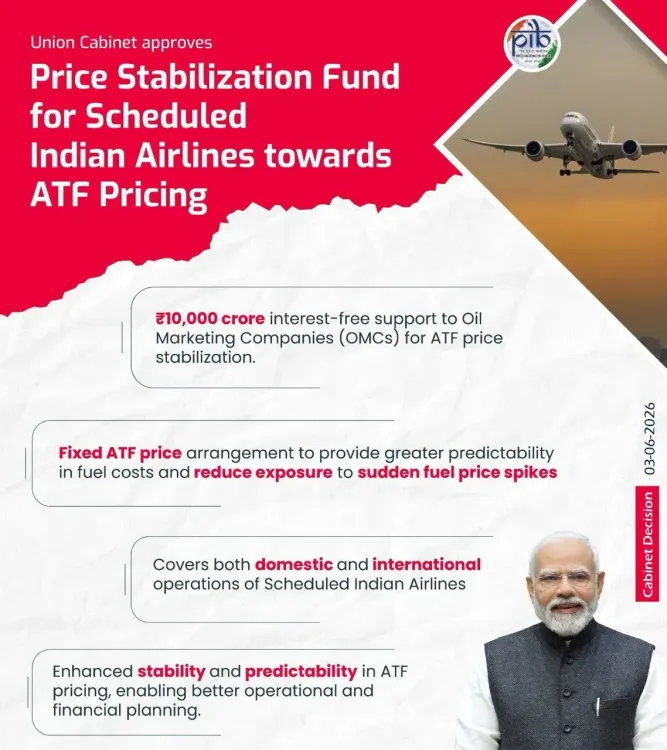
Union Petroleum Minister Hardeep Singh Puri announced Cabinet approval of up to Rs 10,000 crore in one-time budgetary support for Oil Marketing Companies to stabilise ATF prices for Scheduled Indian Airlines, shielding passengers from fare spikes and protecting 77 lakh aviation-linked jobs amid global energy market volatility.
Key Takeaways
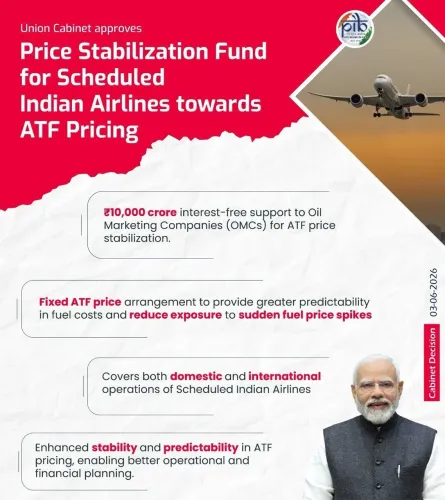
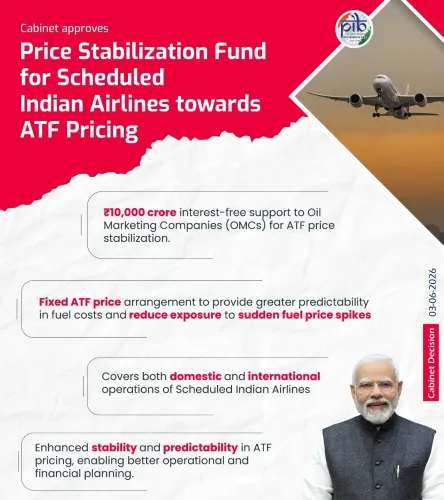
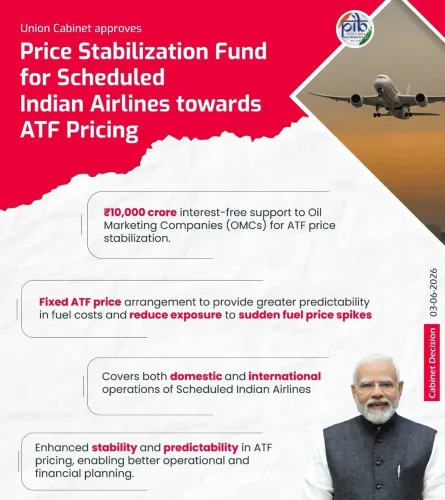
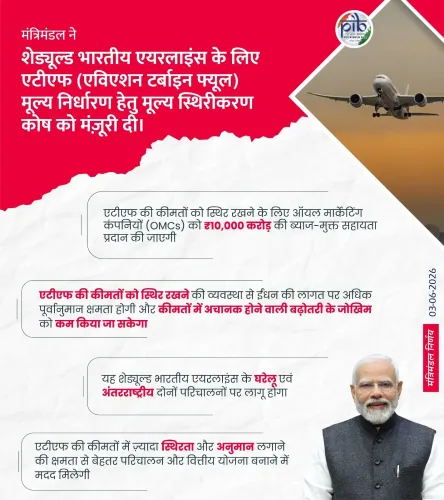
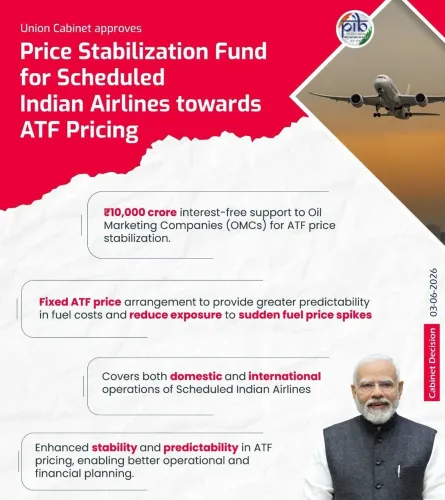
Union Cabinet approves one-time budgetary support of up to Rs 10,000 crore for OMCs to stabilise ATF prices.
Support covers both domestic and international operations of Scheduled Indian Airlines.
Minister says the fund will protect 77 lakh jobs dependent on the aviation ecosystem.
India has not raised ATF prices for domestic airlines despite elevated international rates.
Move aims to prevent fare spikes linked to geopolitical conflict involving major energy producers.
Decision continues a pattern of fiscal intervention through OMCs to absorb global price shocks.
Union Petroleum Minister Hardeep Singh Puri on Wednesday, 3 June 2026, announced that the Union Cabinet, chaired by Prime Minister Narendra Modi, has approved a one-time budgetary support of up to Rs 10,000 crore for Oil Marketing Companies (OMCs) to stabilise Aviation Turbine Fuel (ATF) prices for Scheduled Indian Airlines. The Minister said the measure will cushion both domestic and international operations of Indian carriers and shield passengers from fare spikes linked to the ongoing global energy disruption.
Calling it a 'landmark relief to the country’s aviation and energy sectors', Puri said the fund will 'prevent disruption of airline operations while protecting air passengers from fare spikes driven by the geopolitical conflict involving several energy producers'. He added that the support will safeguard 77 lakh jobs dependent on the aviation ecosystem and protect public investment in airport infrastructure.
Context
The decision comes against the backdrop of sustained volatility in global crude and refined-product markets, with international ATF prices remaining elevated through much of the past year. Puri noted that Indian OMCs have made 'only very minor price adjustments' for consumers, and that ATF prices for domestic airlines have not been raised despite firm international benchmarks.
The Minister contrasted India's position with that of several economies in South Asia and the West, arguing that New Delhi has maintained 'steady and uninterrupted supply of affordable and sustainable energy' even as global supply chains have been strained.
Policy backdrop
Aviation Turbine Fuel typically accounts for around 40 per cent of an Indian airline's operating cost, making carriers acutely sensitive to crude price swings and rupee depreciation. The Centre has previously used a mix of excise duty cuts and state-level VAT reductions to soften ATF costs, particularly during the post-COVID recovery between 2021 and 2023.
The new mechanism marks a shift from tax-side relief to direct budgetary support routed through OMCs — primarily Indian Oil Corporation, Bharat Petroleum and Hindustan Petroleum — which sell ATF at airport fuelling stations. A similar approach was adopted in 2022, when the Centre absorbed under-recoveries at OMCs after the Russia-Ukraine conflict pushed crude above USD 100 a barrel.
Stakeholders and impact
Scheduled Indian carriers operating domestic and international routes stand to be the most direct beneficiaries, with ATF cost relief expected to improve unit economics on price-sensitive routes. Puri framed the move as protecting 'regional and international connectivity', a reference to tier-2 and tier-3 routes that are particularly vulnerable to fuel-driven fare hikes.
For passengers, the support is intended to prevent the kind of sharp ticket-price escalation seen during previous oil shocks. The Minister specifically flagged the cushion for air travellers as a key objective, alongside the protection of jobs across pilots, cabin crew, ground handling, MRO services and airport operations.
OMCs, which would otherwise have had to absorb the gap between subsidised ATF rates and international parity prices, will see their balance sheets insulated through the budgetary transfer. The exact disbursement formula and the period over which the Rs 10,000 crore will be released were not detailed in the Minister's post.
What's next
Attention will now turn to the operational guidelines for the support fund, including how the Rs 10,000 crore is split across OMCs and the trigger thresholds linked to international ATF benchmarks. Monthly ATF price revisions by state-owned refiners will be closely watched for evidence that the cushion is being passed through to airline operators.
The measure is also likely to come up for scrutiny in the next session of Parliament, where questions on aviation sector viability, fuel taxation and the long-term fiscal cost of repeated energy-sector interventions are expected. For now, the Cabinet's decision reinforces a pattern of targeted fiscal action to insulate strategic sectors — energy, aviation and connectivity — from external price shocks.
Point of View
The government signals that aviation is being treated as critical infrastructure rather than a discretionary service. The fiscal trade-off, and how transparently the support is disbursed, will define its long-term credibility.
NationPress
17 Oct 2026
Frequently Asked Questions
What has the Union Cabinet approved for Indian airlines?
The Union Cabinet has approved a one-time budgetary support of up to Rs 10,000 crore for Oil Marketing Companies to provide ATF price stabilisation support to Scheduled Indian Airlines for their domestic and international operations.
Why is the government giving ATF support to airlines now?
The support is intended to prevent disruption of airline operations and shield passengers from fare spikes caused by elevated global ATF prices linked to an ongoing geopolitical conflict involving major energy producers.
How many jobs will the ATF support measure protect?
According to Union Petroleum Minister Hardeep Singh Puri, the fund will protect 77 lakh jobs dependent on the aviation ecosystem, including airline staff, ground handling, MRO and airport operations.
Which companies will receive the Rs 10,000 crore support?
The support will go to Oil Marketing Companies — primarily state-owned Indian Oil Corporation, Bharat Petroleum and Hindustan Petroleum — which market ATF to scheduled Indian carriers.
Will air ticket prices come down because of this decision?
The measure is designed to prevent fare spikes rather than cut existing ticket prices. By stabilising ATF costs for airlines, the government aims to keep fares from rising sharply on domestic and international routes.