Sonowal: Cabinet clears Rs 10,000 cr ATF support for airlines
Synopsis
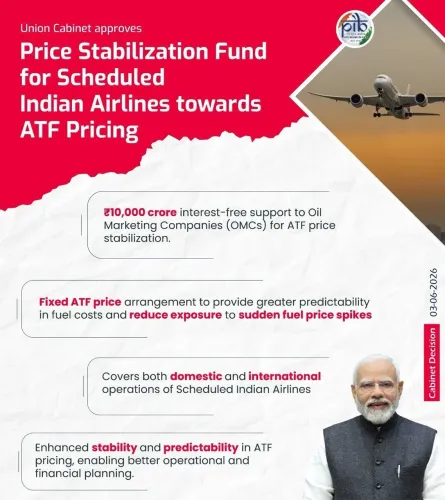
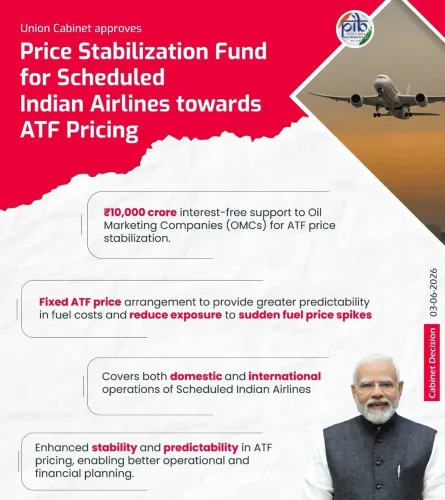
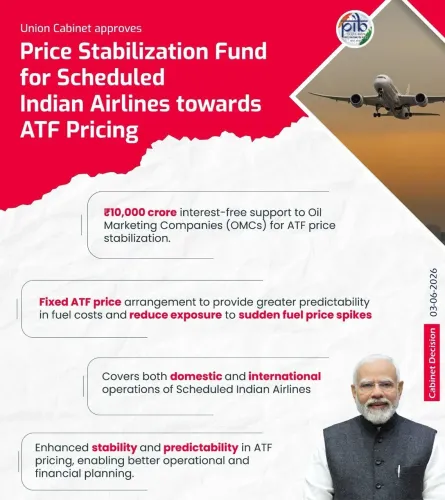
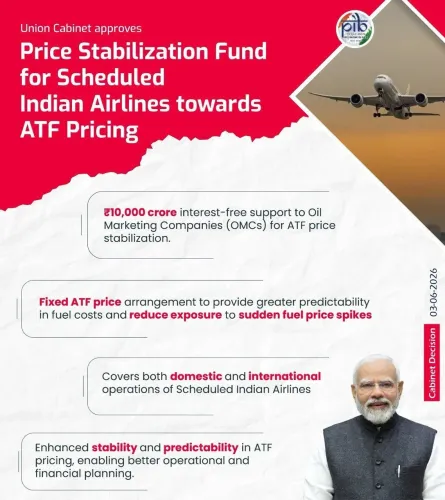
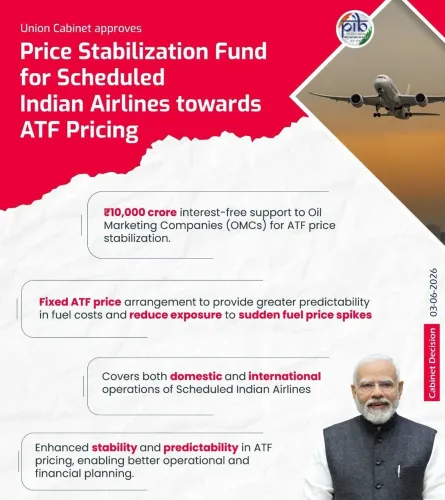
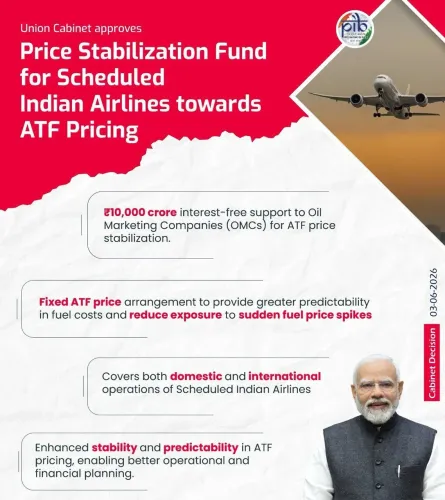
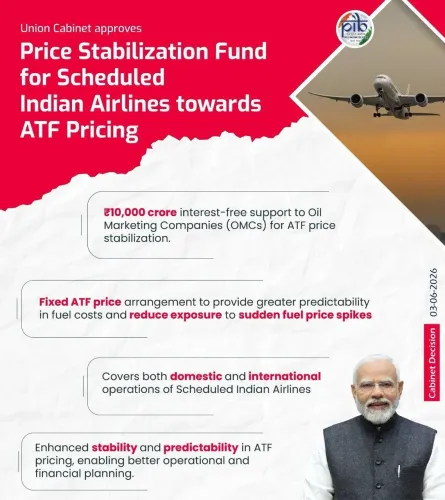
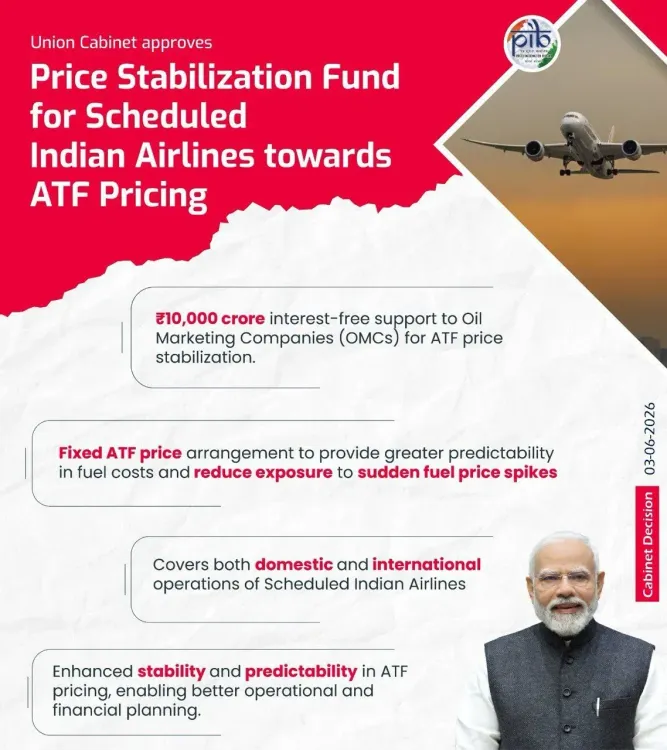
Union Minister Sarbananda Sonowal announced that the Modi-chaired Cabinet has cleared a one-time budgetary support of up to Rs 10,000 crore for Oil Marketing Companies to provide ATF price stabilisation assistance to Scheduled Indian Airlines on domestic and international operations, offering relief on a key cost head.
Key Takeaways
Cabinet approves one-time budgetary support not exceeding Rs 10,000 crore for OMCs.
Funds will enable ATF price stabilisation support for Scheduled Indian Airlines.
Coverage extends to both domestic and international operations of eligible carriers.
ATF accounts for 35-40 percent of Indian airlines' operating costs.
Decision continues the pattern of targeted, time-bound fiscal support to aviation.
Announcement made by Union Ports and Shipping Minister Sarbananda Sonowal.
Union Ports and Shipping Minister Sarbananda Sonowal announced on Wednesday that the Union Cabinet, chaired by Prime Minister Narendra Modi, has approved a one-time budgetary support of up to Rs 10,000 crore for Oil Marketing Companies (OMCs) to extend Aviation Turbine Fuel (ATF) price stabilisation assistance to Scheduled Indian Airlines. The measure covers both domestic and international operations of eligible carriers and was disclosed under the government's #CabinetDecisions briefing.
In his post, Sonowal said the 'Cabinet chaired by Hon'ble PM Shri Narendra Modi ji approves one-time budgetary support not exceeding Rs 10,000 crore for Oil Marketing Companies (OMCs) to provide ATF price stabilisation support to Scheduled Indian Airlines for their domestic and international operations.' The announcement signals a fresh fiscal intervention aimed at cushioning Indian carriers from volatile jet fuel costs.
Context
ATF is consistently flagged by Indian carriers as the single largest line item in their cost structures, typically accounting for 35-40 percent of operating expenses. Sharp swings in global crude prices and a rupee under pressure have repeatedly squeezed airline margins over the past several quarters.
The newly approved support is structured as a budgetary transfer to OMCs — primarily Indian Oil Corporation Ltd (IOCL), Bharat Petroleum Corporation Ltd (BPCL) and Hindustan Petroleum Corporation Ltd (HPCL) — which are the principal ATF suppliers at Indian airports. The mechanism allows OMCs to absorb a portion of price shocks while passing on stabilised rates to Scheduled Indian Airlines licensed by the Directorate General of Civil Aviation.
Policy backdrop
The decision continues a pattern of targeted, time-bound fiscal support to the aviation sector rather than a structural overhaul of the ATF tax regime. In 2020, the central government had announced a Rs 20,000 crore liquidity infusion package for civil aviation during the COVID-19 downturn, and in 2021 excise duty on ATF was reduced to ease input costs for domestic carriers amid global crude price volatility.
The civil aviation ecosystem has also been buttressed by the UDAN regional connectivity scheme, launched in 2016, which subsidises air travel and develops smaller airports. Industry stakeholders have long demanded that ATF be brought under the Goods and Services Tax framework to enable input tax credits — a proposal that remains under deliberation at the GST Council.
Stakeholders and impact
The primary beneficiaries are Scheduled Indian Airlines including Air India, IndiGo and Akasa Air, which together operate the bulk of domestic capacity and a growing share of international routes from India. By moderating ATF pricing, the support is expected to ease pressure on quarterly financials and, indirectly, on ticket pricing for passengers.
For the three state-run OMCs, the Rs 10,000 crore ceiling provides a fiscal backstop against revenue erosion when they offer stabilised ATF prices. Air passengers stand to gain indirectly if carriers translate lower fuel costs into restrained fare hikes, particularly on competitive metro and tier-2 routes.
Domestic carriers have repeatedly argued that high ATF taxation places them at a structural disadvantage against Gulf and Southeast Asian airlines operating into India, especially on long-haul routes. A stabilisation buffer could marginally improve their competitiveness on international sectors.
What's next
The Ministry of Petroleum and Natural Gas, in consultation with the Ministry of Civil Aviation, is expected to notify the operational framework — including the trigger price band, eligibility conditions and disbursement schedule for OMCs. Carriers will be watching closely for the fine print on whether the relief is calibrated to a benchmark crude or ATF price.
Investors and analysts will track airline financials in the coming quarters to gauge the support's pass-through, alongside any complementary measures in the next Union Budget or Finance Bill. The intervention reinforces the Centre's willingness to deploy targeted fiscal tools to keep India's fast-expanding aviation market on a stable growth path.
Point of View
000 crore ATF stabilisation package fits a familiar template — the Centre using one-off fiscal transfers via OMCs to shield strategic sectors from commodity shocks, rather than restructuring the underlying tax regime. It signals that Delhi values aviation's growth trajectory enough to absorb fuel-price volatility on the balance sheet, but stops short of the structural reform airlines have long sought, namely bringing ATF under GST. The political optics are also notable: a senior minister from a non-aviation portfolio amplifying the decision underscores how Cabinet wins are now cross-promoted across the Council of Ministers.
NationPress
13 Sept 2026
Frequently Asked Questions
What did the Cabinet approve for Indian airlines?
The Union Cabinet approved a one-time budgetary support of up to Rs 10,000 crore for Oil Marketing Companies to provide ATF price stabilisation support to Scheduled Indian Airlines for domestic and international operations.
Who announced the Rs 10,000 crore ATF support decision?
Union Ports and Shipping Minister Sarbananda Sonowal announced the decision on X, noting that the Cabinet meeting was chaired by Prime Minister Narendra Modi.
Which companies will receive the Rs 10,000 crore support?
The support will go to Oil Marketing Companies — the public sector undertakings such as IOCL, BPCL and HPCL that supply Aviation Turbine Fuel to airlines at Indian airports.
How much of an airline's cost is ATF in India?
Aviation Turbine Fuel typically accounts for 35-40 percent of an Indian airline's operating costs, making it the single largest expense line for carriers.
Will airfares come down because of this Cabinet decision?
The stabilisation mechanism could indirectly ease pressure on fares if carriers pass on relief, but actual ticket prices will depend on the operational framework notified by the government and market conditions.