Rijiju: Cabinet clears Rs 10,000 cr ATF price support for airlines
Synopsis
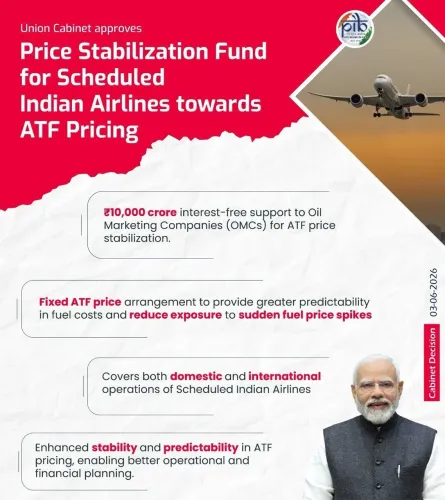
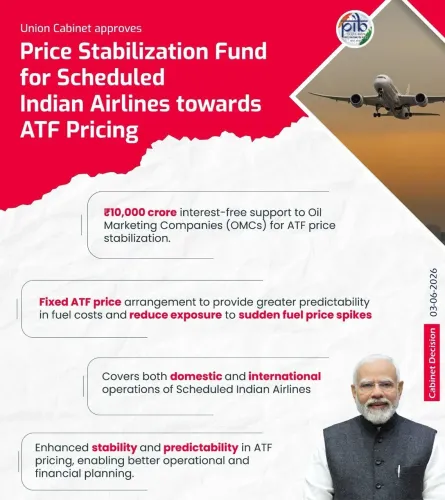
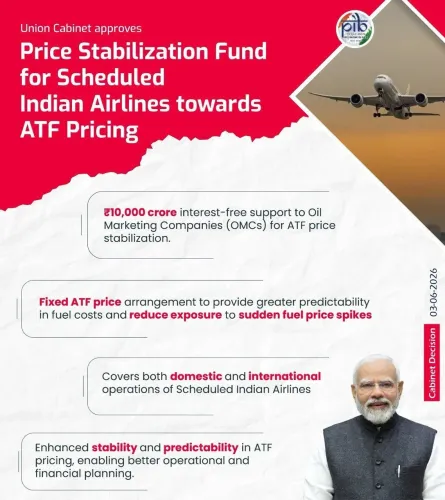
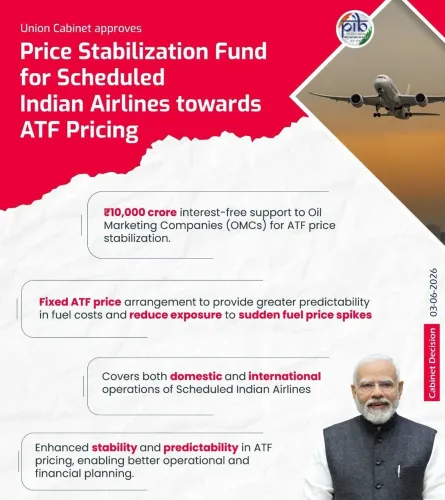
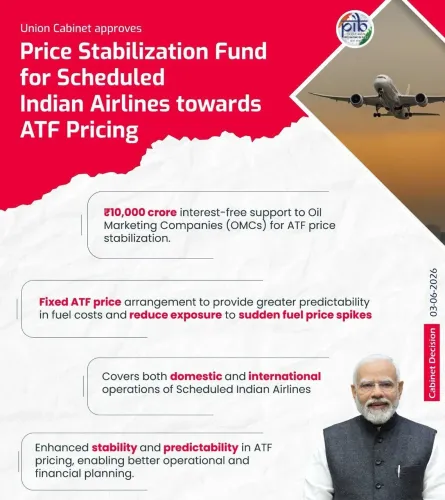
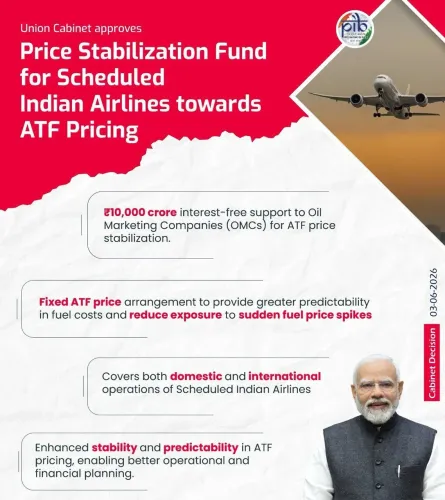
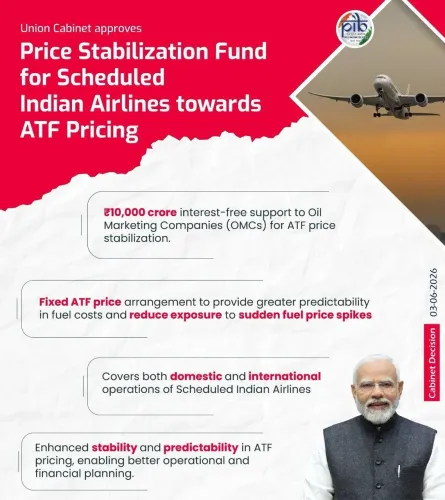
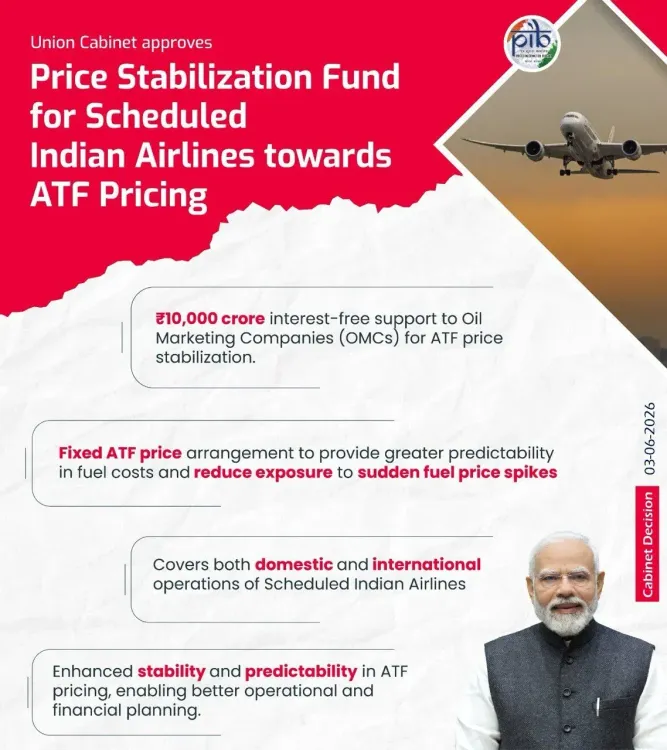
Union Parliamentary Affairs Minister Kiren Rijiju announced that the Union Cabinet has cleared a one-time budgetary support of up to Rs 10,000 crore for Oil Marketing Companies to provide Aviation Turbine Fuel price stabilisation support to Scheduled Indian Airlines, covering both domestic and international operations.
Key Takeaways
Union Cabinet has approved one-time budgetary support of up to Rs 10,000 crore for Oil Marketing Companies.
Funds will be used to extend ATF price stabilisation support to Scheduled Indian Airlines.
Relief covers both domestic and international operations of Indian carriers.
Beneficiary OMCs include IOCL, BPCL and HPCL , which supply ATF nationwide.
Decision follows earlier steps such as the 2021 excise duty cut on ATF from 11% to 5% .
Announcement was made by Union Minister Kiren Rijiju on 3 June 2026 .
Union Parliamentary Affairs Minister Kiren Rijiju announced on 3 June 2026 that the Union Cabinet, chaired by Prime Minister Narendra Modi, has approved a one-time budgetary support of up to Rs 10,000 crore for Oil Marketing Companies (OMCs) to extend Aviation Turbine Fuel (ATF) price stabilisation support to Scheduled Indian Airlines. The relief is intended to cushion both domestic and international operations of Indian carriers against fuel-price volatility.
In his post, Rijiju stated that the Cabinet 'approves one-time budgetary support not exceeding Rs.10,000 crore for Oil Marketing Companies (OMCs) to provide ATF price stabilisation support to Scheduled Indian Airlines for their domestic and international operations.' The announcement was tagged under #CabinetDecisions, indicating it was part of a regular post-Cabinet briefing rollout.
Context
ATF is the single largest operating cost for Indian airlines, typically accounting for around 40% of expenses, and is highly sensitive to swings in global crude oil prices and the rupee-dollar exchange rate. State-level value added tax on ATF, layered on top of central levies, has historically pushed Indian jet fuel prices above global benchmarks.
The new Rs 10,000 crore window will be routed through Oil Marketing Companies — principally Indian Oil Corporation, Bharat Petroleum and Hindustan Petroleum — which supply ATF at airports across the country. By absorbing part of the price shock at the OMC level, the government aims to keep ticket fares stable without directly subsidising airlines.
Policy backdrop
The decision sits within a longer arc of central interventions to insulate Indian aviation from fuel-cost shocks. In 2021, the Centre had reduced excise duty on ATF from 11% to 5%, and successive Budgets have nudged states to bring ATF under a uniform tax regime.
Parallel to such relief, the government has pursued capacity expansion through the National Civil Aviation Policy and the regional connectivity scheme UDAN (Ude Desh ka Aam Naagrik), positioning India as one of the world's fastest-growing aviation markets. The fresh stabilisation package complements that growth push by addressing the cost side of the equation.
Stakeholders and impact
The immediate beneficiaries are DGCA-licensed scheduled carriers operating scheduled passenger and cargo services, both domestically and on international routes. Lower effective ATF outgo can ease pressure on operating margins for carriers that have expanded fleets aggressively in recent years.
Oil Marketing Companies, which often carry under-recoveries when fuel prices spike, will see those gaps partly bridged by the budgetary window. Passengers stand to indirectly benefit if airlines pass on stabilised input costs through steadier fares, particularly on price-sensitive domestic routes and during peak travel seasons.
Airport operators and the wider aviation ecosystem — ground handlers, MRO providers and travel agencies — also gain from a more predictable cost environment that supports schedule reliability and route expansion.
What's next
Attention will turn to the gazette notification spelling out the disbursement mechanism: the formula by which OMCs will draw on the Rs 10,000 crore corpus, the reference price benchmarks, and the duration over which the one-time support is operationalised. The Ministry of Petroleum and Natural Gas and the Ministry of Civil Aviation are expected to issue implementation guidelines in the coming weeks.
Parliamentary scrutiny is likely once the monsoon session convenes, with questions anticipated on utilisation, audit and whether the support will be extended if crude prices remain elevated. For an aviation sector targeting deeper international penetration and record passenger volumes, the policy signal — that the Centre is willing to deploy direct fiscal support to stabilise jet fuel costs — may prove as consequential as the headline number itself.
Point of View
000 crore ATF stabilisation window marks a notable shift from indirect tax tweaks to direct fiscal support for aviation cost structures. It signals that the Centre views jet fuel volatility as a systemic risk to its ambition of making India a top-three global aviation market, not just an airline-level problem. Routing the money through OMCs rather than airlines also sidesteps state-aid optics while still cushioning carriers. The real test will be the disbursement formula and whether the one-time tag holds if crude prices stay elevated.
NationPress
17 Oct 2026
Frequently Asked Questions
What did the Union Cabinet approve for airlines?
The Union Cabinet approved a one-time budgetary support of up to Rs 10,000 crore for Oil Marketing Companies to provide Aviation Turbine Fuel price stabilisation support to Scheduled Indian Airlines for their domestic and international operations.
Who will receive the Rs 10,000 crore support?
The Rs 10,000 crore will go to Oil Marketing Companies such as Indian Oil, Bharat Petroleum and Hindustan Petroleum, which in turn will use it to stabilise ATF prices for Scheduled Indian Airlines.
Why is ATF price stabilisation important for Indian airlines?
ATF typically accounts for around 40% of an Indian airline's operating costs, so price spikes directly hit margins and fares. Stabilising ATF prices helps protect carriers and passengers from sharp swings in global crude oil prices.
Who announced the Cabinet decision on ATF support?
Union Parliamentary Affairs Minister Kiren Rijiju announced the decision on X, attributing the approval to the Union Cabinet led by Prime Minister Narendra Modi.
Is the Rs 10,000 crore ATF support a recurring subsidy?
No. The government has described it as a one-time budgetary support not exceeding Rs 10,000 crore, rather than a recurring subsidy to airlines or OMCs.