Cabinet clears ₹10,000 crore ATF price relief for Indian airlines amid West Asia crisis
Synopsis
With ATF prices up nearly 2.5x since March, the Modi Cabinet has stepped in with a ₹10,000 crore interest-free cushion for OMCs to keep aviation fuel predictable for Indian carriers. The 36-month, clawback-linked design is a rare hybrid — subsidy in spirit, loan on paper — and a direct response to the West Asia crisis spilling onto Indian runways.
Key Takeaways
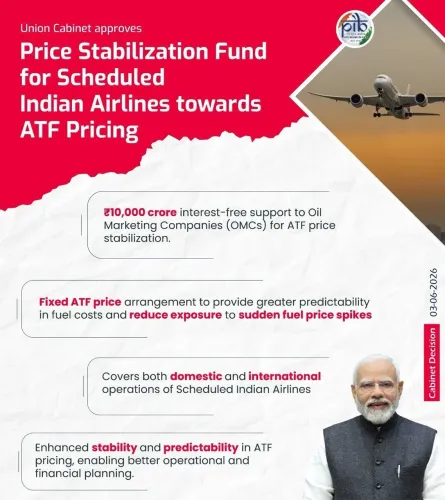
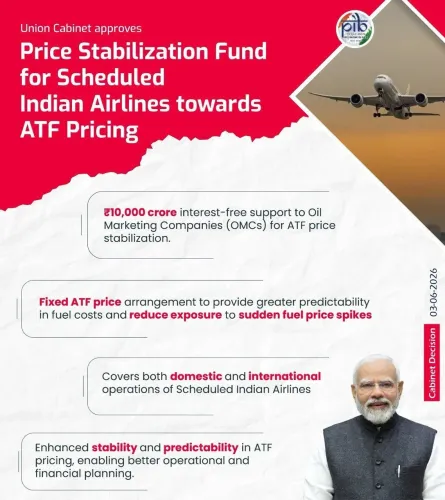
The Union Cabinet on 3 June 2026 approved a ₹10,000 crore interest-free advance to OMCs for ATF price stabilisation.
The scheme covers all Scheduled Indian Airlines on domestic and international operations for up to 36 months .
International ATF prices have surged from ₹60.50/litre in March 2026 to ₹142/litre in May 2026.
The differential will be clawed back from OMCs and returned to the Consolidated Fund of India when prices moderate.
Participating airlines must procure ATF exclusively from OMCs for the duration of the scheme.
The Union Cabinet, chaired by Prime Minister Narendra Modi, on 3 June 2026 approved a one-time budgetary support of ₹10,000 crore as an interest-free advance to Oil Marketing Companies (OMCs) to stabilise Aviation Turbine Fuel (ATF) prices for Scheduled Indian Airlines on domestic and international routes. The move comes as international ATF prices have surged nearly 2.5 times since March, driven by the ongoing West Asia crisis.
Key Developments
The budgetary support will be routed through the Demands for Grants of the Ministry of Petroleum and Natural Gas, shielding OMCs from losses tied to volatile and elevated ATF prices. The scheme will remain in force for 36 months, with provision for annual review, or until the advance is fully recovered, whichever is earlier.
How the mechanism works
According to the Cabinet note, the corpus will compensate OMCs for losses whenever the prevailing Import Parity Price exceeds the benchmark price set under the approved mechanism. When international ATF prices moderate, the differential will be clawed back from OMCs and returned to the Consolidated Fund of India.
“A one-time budgetary support of up to ₹10,000 crore shall be provided as an interest-free advance to OMCs to support ATF price stabilisation for Scheduled Indian Airlines,” the Cabinet note stated.
Who is covered
The scheme will be open to all willing scheduled Indian carriers for both domestic and international operations. Implementation will be through a Memorandum of Understanding (MoU) between participating airlines and OMCs, with the Ministry of Civil Aviation and the Ministry of Petroleum and Natural Gas as signatories.
Under the arrangement, participating airlines will procure ATF only from OMCs for up to three years, subject to annual review or until the advance is fully recovered.
Why it matters
International ATF prices have jumped from ₹60.50 per litre in March 2026 to ₹142 per litre in May 2026 — a near 2.5x spike tied to the West Asia conflict. ATF typically accounts for nearly 40% of Indian carriers' operating costs, making the sector acutely exposed to crude shocks. The fixed-price arrangement is intended to give airlines greater predictability in fuel costs and protect them from sudden spikes.
What's next
Officials said the measure is expected to have positive spill-over effects on tourism, hospitality, trade, exports, regional development, and investment. The MoU framework between carriers and OMCs is expected to be operationalised in the coming weeks, with the support arrangement continuing until the full ₹10,000 crore advance is recovered and settled.
Point of View
000 crore 'support' overstates the giveaway — it is an interest-free advance with a clawback when prices ease, closer to a revolving line than a subsidy. That structural elegance aside, the bigger question is whether tying airlines to OMCs for three years dampens the competitive pricing that private fuel suppliers were beginning to inject into Indian aviation. The West Asia trigger is real, but India's ATF problem is also structural — taxed heavily by states, opaque on benchmarks. A price stabilisation scheme without ATF tax reform treats the symptom, not the disease.
NationPress
26 Sept 2026
Frequently Asked Questions
What is the ₹10,000 crore ATF support scheme approved by the Cabinet?
It is a one-time interest-free advance of up to ₹10,000 crore from the Centre to Oil Marketing Companies, designed to stabilise Aviation Turbine Fuel prices for Scheduled Indian Airlines. The scheme covers both domestic and international operations and will run for up to 36 months.
Why has the government stepped in now?
International ATF prices have surged nearly 2.5 times — from ₹60.50 per litre in March 2026 to ₹142 per litre in May 2026 — due to the ongoing West Asia crisis. The intervention is aimed at shielding airlines from sudden fuel cost spikes and protecting OMCs from losses.
Will the ₹10,000 crore be a permanent subsidy?
No. It is structured as an interest-free advance, not a grant. When international ATF prices moderate, the differential will be recovered from OMCs and returned to the Consolidated Fund of India until the full amount is settled.
Which airlines are eligible for the scheme?
All willing Scheduled Indian Airlines are eligible for both domestic and international operations. Participating carriers must sign an MoU with OMCs and agree to procure ATF only from OMCs for the duration of the scheme.
How will the price stabilisation actually work?
OMCs will be compensated whenever the prevailing Import Parity Price exceeds a benchmark price set under the approved mechanism. This effectively creates a fixed-price arrangement for participating airlines, reducing exposure to volatile global fuel markets.