Rajnath Singh hails Cabinet's Rs 10,000 cr ATF Price Stabilization Fund
Synopsis
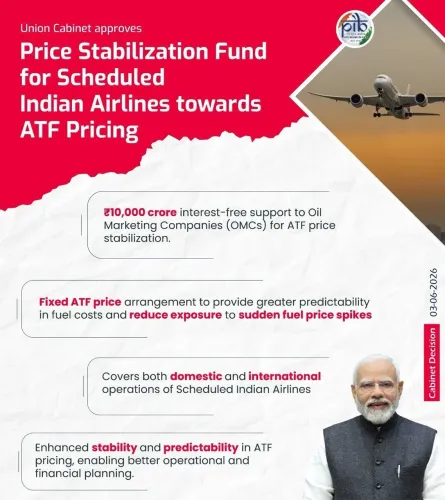
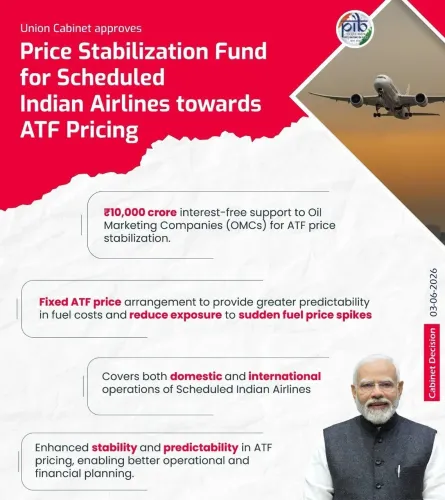
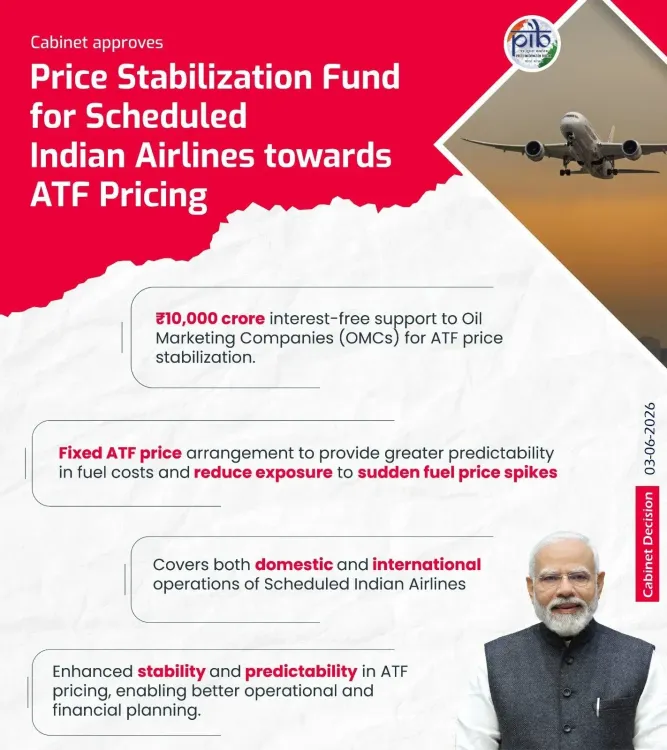
Union Defence Minister Rajnath Singh has welcomed the Union Cabinet's approval of a Rs 10,000 crore Price Stabilization Fund to provide ATF price support to Scheduled Indian Airlines for domestic and international operations, calling it a far-sighted decision to bring stability to India's aviation sector amid global fuel uncertainty.
Key Takeaways
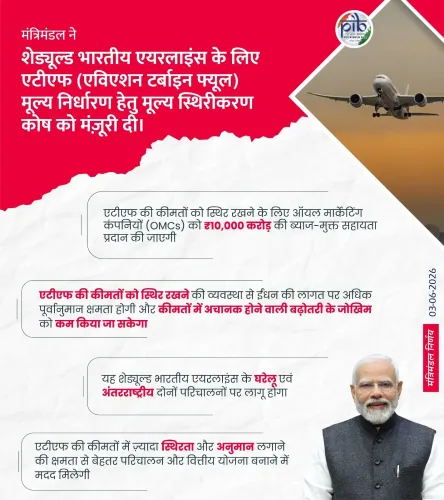
Union Cabinet approved a Rs 10,000 crore Price Stabilization Fund for ATF price support.
Support extends to Scheduled Indian Airlines for both domestic and international operations.
Rajnath Singh called it a 'transformative' and 'far-sighted' decision.
ATF typically forms around 40 per cent of Indian airlines' operating costs.
Fund builds on aviation policy arc that includes the UDAN scheme launched in 2016 .
Rollout rules, eligibility and disbursement triggers are awaited.
Union Defence Minister Rajnath Singh on Wednesday, 3 June 2026, welcomed the Union Cabinet's approval of a Rs 10,000 crore Price Stabilization Fund aimed at cushioning Scheduled Indian Airlines against volatility in aviation turbine fuel (ATF) costs. Posting on X, the senior BJP leader said the decision, taken by the Cabinet chaired by Prime Minister Narendra Modi, would bring 'greater stability and predictability in fuel costs' for both domestic and international airline operations.
'The Union Cabinet chaired by PM Shri Narendra Modi has approved a Rs 10,000 crore Price Stabilization Fund to provide ATF price support to Scheduled Indian Airlines for both domestic and international operations,' Singh wrote, calling it a 'transformative decision' that 'underscores the Government's unwavering commitment to strengthening India's aviation sector.' He thanked the Prime Minister — addressing him as Pradhanmantriji (respected Prime Minister) — for what he termed a 'far-sighted decision.'
Context
ATF typically accounts for around 40 per cent of an Indian airline's operating cost, making carriers acutely sensitive to crude oil swings and rupee depreciation. The new Price Stabilization Fund is designed to provide a buffer when global jet fuel benchmarks spike, easing pressure on airlines that would otherwise be forced to either absorb losses or pass costs on through higher fares.
By extending the support to both domestic and international operations of scheduled carriers, the Cabinet appears to be targeting the full footprint of Indian aviation — from regional routes to long-haul international services where Indian carriers compete with foreign airlines often benefiting from cheaper fuel jurisdictions.
Policy backdrop
The fund sits within a broader policy arc of supporting India's civil aviation expansion. The flagship UDAN (Ude Desh ka Aam Naagrik) regional connectivity scheme, launched in 2016, sought to make air travel affordable on under-served routes through viability gap funding and airport development.
Successive Indian governments have also experimented with calibrated interventions on ATF — including pushing states to lower value-added tax on jet fuel and bringing ATF under discussion for inclusion in the Goods and Services Tax framework. The new corpus represents a more direct fiscal mechanism, channelling central government resources to absorb a share of fuel-cost shocks rather than relying solely on tax rationalisation.
Stakeholders and impact
The most immediate beneficiaries are Scheduled Indian Airlines — the licensed full-service and low-cost carriers operating regular domestic and international schedules. A predictable fuel-cost regime could support fleet expansion plans, route additions and aircraft order commitments that Indian carriers have made in recent years.
Passengers stand to gain indirectly if airlines pass on stabilised costs through steadier base fares, particularly during periods of global crude volatility. Airports, ground-handling firms and the wider aviation services ecosystem also benefit from a financially healthier carrier base. For the exchequer, the Rs 10,000 crore commitment represents a sizeable but bounded contingent liability tied to fuel-price triggers rather than open-ended subsidies.
What's next
Attention will now turn to the operational architecture of the fund — the eligibility thresholds for airlines, the ATF price triggers that activate disbursement, the formula for support, and the administering ministry's notification. Industry watchers will also look for clarity on whether the support will be structured as direct relief, a reimbursement mechanism, or a hedging-style intervention.
The announcement, coming through a senior Cabinet minister's social media endorsement, signals high-level political ownership of the move. Follow-up notifications and any complementary steps on ATF taxation will determine how quickly the Rs 10,000 crore corpus translates into measurable relief for India's airlines and, eventually, its flying public.
Point of View
Reflecting how strategically the government now views civil aviation as a growth engine. By covering both domestic and international operations, it signals intent to make Indian carriers more globally competitive at a time when fleet orders are at record highs. That a Defence Minister chose to amplify the announcement underscores the Cabinet's collective political ownership of economic decisions. The real test lies in the fine print — triggers, caps and timelines will decide whether this is a structural reform or a cyclical backstop.
NationPress
21 Oct 2026
Frequently Asked Questions
What is the ATF Price Stabilization Fund approved by the Union Cabinet?
It is a Rs 10,000 crore fund cleared by the Union Cabinet to provide aviation turbine fuel price support to Scheduled Indian Airlines for both domestic and international operations, aimed at cushioning carriers against global fuel price volatility.
Which airlines will benefit from the Rs 10,000 crore ATF fund?
Scheduled Indian Airlines — the licensed carriers operating regular domestic and international flights — are the intended beneficiaries. Detailed eligibility criteria will be set out when the administering ministry notifies the scheme.
Why did Rajnath Singh comment on a civil aviation decision?
As a senior Union Cabinet minister and BJP leader, Rajnath Singh endorsed the collective Cabinet decision on X, thanking Prime Minister Narendra Modi and framing it as part of the government's broader commitment to strengthening India's aviation sector.
How much of an airline's cost is jet fuel in India?
Aviation turbine fuel typically accounts for roughly 40 per cent of an Indian airline's operating costs, making carriers highly exposed to swings in global crude prices and the rupee-dollar exchange rate.
Will airfares come down because of the ATF Price Stabilization Fund?
The fund is designed to bring stability and predictability in fuel costs rather than directly cut fares. Passengers may benefit indirectly if airlines pass on steadier costs, but the immediate aim is sector viability during periods of global fuel uncertainty.