Kishan Reddy Flags Rs 10,000 Cr ATF Price Stabilisation Fund
Synopsis
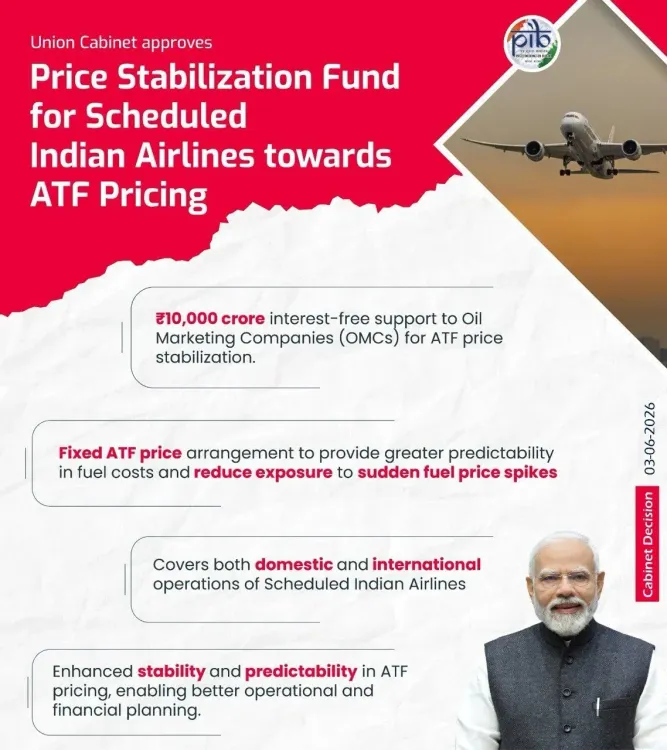
Union Coal and Mines Minister G. Kishan Reddy announced that the Modi Cabinet has approved a one-time Rs 10,000 crore interest-free Price Stabilisation Fund routed through Oil Marketing Companies to cushion Scheduled Indian Airlines from ATF price volatility, with coverage spanning domestic and international operations and a focus on Tier-II, Tier-III and remote-region connectivity.
Key Takeaways
Union Cabinet has approved a one-time Rs 10,000 crore Price Stabilisation Fund for Scheduled Indian Airlines.
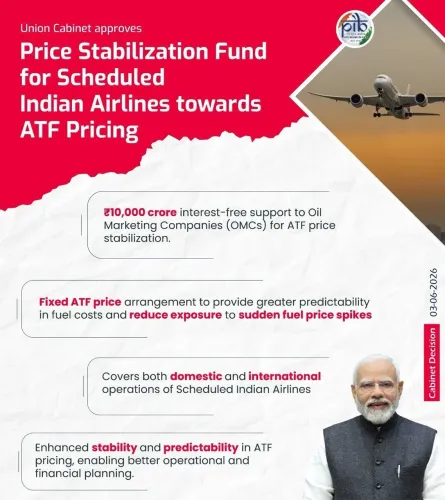
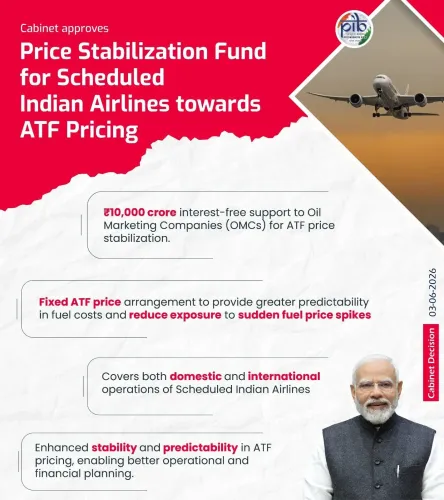
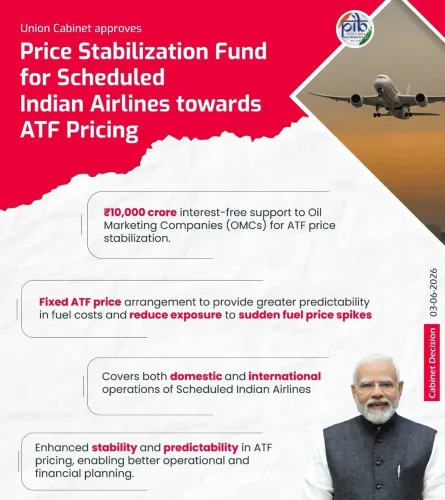
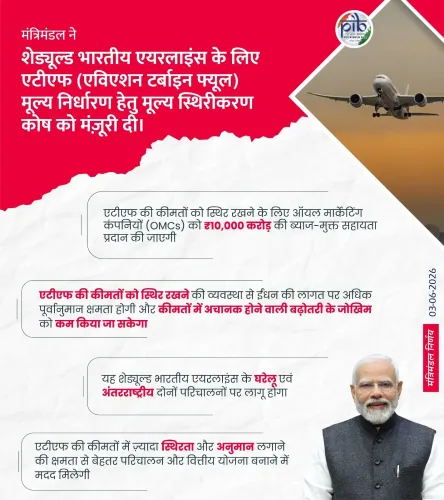
The corpus will be routed as interest-free support to Oil Marketing Companies to enable a fixed-price ATF mechanism.
Coverage extends to both domestic and international operations of Indian carriers.
The scheme aims to limit fare volatility and protect connectivity to Tier-II, Tier-III and remote regions.
ATF accounts for a large share of airline operating costs, making the sector highly exposed to crude price swings.
Detailed disbursement guidelines and trigger price norms are awaited from the concerned ministries.
Union Coal and Mines Minister G. Kishan Reddy on Wednesday announced that the Union Cabinet, chaired by Prime Minister Narendra Modi, has cleared a one-time Rs 10,000 crore Price Stabilisation Fund to shield Scheduled Indian Airlines from swings in Aviation Turbine Fuel (ATF) prices. The minister said the move is aimed at insulating carriers and passengers from global fuel volatility while protecting connectivity across the country.
Context
In his post, the minister described the package as an 'interest-free support to Oil Marketing Companies (OMCs)' meant to underwrite a fixed-price ATF mechanism for scheduled carriers. He said the cover would extend to both domestic and international operations of Indian airlines.
The stated objectives include 'reduced exposure to sudden fuel price spikes', 'greater stability and predictability in fuel costs', and 'protection against fare volatility for passengers'. The minister added that the decision would help sustain 'connectivity to Tier-II, Tier-III and remote regions'.
Policy backdrop
ATF typically accounts for around 40 per cent of an Indian airline's operating cost, leaving carriers acutely exposed to crude price cycles and rupee movements. In 2022, the Centre had reduced excise duty on ATF to cushion airlines against the crude spike triggered by the Ukraine conflict, while several states subsequently trimmed VAT on the fuel.
The current Cabinet decision channels support through Oil Marketing Companies such as Indian Oil Corporation, Bharat Petroleum and Hindustan Petroleum, which sell ATF at airport fuel stations. By providing the OMCs an interest-free corpus, the government can absorb a portion of the gap between market-linked ATF prices and a notified fixed price for scheduled carriers without an immediate revenue hit to the oil companies.
The intervention also runs parallel to a longer-standing industry demand to bring ATF under the Goods and Services Tax, which would allow airlines to claim input tax credit on their single largest cost head.
Stakeholders and impact
The principal beneficiaries are scheduled domestic carriers, including Air India, IndiGo, SpiceXet and Akasa Air, which together operate the bulk of Indian commercial air traffic. A fixed-price ATF window, even for a defined period, gives airline finance teams greater visibility on unit costs and could ease pressure on fares on thin regional routes.
For Oil Marketing Companies, the interest-free corpus is intended to neutralise the working-capital cost of selling ATF at a notified rate when international benchmarks are higher. Passengers, particularly on routes operated under regional connectivity initiatives, stand to gain from steadier fares, while airport-linked employment in ground handling, catering and maintenance is indirectly cushioned.
The minister said the package would 'strengthen India's aviation sector, support airlines' operational and financial planning, safeguard employment across the aviation ecosystem, and promote economic growth through enhanced connectivity'.
What's next
Detailed operational guidelines on how the Rs 10,000 crore corpus will be disbursed to OMCs, the trigger price at which the stabilisation mechanism kicks in, and the duration of the cover are expected to follow from the concerned ministries. Subsequent ATF price revisions by oil companies will offer the first test of whether the fixed-price mechanism is translating into visible relief at the airport fuel pump.
For airlines and passengers alike, the bigger signal lies in the Centre's willingness to use a dedicated fund — rather than ad hoc tax cuts — to manage aviation fuel risk, a template that could shape future interventions in transport sectors hostage to crude price cycles.
Point of View
Signalling that the Centre views air connectivity as strategic infrastructure rather than a discretionary service. Routing relief through Oil Marketing Companies, instead of direct airline subsidies, sidesteps competition-distortion concerns and keeps the intervention within an existing administrative pipeline. The choice also dovetails with the long-pending push to bring ATF under GST, which would deliver a more permanent fix. The real test will be the trigger price and exit clause — without them, a stabilisation fund can quietly turn into a recurring subsidy.
NationPress
18 Oct 2026
Frequently Asked Questions
What is the Rs 10,000 crore ATF Price Stabilisation Fund?
It is a one-time, interest-free corpus approved by the Union Cabinet to support Oil Marketing Companies in offering Scheduled Indian Airlines ATF at a stabilised, fixed price amid global fuel volatility.
Which airlines will benefit from the ATF fund?
Scheduled Indian carriers operating domestic and international flights, such as Air India, IndiGo, SpiceJet and Akasa Air, are the intended beneficiaries of the fixed-price ATF mechanism.
How will the ATF Price Stabilisation Fund affect air fares?
By cushioning airlines against sudden ATF price spikes, the fund is expected to limit fare volatility for passengers, particularly on regional and remote-area routes.
Who announced the Cabinet decision on the ATF fund?
Union Coal and Mines Minister G. Kishan Reddy announced the Cabinet decision on his official social media handle, attributing the approval to the Union Cabinet chaired by Prime Minister Narendra Modi.
Why is ATF pricing critical for Indian airlines?
Aviation Turbine Fuel is the single largest operating cost for airlines, often around 40 per cent of expenses, so sharp swings in crude prices and taxes can quickly turn profitable routes loss-making.