IBM CEO Arvind Krishna: India can lead global AI, avoid Europe's over-regulation trap
Synopsis
IBM's Arvind Krishna delivered a pointed verdict on India's AI future in New Delhi: the country is under-punching on the global AI stage despite having the digital foundation — Aadhaar, UPI, quick commerce — to lead. His sharpest line was reserved for Europe, which he said regulates so hard that 'innovation becomes hard,' implicitly holding India up as the model the world should follow.
Key Takeaways
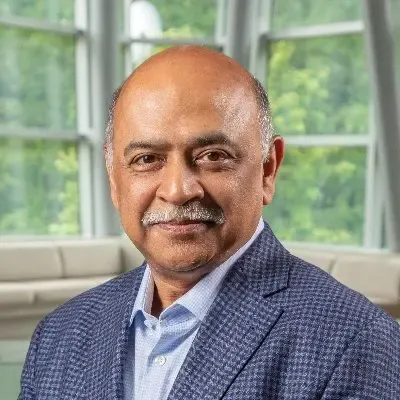
Arvind Krishna , Chairman and CEO of IBM , said India can claim a much larger share of the global AI landscape on 16 November 2026 in New Delhi .
Krishna praised India's Aadhaar framework, digital payments , and quick commerce as proof of its digital execution capacity.
He credited the Indian government for avoiding over-regulation, contrasting it with Europe where he said innovation has been constrained.
Krishna warned against top-down industrial policy, saying it forces governments to 'pick winners' — a path he called 'dangerous.' He described India as a triple asset for IBM: a market, a product-building hub, and a global talent base.
India's AI Governance Guidelines propose an AI Safety Institute , an AI Governance Group , and a Technology and Policy Expert Committee .
Arvind Krishna, Chairman and Chief Executive Officer of IBM, said on Monday, 16 November 2026 that India has the potential to claim a far larger share of the global artificial intelligence (AI) landscape than it currently does, provided it sustains its policy momentum and resists the urge to over-regulate. Krishna made the remarks during an interaction in New Delhi, offering a pointed contrast between India's approach and what he called Europe's stifling regulatory environment.
India's AI Opportunity
Krishna acknowledged that India has already demonstrated an exceptional capacity for large-scale digital transformation. He pointed to the Aadhaar biometric framework, digital payments, and the explosive growth of quick commerce as evidence of what the country can achieve at scale. He argued, however, that AI demands a similarly bold and deliberate national positioning. 'Somehow on AI, I think India has to find its place in terms of what it wants to do,' Krishna said.
What the IBM CEO Said About Government Policy
Krishna credited the Indian government for its measured stance on AI regulation, saying it deserves 'a fair amount of credit on not regulating the industry so hard.' He drew a direct comparison with Europe, stating: 'Europe is the only place where they regulate so hard that innovation becomes hard.' He acknowledged that the government is actively encouraging India-made AI solutions for domestic public-sector deployment, calling that a sensible direction.
At the same time, Krishna cautioned against top-down industrial policy. 'I'm not a big believer that the government should cause bailouts and write industrial policy top-down. I think that's a dangerous path to go down,' he said, warning that such an approach effectively forces the government to 'pick winners' — an outcome he considers counterproductive.
India's Strategic Value for IBM
On IBM's own relationship with India, Krishna was unequivocal. He described the country as a triple asset for the company: 'It's a great market. It's a great place to build products, and it's a great place to have employees who help IBM on a global footprint.' This positions India not merely as a talent hub but as a core node in IBM's worldwide operations.
India's AI Governance Framework
Krishna's remarks come as India's AI Governance Guidelines have already articulated a principle-based approach built around trust, people-first governance, and responsible AI innovation. The framework identifies misinformation, deepfakes, algorithmic bias, and unintended societal harm as priority risks. It recommends reviewing existing laws for regulatory gaps covering liability, data protection, copyright, content authentication, and the misuse of generative AI. The guidelines also propose establishing an AI Governance Group, a Technology and Policy Expert Committee, and an AI Safety Institute — signalling an institutional architecture that stops well short of prescriptive sector-level mandates.
What This Means Going Forward
With global AI governance debates intensifying — and the EU AI Act already reshaping how companies operate in Europe — India's lighter-touch, principles-led approach could become a competitive differentiator in attracting AI investment and talent. Whether the country can translate that regulatory advantage into genuine AI leadership, however, will depend on private-sector ambition matching the policy headroom that has been created.
Point of View
Like every major AI vendor, benefits from permissive markets — but the structural observation is not wrong. India's principle-based framework does give it room to experiment that the EU AI Act has foreclosed in Europe. The harder question is whether regulatory headroom alone translates into AI leadership, or whether it simply makes India an attractive deployment market for US and Chinese AI products built elsewhere. The gap between 'great place for employees' and 'great place that builds world-leading AI' is precisely where India's AI policy still has work to do.
NationPress
16 Nov 2026
Frequently Asked Questions
What did IBM CEO Arvind Krishna say about India's role in global AI?
Arvind Krishna said India has the potential to play a much bigger role in the global AI landscape than it currently does, citing its strong digital foundations in Aadhaar, digital payments, and quick commerce. He said India needs to find its place in AI and that the government has so far taken the right approach by avoiding over-regulation.
How did Krishna compare India's AI regulation to Europe's?
Krishna said India deserves credit for not regulating AI as heavily as Europe, adding that Europe is 'the only place where they regulate so hard that innovation becomes hard.' He argued that India's lighter-touch approach gives its AI ecosystem room to grow.
Why is Krishna against top-down AI industrial policy?
Krishna cautioned that government-driven industrial policy effectively forces authorities to pick commercial winners, which he called a 'dangerous path.' He said he does not believe governments should issue bailouts or dictate sectoral direction in AI development.
What is India's AI Governance Framework?
India's AI Governance Guidelines adopt a principle-based approach centred on trust, people-first governance, and responsible innovation. The framework identifies deepfakes, misinformation, algorithmic bias, and societal harm as key risks, and proposes an AI Safety Institute, an AI Governance Group, and a Technology and Policy Expert Committee.
Why is India strategically important to IBM?
IBM CEO Arvind Krishna described India as a market, a product-development base, and a global talent hub — making it a core part of IBM's worldwide operations rather than just an outsourcing destination.