India-UK CETA takes effect July 15: British goods cheaper, 99% Indian exports duty-free
Synopsis
From 15 July, the India-UK CETA reshapes trade between the world's fifth and sixth largest economies — giving Indian exporters duty-free access on 99% of tariff lines while making British Scotch, cars, and chocolates progressively cheaper in India. After 14 rounds of negotiations and a 30-chapter agreement, the deal's real test begins now: whether Indian MSMEs, farmers, and exporters can actually capture the market access on offer.
Key Takeaways
The India-UK CETA comes into force on 15 July 2025 , after being signed on 24 July 2025 following 14 rounds of negotiations.
Indian exporters gain zero-duty access on approximately 99 per cent of UK tariff lines, covering nearly all of India's export value to the UK.
Key beneficiary sectors include textiles, leather, footwear, gems and jewellery, marine products, sports goods, and toys .
Scotch whisky tariffs drop from 150 per cent to 75 per cent immediately, falling to 40 per cent over 10 years .
India will make 85 per cent of UK tariff lines fully duty-free over the next decade, out of a total 90 per cent reduction commitment.
The Double Contributions Convention exempts eligible Indian professionals in the UK from dual social security payments for a specified period.
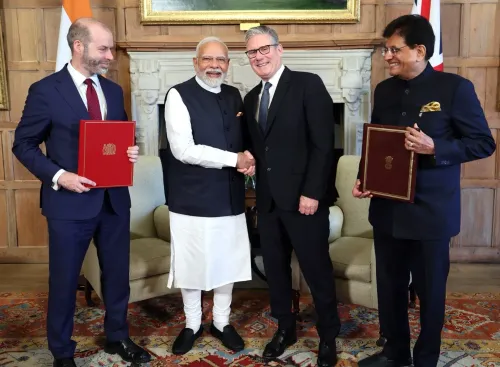
The India-UK Comprehensive Economic and Trade Agreement (CETA) comes into force on 15 July 2025, marking a landmark shift in bilateral trade relations. The agreement grants Indian exporters near-total duty-free access to the UK market while opening the door to cheaper British goods in India — from Scotch whisky to cosmetics — with tariff reductions beginning on day one.
What Changes for Indian Exporters
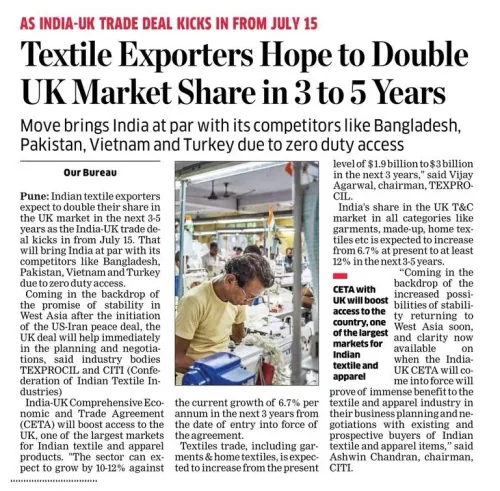
Indian exporters will receive zero-duty access on approximately 99 per cent of tariff lines, covering nearly the entire value of India's exports to the UK. Labour-intensive sectors stand to gain the most: textiles, leather, footwear, marine products, gems and jewellery, sports goods, and toys are among the primary beneficiaries. Engineering goods, auto components, and organic chemicals are also set to benefit from improved market access.
British Goods Set to Get Cheaper in India
Tariffs on a wide range of UK products — including Scotch whisky, gin, chocolates, biscuits, and cosmetics — begin declining from 15 July, though reductions for several items will be phased in over the coming years. Notably, duties on Scotch whisky will be cut from 150 per cent to 75 per cent initially, declining further to 40 per cent over 10 years. Tariffs on British automobiles will be reduced gradually under a quota-based mechanism.
India's Tariff Commitments Under the Pact
India has agreed to reduce or eliminate tariffs on 90 per cent of tariff lines, with 85 per cent becoming fully duty-free over the next decade. The Central Board of Indirect Taxes and Customs (CBIC) has issued the rules governing preferential tariff treatment, specifying the framework for determining product eligibility and laying out compliance requirements for both exporters and importers.
What the Government Said
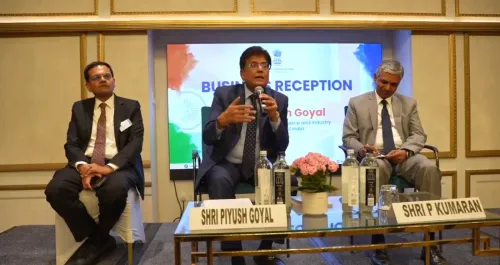
Union Commerce and Industry Minister Piyush Goyal had earlier stated that the CETA would deepen collaboration across trade, investment, and innovation, urging Indian companies to engage actively with UK counterparts and convert the agreement into sustained business growth. In June, he said the deal would help Indian farmers, fishermen, artisans, and small businesses prosper globally and accelerate job creation, while enabling consumers to access high-quality goods at competitive prices. He also noted that the agreement creates opportunities for women entrepreneurs, youth, startups, and MSMEs without compromising India's core interests.
Scope and Background of the Agreement
Signed on 24 July 2025 after 14 rounds of negotiations, the CETA comprises 30 chapters covering goods, services, digital trade, financial services, intellectual property, innovation, sustainability, and government procurement. The pact also includes the Double Contributions Convention, offering relief to eligible Indian professionals working temporarily in the UK by allowing them to avoid paying social security contributions in both countries for a specified period. This is among the most comprehensive trade agreements India has signed, and its implementation signals a new chapter in the two countries' post-Brexit economic relationship.
Point of View
But the headline numbers — 99% duty-free access for Indian exports — mask a more complex reality. Market access and market capture are different things; Indian MSMEs and small exporters will need active hand-holding, trade financing, and logistics upgrades to actually exploit UK shelf space. On the import side, the phased whisky tariff cut from 150% to 40% over a decade is a political concession that domestic spirits lobbies will watch closely. The Double Contributions Convention, largely unreported, could be quietly significant for the Indian IT services diaspora. The real scorecard on this deal will be written not in July 2025, but in the bilateral trade data of 2027 and beyond.
NationPress
14 Jul 2026
Frequently Asked Questions
What is the India-UK CETA and when does it take effect?
The India-UK Comprehensive Economic and Trade Agreement (CETA) is a landmark bilateral trade deal signed on 24 July 2025 after 14 rounds of negotiations. It comes into force on 15 July 2025, covering 30 chapters including goods, services, digital trade, intellectual property, and government procurement.
What do Indian exporters gain from the India-UK trade deal?
Indian exporters receive zero-duty access on approximately 99 per cent of UK tariff lines, covering nearly the entire value of India's exports to the UK. Sectors such as textiles, leather, footwear, gems and jewellery, marine products, and engineering goods are among the biggest beneficiaries.
Which British goods will become cheaper in India after July 15?
Tariffs on Scotch whisky, gin, chocolates, biscuits, cosmetics, and British automobiles will begin declining from 15 July 2025. Scotch whisky duties drop immediately from 150 per cent to 75 per cent, with a further reduction to 40 per cent over 10 years. Some product categories will see phased reductions over several years.
What are India's tariff commitments under the CETA?
India has committed to reducing or eliminating tariffs on 90 per cent of tariff lines, with 85 per cent becoming fully duty-free over the next decade. The Central Board of Indirect Taxes and Customs (CBIC) has issued the compliance framework for preferential tariff treatment under the pact.
What is the Double Contributions Convention in the India-UK CETA?
The Double Contributions Convention is a provision within the CETA that allows eligible Indian professionals working temporarily in the UK to avoid paying social security contributions in both countries simultaneously for a specified period, reducing the financial burden on Indian workers in the UK.