India's rise from 'Fragile Five' to global growth engine: banking reforms and capex drive

Synopsis
A decade after being tagged among the world's most vulnerable economies, India has repaired its banking system, launched a $11 billion chip fab, and turned itself into the world's second-largest mobile exporter — all backed by ₹12.22 lakh crore in public capital spending. The Vietnam Times report puts numbers to a transformation that is still unfolding.
Key Takeaways
India moved from the 'Fragile Five' label in 2013 to a recognised global growth engine, according to a Vietnam Times report.
A ₹12.22 lakh crore public capex blueprint underpinned the economic shift.
Gross NPA ratio has fallen from a peak of 11.18 per cent in 2018 to a multi-decade low of 2.5 per cent ; net NPAs stand at 0.6 per cent .
The government injected ₹3.10 lakh crore into public sector banks between 2015 and 2021 , supported by the Insolvency and Bankruptcy Code (IBC) .
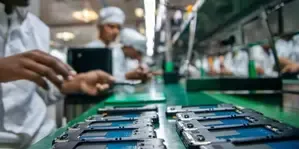
The ₹1.97 lakh crore PLI scheme has made India the world's second-largest mobile phone exporter , with exports exceeding $28 billion .
Tata Electronics' $11 billion semiconductor fab at Dholera, Gujarat is projected to cut front-end chip imports by $10–12 billion annually.
India has undergone a sweeping economic transformation over the past decade — from being labelled part of the 'Fragile Five' by global analysts in 2013 to emerging as a self-reliant growth engine powered by banking reforms, a domestic semiconductor push, and indigenous technology development, according to a report by the Vietnam Times. The shift, the report argues, was driven by deliberate state-led capital deployment and structural financial repair at a scale rarely attempted by a developing economy.
Public Capex as the Cornerstone
At the heart of the transformation, the report identifies a ₹12.22 lakh crore public capital expenditure blueprint that it credits with converting India from 'a passive tech consumer into a sovereign architect of its own future.' The outlay has funded infrastructure, domestic manufacturing capacity, and digital sovereignty initiatives that have collectively reshaped India's macroeconomic profile.
Complementing the capex push, the government's ₹1.97 lakh crore Production Linked Incentive (PLI) scheme has propelled India to become the world's second-largest mobile phone exporter, with shipments scaling past $28 billion, according to the report.
Banking Sector Repair: From Crisis to Stability
The report traces the origins of India's banking crisis to decades of reckless corporate lending that left public sector banks carrying vast quantities of stressed credit. By 2018, the Gross Non-Performing Asset (NPA) ratio had peaked at a troubling 11.18 per cent.
The government responded with a direct capital infusion of ₹3.10 lakh crore into public sector banks between 2015 and 2021. Alongside this recapitalisation, the Insolvency and Bankruptcy Code (IBC) gave lenders a credible legal mechanism to resolve bad loans, enabling banks to aggressively clean up their balance sheets.
The results, as cited in the report, are stark: the Gross NPA ratio now sits at a multi-decade low of 2.5 per cent, with net NPAs down to a near-negligible 0.6 per cent.
Silicon Ambitions: The Dholera Mega-Fab
India's semiconductor drive is perhaps the most ambitious chapter of this transformation. At Dholera, Gujarat, Tata Electronics is constructing a flagship $11 billion mega-fabrication plant in partnership with global chip industry veterans and deploying advanced ASML lithography equipment.
According to the report, once operational, this single facility is projected to eliminate between $10 billion and $12 billion in annual front-end chip import costs — a significant dent in one of India's largest import bills.
Indigenous Innovation: Trains and Rockets
The report also highlights India's progress in reducing import dependence across strategic sectors. The Vande Bharat train, featuring 75 to 80 per cent indigenous components, is cited as a case study in domestic capability — accelerating from 0 to 100 km/h in 52 seconds, a performance benchmark the report compares to traditional Japanese bullet trains, and produced at roughly half the cost of imported alternatives.
In the space sector, private launch firm Skyroot — which conducted India's first private rocket flight in 2022 — is preparing the maiden commercial orbital launch of its Vikram-1 vehicle, targeting a share of the global $25 billion small-satellite launch market, the report notes.
What This Signals for India's Economic Trajectory
Taken together, the Vietnam Times report frames India's decade-long policy arc as a coherent, if still incomplete, pivot from consumption-driven vulnerability to production-led resilience. The structural banking repair, scale of public investment, and early industrial wins in electronics and space position India as a credible contender in global supply chain diversification — a conversation accelerating amid US-China trade tensions. Whether the momentum translates into sustained productivity gains and broad-based employment remains the critical open question.
Point of View
Not just accounting manoeuvres. But the report, sourced from Vietnam Times, reflects an external admirer's lens and glosses over what remains unfinished: the PLI scheme's job creation record is mixed, the Dholera fab is still under construction, and India's manufacturing share of GDP has not materially shifted despite the capex surge. The Skyroot and Vande Bharat milestones are genuine, but cherry-picked. The stronger story — and the more honest one — is that India has built the scaffolding; whether the building rises depends on execution over the next five years.
NationPress
27 Jun 2026
Frequently Asked Questions
What is the 'Fragile Five' label and how did India escape it?
The 'Fragile Five' was a term coined by global analysts in 2013 to describe five emerging-market economies — including India — deemed vulnerable to capital outflows and currency depreciation. According to a Vietnam Times report, India shed that label through a combination of ₹12.22 lakh crore in public capital expenditure, banking sector recapitalisation, and domestic manufacturing incentives that reduced import dependence and strengthened macroeconomic fundamentals.
How did India fix its banking sector NPA crisis?
The government injected ₹3.10 lakh crore directly into public sector banks between 2015 and 2021, while the Insolvency and Bankruptcy Code (IBC) provided a legal framework for resolving bad loans. The Gross NPA ratio, which had peaked at 11.18 per cent in 2018, has since fallen to a multi-decade low of 2.5 per cent, with net NPAs at 0.6 per cent.
What is the Tata Electronics semiconductor fab at Dholera?
Tata Electronics is building an $11 billion mega-fabrication plant at Dholera in Gujarat, deploying advanced ASML lithography equipment in partnership with global chip industry veterans. Once operational, the facility is projected to reduce India's front-end chip import bill by $10 billion to $12 billion annually, according to the Vietnam Times report.
How has the PLI scheme changed India's electronics exports?
The ₹1.97 lakh crore Production Linked Incentive (PLI) scheme has helped make India the world's second-largest mobile phone exporter, with shipments crossing $28 billion. The scheme has also supported production-linked growth in sectors including pharmaceuticals, solar modules, and EV components.
What is Skyroot's Vikram-1 and why does it matter?
Vikram-1 is a fully commercial orbital launch vehicle being developed by Skyroot, India's first private rocket company, which conducted the country's first private rocket launch in 2022. The vehicle is targeting a share of the $25 billion global small-satellite launch market, signalling India's ambition to compete commercially in the fast-growing space economy.