DR Congo Ebola outbreak crosses 5,000 cases, WHO keeps global emergency
Synopsis
The DRC Ebola outbreak has crossed 5,000 cases and is killing roughly one person every 30 minutes — making it the second-largest ever recorded and on track to become the deadliest if unchecked. With no approved Bundibugyo-specific vaccine, the world is watching two experimental vaccines in human trials and a WHO treatment study whose results are weeks away.
Key Takeaways
The DRC Ebola outbreak has surpassed 5,021 confirmed cases and 2,378 deaths across 55 health zones in six provinces .
The case fatality rate stands at 47.4 per cent ; Africa CDC says the virus is killing roughly one person every 30 minutes .
It is now the second-largest Ebola outbreak ever recorded , spreading faster than the 2014-2016 West Africa epidemic and DRC's own 2018-2020 outbreak .
The eastern province of Ituri accounts for 84.8 per cent of cumulative cases; infections are accelerating in neighbouring provinces.
Two Bundibugyo-specific vaccines have entered human trials ; the WHO-sponsored PARTNERS trial is testing remdesivir and MBP134, with preliminary results expected in three to four weeks .
Uganda , South Sudan , and the Central African Republic are at elevated risk of imported cases, according to the WHO.
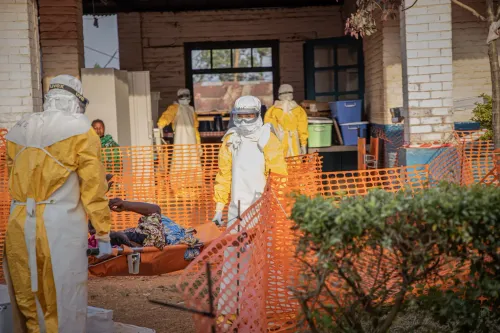
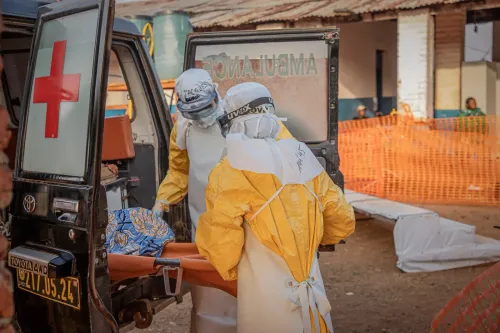
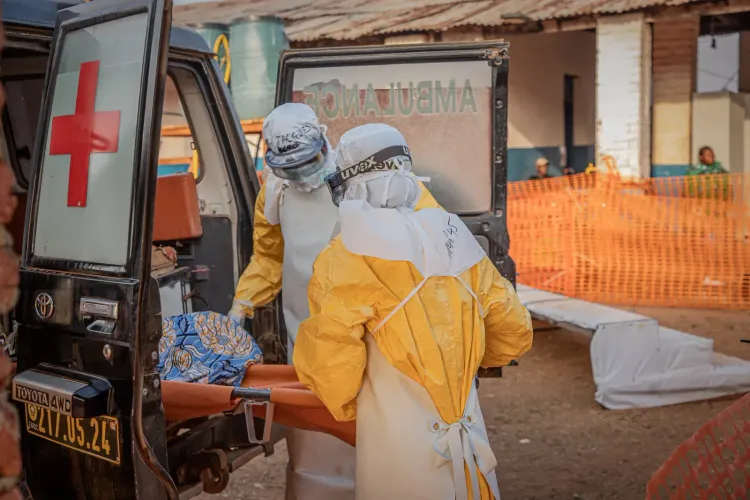
The World Health Organisation (WHO) has reaffirmed that the Ebola outbreak in the Democratic Republic of the Congo (DRC) remains a public health emergency of international concern (PHEIC), as the epidemic surpasses 5,021 confirmed cases and 2,378 deaths across 55 health zones in six provinces. The outbreak, caused by the Bundibugyo ebolavirus, is now the second-largest Ebola epidemic ever recorded and is spreading faster than all previous outbreaks, WHO chief Tedros Adhanom Ghebreyesus warned at an emergency committee meeting.
Scale of the Crisis
As of Sunday, 19 August, the case fatality rate stood at 47.4 per cent, according to the latest WHO tally. The Africa Centers for Disease Control and Prevention (Africa CDC) stated on Monday that the outbreak is currently killing roughly one person every 30 minutes and risks becoming the deadliest Ebola epidemic ever recorded globally if its trajectory is not urgently reversed.
The epidemic has already surpassed the 2018-2020 Ebola outbreak in eastern DRC, previously the country's deadliest. During the first 95 days of reporting, the seven-day moving average rose to more than 90 confirmed cases a day — substantially higher than at the same stage of both the 2014-2016 West Africa epidemic and the DRC's 2018-2020 outbreak, according to a WHO situation report.
Why the Virus Is Spreading So Fast
The eastern province of Ituri remains the epicentre, accounting for 84.8 per cent of cumulative cases, but infections are accelerating in neighbouring provinces. DRC Health Minister Roger Kamba said the outbreak had spread unusually fast despite a 'very rapid and very vigorous' response, attributing the speed partly to Bundibugyo's less distinctive early symptoms, which allow infected individuals to remain in their communities longer before seeking care.
WHO Director-General Tedros Adhanom Ghebreyesus cautioned that population movement 'along roads, rivers and mining routes,' combined with insecurity and displacement, was fuelling the epidemic. The WHO warned that high mortality, deaths outside treatment facilities, a growing surveillance workload, and uneven response capacity indicate that current containment measures are insufficient to interrupt transmission.
'We must be frank: the epidemic is far from being under control,' Tedros said. 'It had a big head start, and we are still playing catch-up.'
Experimental Vaccines and Treatments Under Trial
With no approved vaccine or treatment specifically targeting the Bundibugyo virus, authorities are turning to experimental and repurposed medical tools. Two vaccines designed specifically against Bundibugyo virus have entered human trials, Tedros confirmed. A WHO-sponsored PARTNERS treatment trial is evaluating antiviral remdesivir, the experimental monoclonal antibody MBP134, and their combination. Preliminary results could be available in 'about three to four weeks,' according to Health Minister Kamba.
Researchers are also studying oral antiviral obeldesivir as post-exposure prophylaxis. Separately, authorities are examining whether Ervebo — the licensed vaccine against Zaire ebolavirus — could offer cross-protection against Bundibugyo virus. Kamba said observations among vaccinated health workers and laboratory studies had suggested possible cross-protection, while stressing that this remains unconfirmed. The Africa CDC on Monday backed a DRC request for controlled expanded use of Ervebo among high-risk frontline workers, alongside a Phase III trial to assess its efficacy against Bundibugyo virus.
Cross-Border Spread Risk Remains Elevated
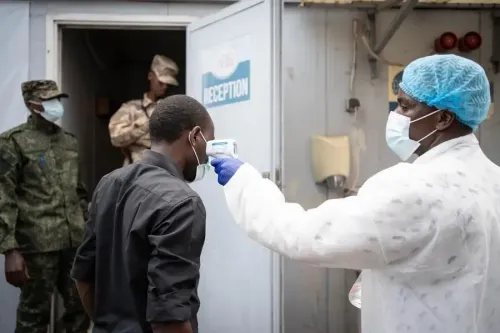
Tshopo province and its capital Kisangani are of particular concern due to their road, river, and air links, which could facilitate longer-distance transmission toward Kinshasa, the national capital. Kamba confirmed that no cases from the current outbreak have been confirmed in Kinshasa. Authorities have stepped up screening along river routes to the capital.
The WHO has identified Uganda, South Sudan, and the Central African Republic as being at particularly high risk of imported cases, given their proximity to affected areas and frequent cross-border population movements. The risk of further spread within the DRC is assessed as 'very high.'
What Comes Next
The WHO's emergency committee meeting signals that the international response is being intensified, but health authorities acknowledge they are still catching up to the outbreak's pace. Preliminary results from the PARTNERS treatment trial are expected within weeks, which could determine whether existing antivirals can meaningfully reduce the fatality rate. The trajectory of the epidemic over the coming month will be critical in determining whether the worst-case scenario — the deadliest Ebola outbreak in history — can be averted.
Point of View
But it targets Zaire ebolavirus — not Bundibugyo. The DRC is now paying the price of that asymmetry in real time, with experimental tools racing against a virus that is spreading faster than any previous Ebola outbreak at the same stage. The WHO's 'playing catch-up' admission is an unusually candid acknowledgement of system failure. If preliminary treatment trial results in three to four weeks are unfavourable, the international community faces a scenario where the deadliest Ebola outbreak in history unfolds without a proven medical countermeasure — a failure that will demand a reckoning on how research funding is allocated between known and emerging Ebola strains.
NationPress
3 Oct 2026
Frequently Asked Questions
How many cases and deaths has the DRC Ebola outbreak caused?
As of Sunday, 19 August, the outbreak had recorded 5,021 confirmed cases and 2,378 deaths across 55 health zones in six provinces of the Democratic Republic of the Congo, with a case fatality rate of 47.4 per cent, according to WHO data.
Why is the DRC Ebola outbreak spreading so fast?
Health authorities attribute the rapid spread to Bundibugyo ebolavirus's less distinctive early symptoms, which allow infected people to remain in communities longer before seeking care. Population movement along roads, rivers, and mining routes, combined with insecurity and displacement, is also fuelling transmission, according to WHO Director-General Tedros Adhanom Ghebreyesus.
Is there an approved vaccine or treatment for Bundibugyo ebolavirus?
No approved vaccine or treatment specifically targets the Bundibugyo virus. Two Bundibugyo-specific vaccines have entered human trials, and the WHO-sponsored PARTNERS trial is evaluating remdesivir and the experimental monoclonal antibody MBP134. Preliminary results are expected in about three to four weeks, according to DRC Health Minister Roger Kamba.
Which countries are at risk of Ebola spreading from DRC?
The WHO has identified Uganda, South Sudan, and the Central African Republic as being at particularly high risk of imported Ebola cases, due to their proximity to affected areas and frequent cross-border population movements. Within DRC, Tshopo province and its capital Kisangani are of concern due to transport links toward Kinshasa.
What is the significance of the WHO retaining the PHEIC status for this outbreak?
A public health emergency of international concern (PHEIC) is the WHO's highest level of alert, unlocking accelerated international funding, coordination, and resource mobilisation. Its retention signals that the outbreak has not been brought under control and that the global health community must sustain or intensify its response.