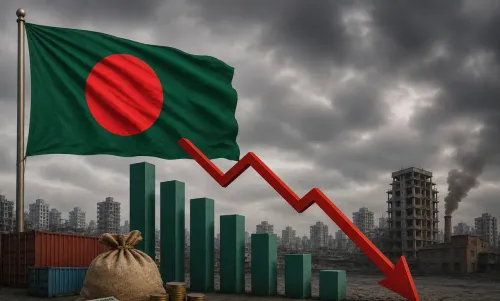
Bangladesh fiscal risks mount as ADB flags weak tax collection, rising debt
Synopsis
The ADB has flagged Bangladesh as a moderate debt-distress risk — not because of a sudden crisis, but because of deep structural weaknesses: taxes falling 15% short of targets, public debt at 41% of GDP, and a looming LDC graduation in November 2026 that will strip away the concessional financing the country has long relied on.
Key Takeaways
The Asian Development Bank (ADB) has assessed Bangladesh as facing a moderate risk of external and overall debt distress.
Public debt reached approximately 41% of GDP in FY25 ; domestic debt accounts for 55.6% of the total debt stock.
Tax administration collects over 15% below targets , relying on manual systems with fragmented databases.
Bangladesh's graduation from LDC status in November 2026 will reduce access to concessional financing, raising the urgency of domestic revenue reform.
Disaster-related shocks are identified as the most serious long-term threat to debt sustainability, per ADB stress tests.
Rising government guarantees to state-owned enterprises are expanding contingent fiscal liabilities at a critical transition stage.
Bangladesh faces a moderate risk of external and overall debt distress, with limited capacity to absorb near-term economic shocks, the Asian Development Bank (ADB) has warned in a new assessment. The Manila-based lender identified weak revenue mobilisation and rising domestic borrowing as the primary drivers of growing fiscal pressure on the country.
Key Vulnerabilities Identified
The ADB pointed to a persistently low tax-to-GDP ratio — below the average for lower-middle-income economies — alongside weak tax administration, fragmented public expenditure management, and inadequate debt administration as core structural vulnerabilities. According to the assessment, Bangladesh's tax administration relies heavily on manual systems with fragmented databases, leaving it collecting taxes over 15 percent short of targets.
Bangladesh's public debt has surged to approximately 41 percent of GDP in FY25. Domestic debt accounted for 55.6 percent of the country's public and publicly guaranteed debt stock, generating significant rollover and debt-servicing pressures. External debt made up the remaining 44.4 percent, which the ADB noted remains largely concessional and below solvency thresholds — though export moderation in FY23 and FY24 has added to external-side risks.
LDC Graduation Adds Pressure
A critical inflection point looms: Bangladesh is scheduled to graduate from least-developed-country (LDC) status in November 2026. The ADB warned this transition will progressively reduce access to concessional financing and preferential trade support measures, making stronger domestic revenue mobilisation not just desirable but necessary. Without meaningful fiscal reform, the country's ability to service and manage its debt could deteriorate further at precisely the moment external support is being scaled back.
Domestic Borrowing and Sovereign-Bank Linkages
Rising domestic borrowing is compounding the pressure in two ways. First, it is increasing debt-service-to-revenue ratios. Second, it is deepening sovereign-bank linkages, which the ADB said amplifies crowding-out risks for private sector credit and raises contingent liability exposure. A bank-dominated investor base further concentrates rollover risk within the domestic financial system.
State-owned enterprises are adding to fiscal risk, with rising government guarantees expanding Bangladesh's overall contingent liability burden at what the lender described as a critical stage of economic transition.
Stress Tests and Long-Term Threats
Stress tests conducted as part of the assessment found that disaster-related shocks remain the most serious long-term threat to Bangladesh's debt sustainability. The ADB stressed that the risks stem from structural weaknesses rather than any sudden deterioration in headline debt metrics — a distinction that makes the vulnerabilities harder to address through short-term policy adjustments alone.
With LDC graduation approaching and fiscal buffers thin, the trajectory of Bangladesh's revenue reforms and debt management capacity will be closely watched by multilateral lenders and sovereign credit analysts in the months ahead.
Point of View
But something potentially more stubborn — a structural fiscal deficit of capacity. Bangladesh has consistently underperformed on tax collection relative to its income peers, and LDC graduation will remove the concessional crutch without automatically improving the domestic revenue base. The sovereign-bank linkage risk is particularly underappreciated: as the government leans harder on domestic borrowing, it crowds out private credit at the exact moment Bangladesh needs private investment to sustain post-LDC growth. Fixing this requires institutional reform — tax digitisation, expenditure rationalisation, SOE discipline — none of which can be delivered quickly or without political cost.
NationPress
20 Sept 2026
Frequently Asked Questions
What fiscal risks has the ADB identified for Bangladesh?
The ADB has flagged a moderate risk of external and overall debt distress, driven by weak tax collection, rising domestic borrowing, and a bank-dominated investor base. Structural weaknesses — not a sudden deterioration — are identified as the root cause.
How much is Bangladesh's public debt as a share of GDP?
Bangladesh's public debt reached approximately 41% of GDP in FY25. Domestic debt accounted for 55.6% of the public and publicly guaranteed debt stock, with external debt making up the remaining 44.4%.
Why does Bangladesh's LDC graduation matter for its finances?
Bangladesh is set to graduate from least-developed-country status in November 2026, which will progressively reduce its access to concessional loans and preferential trade arrangements. The ADB warns this makes stronger domestic revenue mobilisation urgent, as the country will need to replace external support with self-generated fiscal capacity.
What is wrong with Bangladesh's tax collection system?
According to the ADB assessment, Bangladesh's tax administration relies heavily on manual processes with fragmented databases, resulting in collections that fall more than 15% short of targets. The country's tax-to-GDP ratio remains low even by lower-middle-income economy standards.
What is the biggest long-term threat to Bangladesh's debt sustainability?
ADB stress tests identified disaster-related shocks as the most serious long-term threat to Bangladesh's debt sustainability. The country's limited fiscal buffers reduce its ability to absorb such shocks without significant debt deterioration.