Beijing weaponising Buddhism to serve CCP's agenda, report finds
Synopsis
A report by the Dalai Lama's nephew, published in the European Times, lays out how the CCP — constitutionally atheist — has systematically co-opted Buddhism: controlling reincarnation, mandating patriotic education for monks, and projecting a sanitised version of the faith globally while repressing it in Tibet. The conclusion is stark: Beijing's attempt to own faith is exposing its own insecurity.
Key Takeaways
Khedroob Thondup , nephew of the Dalai Lama , authored the analysis in the European Times , published 4 July .
The CCP , constitutionally atheist, promotes Buddhism only when it serves as a cultural asset or political supplement — treating it as a threat when linked to Tibetan identity.
Beijing claims authority over the reincarnation of Tibetan lamas, including the future Dalai Lama , which Thondup calls a bid to sever Buddhism from its spiritual lineage.
Monks across Tibet are required to undergo 'patriotic education'; public allegiance to the Dalai Lama is criminalised.
China projects itself internationally as a Buddhist heritage protector through state-funded pilgrimages in Thailand , Sri Lanka , and Myanmar , while tightening control domestically.
China's systematic co-option of Buddhism has hollowed out the faith, turning temples into tourist attractions, monks into state employees, and sacred scriptures into vehicles for promoting obedience to the Chinese Communist Party (CCP), according to a detailed analysis published in the European Times. The report, authored by Khedroob Thondup, nephew of the Dalai Lama, argues that the distortion is most acute in Tibet, where Buddhism is not merely managed but actively weaponised against those who hold it sacred.
Faith as a Political Tool
'China's paradoxical embrace of Buddhism is not about faith but function,' Thondup wrote. 'The CCP, constitutionally atheist, has long sought to neutralise religion's independent authority. Buddhism is tolerated and even promoted when it can be reframed as a cultural asset, a tourist attraction, or a moral supplement to socialism. But when Buddhism carries political or ethnic identity, as in Tibet, it is treated as a threat.'
By promoting a state-sanctioned version of the faith that frames Buddhism as a 'harmonious' tradition discouraging dissent, the CCP effectively channels spiritual yearning into politically compliant expressions, Thondup argued.
Control Over Reincarnation and Monasteries
One of the most consequential assertions in the report concerns Beijing's insistence on its authority to approve the reincarnation of Tibetan lamas — including the future Dalai Lama. Thondup described this as 'a direct attempt to sever Tibetan Buddhism from its spiritual lineage and bind it to state power.'
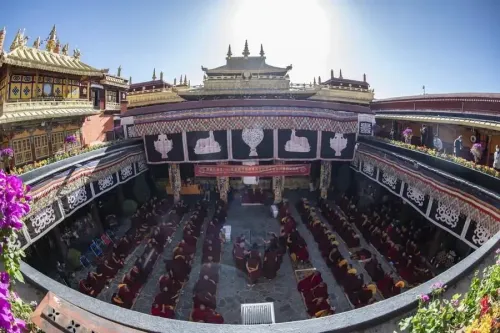
Monasteries across Tibet, according to the report, operate under strict surveillance. Monks are required to undergo 'patriotic education', with political indoctrination taking precedence over religious learning. Tibetan Buddhist rituals, festivals, and teachings are restricted, regulated, or rebranded as 'folk culture', eroding their spiritual depth. 'Public allegiance to the Dalai Lama is criminalised, casting devotion itself as subversion,' Thondup wrote.
Global Projection vs. Domestic Repression
The report draws a sharp contrast between China's international posture and its domestic conduct. Beijing projects itself as a protector of Buddhist heritage through temple restoration, international forums, and state-funded pilgrimages across Thailand, Sri Lanka, and Myanmar — moves Thondup characterises as bids for global legitimacy.
In Tibet, however, the objective is markedly different. Where Buddhism is intertwined with identity, Beijing seeks to weaken Tibetan nationalism and dilute resistance to assimilation by tightening control over the faith. This comes amid longstanding international criticism of China's human rights record in Tibet, which Beijing consistently rejects as interference in its internal affairs.
The Limits of State Control Over Faith
Thondup concluded with a broader observation about the CCP's strategy: 'Even in an atheist state, religion remains too powerful to ignore. The CCP's paradoxical reliance on Buddhism shows that belief, when stripped of transcendence, can be repurposed as ideology. But the repression of Tibetan Buddhism demonstrates the limits of this strategy: faith, at its core, resists control. The more Beijing tries to own it, the more it exposes its own insecurity.'
The report adds to a growing body of documentation by Tibetan advocates and international observers warning that China's religious management policies risk permanently fracturing one of the world's oldest living Buddhist traditions.
Point of View
But because of who is saying them and where. A piece authored by the Dalai Lama's nephew and published in a European outlet is calibrated for Western policy audiences — and its timing, amid ongoing debates about China's influence in Southeast Asian Buddhist nations, is deliberate. What mainstream coverage tends to understate is the reincarnation question: Beijing's insistence on approving the next Dalai Lama is not merely a religious dispute but a succession crisis with geopolitical stakes for India, Tibet, and the broader Himalayan region. The CCP's strategy of weaponising Buddhism abroad while suppressing it in Tibet reflects a broader pattern — using soft power as cover for hard control.
NationPress
4 Jul 2026
Frequently Asked Questions
What does the report say about China's use of Buddhism?
The report, published in the European Times, argues that China has hollowed out Buddhism by turning temples into tourist attractions, monks into state employees, and scriptures into tools for promoting loyalty to the CCP. It says the distortion is most severe in Tibet, where the faith is actively weaponised against its own practitioners.
Who is Khedroob Thondup and why does his analysis matter?
Khedroob Thondup is the nephew of the Dalai Lama and a prominent Tibetan advocate. His analysis carries weight as a first-hand perspective from within the Tibetan Buddhist leadership, and its publication in a European outlet signals an effort to inform Western policymakers about Beijing's religious management policies.
Why is Beijing's claim over Dalai Lama reincarnation significant?
Beijing's assertion that it holds authority to approve the reincarnation of Tibetan lamas — including the next Dalai Lama — is described in the report as a direct attempt to sever Tibetan Buddhism from its spiritual lineage and bind it to state power. The issue has major geopolitical implications for India, Tibet, and the broader Himalayan region.
How does China project itself internationally on Buddhism?
China funds temple restorations, international Buddhist forums, and state-sponsored pilgrimages to Thailand, Sri Lanka, and Myanmar to project itself as a protector of Buddhist heritage and gain global legitimacy, even as it tightens control over Buddhist practice domestically in Tibet.
What restrictions do Tibetan monks face under Chinese rule?
According to the report, monks in Tibet are required to undergo 'patriotic education' prioritising political indoctrination over religious learning. Tibetan Buddhist rituals, festivals, and teachings are restricted or rebranded as 'folk culture', and public allegiance to the Dalai Lama is criminalised.