China's debt-interest bill tops 19% of budget, now outpaces US federal ratio
Synopsis
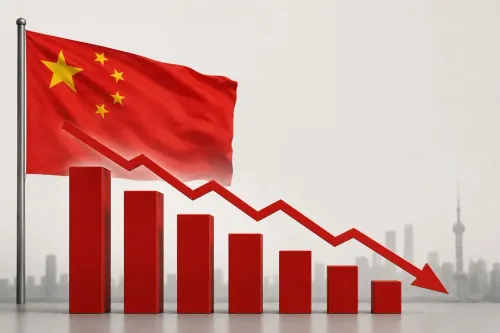
China's interest payments have ballooned to 19.2% of its central budget — now higher as a share than the US figure of 14% — after a 341% surge since 2013. With GDP growth slowing, consumers reluctant to spend, and the property sector still in distress, Beijing's state-led growth model is showing serious cracks just as its fiscal room narrows.
Key Takeaways
China's debt-servicing costs will consume 19.2 per cent of the central government's general public budget in 2025 , up from 12 per cent in 2014 , per Conference Board estimates.
At 19 per cent of total spending, China's interest burden now exceeds the US ratio of 14 per cent , according to CSIS .
China's interest payments surged 341 per cent between 2013 and 2025 — faster than defence ( 141% ), science ( 137% ), or total spending ( 102% ).
China's GDP growth is reportedly on course to miss the 4.5–5 per cent annual target, weighed by weak consumption, a struggling property sector, and trade barriers.
Beijing has directed state banks to fund priority sectors including EVs , AI , robotics , and renewable energy , but analysts warn the state-led model is 'running out of steam.'
China's debt burden has escalated sharply over the past decade, with interest payments on government borrowing now consuming a larger share of the national budget than in the United States, according to recent analyses by multiple global research bodies. The trend signals a structural stress point in the world's second-largest economy at a moment when growth is already under pressure.
Key Figures Behind the Debt Spiral
Debt-servicing payments in China will account for 19.2 per cent of the central government's general public budget in 2025, up sharply from 12 per cent in 2014, according to new estimates from the Conference Board cited by the Financial Times. A separate assessment by the Centre for Strategic and International Studies (CSIS) corroborates this picture, finding that 19 per cent of Beijing's total spending is now earmarked for interest on debt — exceeding the 14 per cent of the US federal budget directed toward interest costs.
The CSIS report, authored by Jason Ma, notes that China's interest payments skyrocketed 341 per cent between 2013 and 2025 — faster than any other major budget category. By comparison, total government spending rose 102 per cent over the same period, while outlays on social security and employment climbed 207 per cent, science and technology 137 per cent, and defence 141 per cent.
How China and the US Are Diverging
The CSIS report acknowledges that US debt-interest spending also presents a grim picture, having surged roughly 390 per cent since 2013 to reach $1 trillion. However, according to the report, the two economies are diverging in critical ways.
'The US economy is accelerating, helped by the AI boom, and despite high inflation, resilient consumers have continued to spend. Unemployment is low and signals full employment, while stock markets are at or near record highs,' the CSIS report stated.
China's trajectory runs in the opposite direction. Its GDP growth has been decelerating and is reportedly on pace to fall short of its annual target range of 4.5 to 5 per cent. Export-facing sectors continue to expand, but trade partners are erecting fresh barriers. Chinese consumers remain reluctant to spend, domestic investment is weak, and the property sector is still recovering from what the report describes as an 'epic crash.' Chinese equity markets have also been broadly subdued.
The State-Led Growth Model Under Strain
Beijing has directed state-owned banks to channel financing toward priority industries including electric vehicles, robotics, artificial intelligence, and renewable energy. While this reflects a deliberate industrial strategy, the CSIS report warns that the state-led growth model 'now looks like it's running out of steam.' Local governments have routinely sought to stimulate favoured industries through low-cost loans, contributing to the rapidly expanding debt mountain.
This comes amid growing scrutiny from international analysts over China's fiscal transparency, with off-balance-sheet borrowing by local government financing vehicles (LGFVs) considered a significant — and only partially accounted for — component of the broader debt picture.
What This Means Going Forward
The convergence of slowing growth, a deflated property sector, weak consumer demand, and rising debt-servicing costs leaves Beijing with diminishing fiscal headroom. Critics argue that without a meaningful rebalancing toward domestic consumption and a credible path to deleveraging, the debt overhang could increasingly constrain China's ability to deploy counter-cyclical stimulus when needed. How Beijing navigates this tightening fiscal space will be closely watched by global markets and trading partners alike.
Point of View
But it obscures a more fundamental difference: the US is absorbing its debt costs inside an accelerating economy, while China is accumulating them inside a decelerating one. That asymmetry matters enormously. Beijing's off-balance-sheet local government debt — much of it through LGFVs — is not fully captured in these figures, which means the true interest burden is likely higher still. With the property sector yet to stabilise and consumer confidence fragile, China's room to deploy the kind of large-scale stimulus that rescued growth in 2008 and 2015 is narrowing. The real risk is not default — Beijing controls its banking system — but a prolonged era of fiscal drag that permanently lowers China's growth ceiling.
NationPress
15 Oct 2026
Frequently Asked Questions
What share of China's budget goes to debt interest payments in 2025?
According to Conference Board estimates cited by the Financial Times, debt-servicing payments will account for 19.2 per cent of China's central government general public budget in 2025, up from 12 per cent in 2014. A separate CSIS assessment puts Beijing's interest spending at 19 per cent of total outlays.
How does China's debt interest burden compare with that of the United States?
China's interest payments now represent 19 per cent of government spending, exceeding the US figure of 14 per cent of the federal budget, according to the CSIS report. Notably, US debt-interest costs have also surged — rising roughly 390 per cent since 2013 to $1 trillion — but the US economy is growing faster, giving it more capacity to absorb those costs.
How fast have China's interest payments grown since 2013?
China's spending on interest payments rose 341 per cent between 2013 and 2025, faster than any other major budget category, according to CSIS. Total government spending grew 102 per cent over the same period, while defence spending rose 141 per cent and social security outlays climbed 207 per cent.
Why is China's economic outlook under pressure despite strong exports?
While China's export-facing sectors are growing, the broader economy faces multiple headwinds: trade partners are raising barriers, domestic consumers remain reluctant to spend, investment is weak, and the property sector is still recovering from a severe downturn. GDP growth is reportedly on pace to fall short of Beijing's 4.5–5 per cent annual target.
What sectors is Beijing prioritising with state bank financing?
Beijing has directed state-owned banks to provide low-cost financing to priority industries including electric vehicles, robotics, artificial intelligence, and renewable energy. However, analysts warn that this state-directed lending model is contributing to the debt build-up and may be running out of momentum as a growth driver.