Hungary sinks barges in Danube to save Paks nuclear plant from shutdown
Synopsis
Hungary is physically sinking barges in the Danube to stop its main nuclear plant — which supplies half the country's electricity — from going offline. With the river forecast to breach critical cooling-water thresholds by Monday, the operation lays bare how climate-driven drought is now a direct nuclear energy security risk in Central Europe.
Key Takeaways
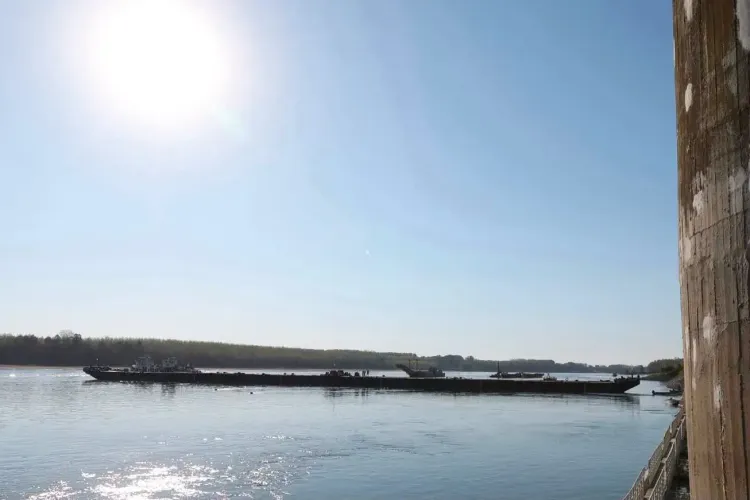
Hungarian authorities began controlled sinking of two barges in the Danube River near Paks on 15 August to raise local water levels.
Prime Minister Peter Magyar confirmed the emergency operation at an on-site press conference, noting a 1 cm rise already recorded at the pumping station.
If the Danube falls below minus 132 cm , one of two operating turbines must shut down; below minus 140 cm , the entire plant could go offline.
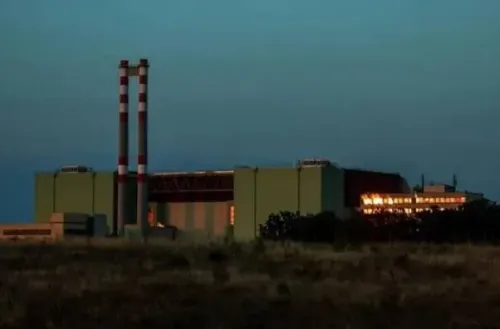
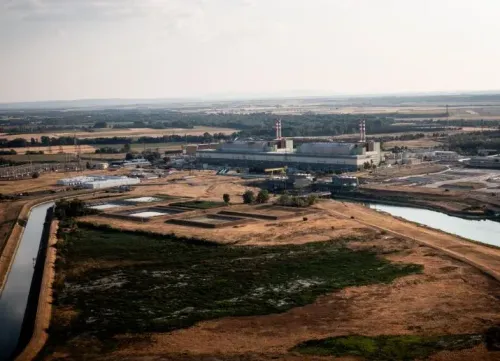
The Paks nuclear power plant , located 100 km south of Budapest , normally supplies around half of Hungary's electricity via its four reactors .
Low water levels have disrupted Paks operations multiple times this month due to prolonged dry and hot weather across Central Europe.
A temporary riverbed sill is also under construction alongside the barge operation to sustain cooling-water intake.
Hungarian authorities on Saturday, 15 August began the controlled sinking of two barges in the Danube River near the Paks nuclear power plant as dangerously low water levels once again threatened the facility's cooling operations. Prime Minister Peter Magyar, speaking at a press conference at the site, confirmed the emergency measure and said early signs were encouraging.
'We have received good news, because the water level has already risen by one centimetre at the power plant's pumping station,' Magyar told reporters.
How the Barge Operation Works
The two barges were positioned across part of the river near Paks and initially lowered by approximately 20 centimetres in a deliberate emergency manoeuvre designed to raise the local water level and ensure sufficient cooling-water intake for the plant's reactors. The operation is running alongside the construction of a temporary riverbed sill — a physical barrier intended to pool water around the plant's intake points.
Authorities said water levels, flow velocity, and the condition of the riverbed were being continuously monitored throughout the intervention.
The Shutdown Thresholds Authorities Are Racing to Avoid
According to Magyar, current forecasts indicate the Danube at Paks could fall below minus 132 centimetres as early as Monday morning — a critical threshold at which one of the plant's two operating turbines would be forced offline. A further decline to below approximately minus 140 centimetres could compel a full shutdown of the entire nuclear plant.
'We have to prevent this, and we will prevent it,' Magyar said, underscoring the urgency of the measures.
A Pattern of Disruption This Summer
The latest intervention is not an isolated incident. Low water levels have repeatedly disrupted operations at Paks in recent weeks, driven by prolonged dry and hot weather across Central Europe. Earlier this month, declining Danube levels forced the plant to reduce output before a temporary rise allowed Unit 2 to gradually increase production again. This marks at least the second emergency response cycle within a single month.
Located approximately 100 km south of Budapest, the Paks nuclear power plant normally generates around half of Hungary's electricity. Its four reactors rely entirely on Danube water for cooling — a structural dependency that climate-driven low-water events are now stress-testing with increasing frequency.
Broader Energy Security Implications
Hungary's heavy reliance on a single nuclear facility for the majority of its power generation leaves the country with limited buffer when that plant faces operational constraints. The recurring Danube water crisis raises questions about long-term resilience planning for the plant, which was originally designed and built during the Soviet era. Any prolonged shutdown would force Hungary to source replacement power from regional grids at elevated cost, with knock-on implications for domestic energy prices.
With Monday's forecast water levels the immediate concern, authorities are expected to provide further updates through the weekend as the barge operation and riverbed construction continue.
Point of View
But they are not an energy strategy. Hungary's near-total dependence on a single nuclear facility for half its electricity, with no large-scale backup, is the real vulnerability that Monday's forecast is exposing. The question mainstream coverage is not asking: how many more emergency cycles before a shutdown becomes unavoidable, and what is Budapest's plan when it does?
NationPress
30 Sept 2026
Frequently Asked Questions
Why is Hungary sinking barges in the Danube River?
Hungary is deliberately sinking two barges near the Paks nuclear power plant to raise the local water level in the Danube and maintain sufficient cooling-water intake for the plant's reactors. Prolonged dry and hot weather has caused the river to drop to critically low levels, threatening the plant's operation.
What happens if the Danube water level keeps falling at Paks?
If the Danube at Paks falls below minus 132 centimetres, one of the plant's two operating turbines would have to be shut down. A further drop below approximately minus 140 centimetres could force the entire nuclear plant offline, according to Prime Minister Peter Magyar.
How important is the Paks nuclear plant to Hungary?
The Paks nuclear power plant is Hungary's primary electricity source, normally generating around half of the country's total power. Its four reactors depend entirely on Danube river water for cooling, making low water levels a direct operational risk.
Has the Paks plant faced this problem before?
Yes. Low Danube water levels have disrupted Paks operations multiple times in recent weeks. Earlier in August, declining levels forced the plant to reduce output before a temporary rise allowed Unit 2 to gradually increase production again — making this the second emergency response cycle within the same month.
What other measures are being taken alongside the barge sinking?
Alongside the controlled barge sinking, authorities are constructing a temporary riverbed sill designed to pool water around the plant's cooling-water intake. Water levels, flow velocity, and riverbed conditions are being continuously monitored throughout the operation.