Is India the Indispensable Anchor of the Indo-Pacific?

Synopsis
The U.S. has identified India as a crucial anchor in South Asia and the Indo-Pacific, emphasizing strategic partnerships. Learn how this aligns with the 'America First' approach and strengthens regional security against global challenges.
Key Takeaways
India is recognized as a strategic anchor in South Asia.
The U.S. emphasizes an 'America First' approach in global engagement.
Recent trade agreements enhance economic cooperation.
Defense collaboration is pivotal for regional security.
Concerns about debt-trap diplomacy are highlighted.
On February 11, Washington (NationPress) recognized India as the keystone of South Asia and the broader western Indo-Pacific region. This designation comes as the Trump administration unveiled an “America First” strategy focused on trade agreements, defense collaboration, and strategic investments throughout the region.
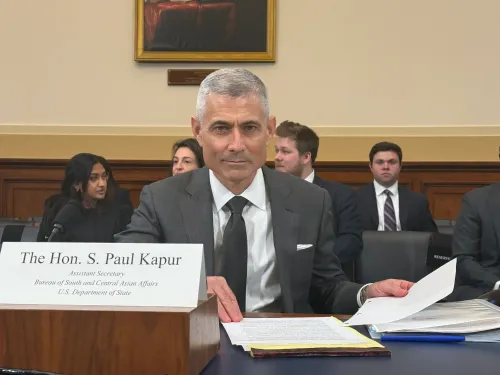
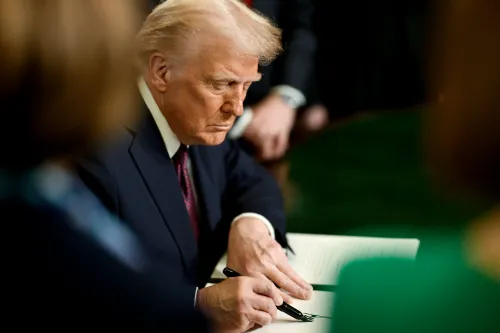
Paul Kapur, the Assistant Secretary of State for South and Central Asia, submitted written testimony to the House Foreign Affairs Committee’s Subcommittee on South and Central Asia. He emphasized that President Donald Trump’s National Security Strategy clearly states that the U.S. should prioritize its interests through active involvement in crucial global areas.
“Under the President’s guidance, we have advanced our economic and security objectives while supporting our allies,” Kapur remarked ahead of his testimony.
Kapur characterized South Asia as “extremely significant,” noting that “India is home to over a billion people and spans a vast subcontinent.”
He cautioned that a “hostile power” controlling South Asia could leverage its influence over the global economy, asserting that “the United States must thwart this scenario and maintain the region’s freedom.”
Kapur stated that India, “due to its size, location, and dedication to an open and free region, serves as the anchor for South Asia and, more broadly, the western Indo-Pacific.”
He highlighted the increasing bilateral collaboration, showcasing high-level diplomatic interactions and cooperation in defense, technology, and energy. He mentioned the renewed ten-year US-India Defense Framework Agreement, the TRUST initiative, and India's acquisition of various U.S. products, “from drones to liquefied natural gas.”
Kapur also pointed out recent advancements in trade. “Just last week, President Trump and Prime Minister Modi finalized a groundbreaking trade framework,” he indicated.
Furthermore, he noted that “two days ago, the Trump Administration finalized a trade agreement with Bangladesh, granting U.S. exporters access to Bangladesh’s market of 175 million consumers.”
Beyond trade, he outlined three principal strategies for enhancing strategic capacity: “Defense collaboration, targeted investments, and diplomacy.”
Referring to Pakistan as “another vital partner,” Kapur stated that Washington is collaborating with Islamabad to unlock the potential of its critical mineral resources, integrating U.S. government seed funding with private sector expertise.
He also referenced growing trade in energy and agriculture, along with ongoing counterterrorism efforts.
Kapur emphasized the significance of Bangladesh, Nepal, Maldives, Sri Lanka, and Bhutan, noting their strategic positions but also their vulnerability to coercion.
He raised concerns over “the perils of debt-trap diplomacy.”
Kapur called for bipartisan collaboration, urging, “Let’s unite to enhance strategic capacity in the region, empowering our partners to support themselves and ensuring a safer, stronger, and more prosperous United States.”
South Asia remains a cornerstone of Washington’s Indo-Pacific strategy, especially as the U.S. aims to counter China’s expanding influence in the region. India has emerged as a pivotal ally through defense collaboration, multilateral partnerships, and increased trade engagement.
Point of View
It is crucial to acknowledge the strategic significance of India's role in the Indo-Pacific. The U.S. recognition of India as an anchor reflects the growing geopolitical landscape where partnerships are paramount for security and stability in South Asia. This approach is essential in countering global challenges and ensuring mutual prosperity.
NationPress
23 Sept 2026
Frequently Asked Questions
Why is India considered an anchor in the Indo-Pacific?
India's geographical significance, large population, and commitment to a free and open region make it a vital partner for the U.S. in ensuring stability and countering coercive influences in South Asia.
What is the 'America First' strategy?
'America First' is a national strategy aimed at prioritizing U.S. economic and security interests through active engagement in critical global regions, including trade and defense partnerships.
What are the recent trade agreements between the U.S. and India?
Recent agreements include a historic trade framework between President Trump and Prime Minister Modi, as well as a deal with Bangladesh that provides U.S. exporters access to a significant market.
What role does Pakistan play in U.S. strategy in South Asia?
Pakistan is viewed as another key partner, with the U.S. collaborating to harness its mineral resources and enhance trade, while also addressing security concerns.
How does this impact U.S.-China relations?
This strategy underscores the U.S.'s efforts to counter China's growing influence in the Indo-Pacific by strengthening alliances with regional powers like India.