How is Strong India Countering China's Influence?
Synopsis
In a critical discussion, US officials highlight India's role as a stabilizing force in South Asia, emphasizing the importance of New Delhi's independence. This comes amidst heightened tensions with China and a newly forged trade framework between the US and India. Discover how these developments shape regional dynamics and US strategic interests.
Key Takeaways
India's strategic autonomy is vital for regional stability.
The US aims to prevent any single hegemon, especially China, from dominating the Indo-Pacific.
The recent trade framework emphasizes economic collaboration.
Bipartisan support reinforces the strength of US-India relations.
Defense cooperation is a cornerstone of the partnership.
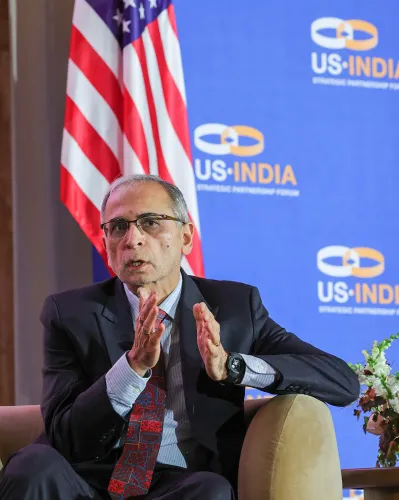
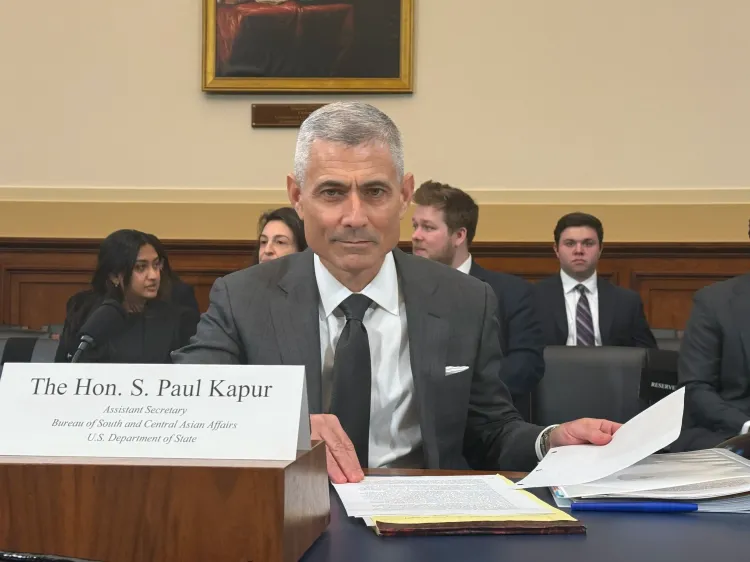
Washington, Feb 12 (NationPress) Describing South Asia as “extremely significant,” US Assistant Secretary of State for South and Central Asia S. Paul Kapur informed lawmakers that the dimensions and position of India position it as the region’s anchor, asserting that a robust, autonomous New Delhi is essential in averting any “single hegemon” from exercising “coercive leverage” over the Indo-Pacific.
During his testimony before a House subcommittee on US foreign policy in South and Central Asia on Wednesday (local time), Kapur stated, “India alone has well over 1 billion people and occupies a subcontinental landmass; a hostile power dominating South Asia could exert coercive leverage over the world economy.”
“The United States must prevent this from happening and keep the region free and open,” he added.
Kapur characterized the administration’s strategy as grounded in collaboration with allies. “America First does not mean America alone,” he emphasized, highlighting the need for Washington to “cooperate with like-minded partners who can share the burden.”
“All India, with its size, location, and commitment to a free and open region, anchors South Asia and more broadly the western half of the Indo-Pacific,” he explained to the lawmakers.
When questioned about China’s increasing influence, Kapur made the US's intentions clear. “What we’re trying to do fundamentally is not to keep China out of the region but to prevent China or any single hegemon from taking over or imposing coercive leverage on the region,” he stated.
He argued that India’s strategic independence is advantageous to Washington.
“In India, that is able to be independent and preserve its freedom of action actually works to our strategic advantage and promotes our strategic interests,” Kapur noted.
“In India, that is able to be independent and preserve its freedom of action, takes a huge swath of the Indo-Pacific off of China’s plate and almost by definition prevents it from becoming the dominant power in the region,” he added.
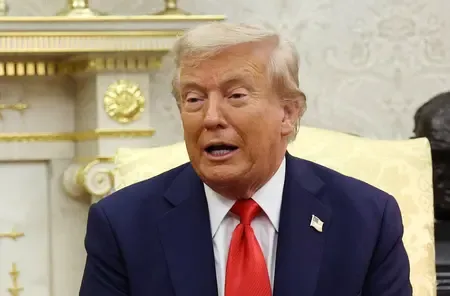
This testimony came shortly after President Donald Trump and Prime Minister Narendra Modi established what Kapur referred to as “a historic trade framework.”
“Just last week, President Trump and Prime Minister Modi reached an agreement on a historic trade framework,” he mentioned, adding, “Following the trade framework President Trump reached last week with Prime Minister Modi, we can now focus on other shared priorities.”
House subcommittee chair Congressman Bill Huizenga emphasized India’s role in US strategy. “India, the largest democracy in the world and one of the fastest growing economies, remains a vital strategic partner,” he stated.
Huizenga highlighted specifics of the trade deal. “The US-India trade deal sets India’s tariff rate at 18 percent, one of the lowest regionally,” he noted, adding that Delhi has agreed to purchase more American energy.
He also framed India as pivotal in countering Beijing. “India shares our objective of ensuring that China cannot bully its neighbours or threaten American assets in the Indian Ocean,” Huizenga remarked.
Beyond trade, Kapur elaborated on what he termed “three broad categories of approach to strategic capacity building” -- “defence cooperation, targeted investment, and diplomacy.”
On defence, he stressed continuity despite recent trade tensions. “Despite some of the uncertainties surrounding the trade relationship in recent months, our other initiatives and efforts with India have continued forward, defence, energy, technology, and so on,” he stated.
“We just signed the ten-year framework, which is going to help us move forward in interoperability, in joint exercises, and many of the things that we -- that we do and have been doing in recent years,” Kapur added.
He mentioned “some potential purchases of weapons systems in the pipeline that will help India to protect itself better, ensure its sovereignty, and also will create American jobs.”
Kapur also emphasized “Indian purchases of US products ranging from drones to liquefied natural gas” as part of the expanding energy and technology cooperation.
Democratic Congressman Ami Bera highlighted bipartisan consistency in India policy. “This kind of strategic thinking has transcended both Democratic and Republican administrations,” he stated.
Bera also added that even amid turbulence, “we continued to move forward on most axes of the relationship in a pretty robust way.”
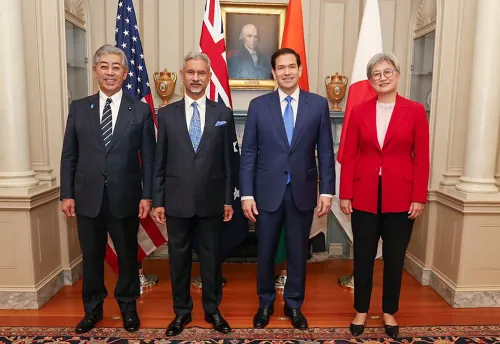
Kapur also mentioned cooperation “bilaterally and also through the quad,” describing it as “a very important platform” that enables the United States to “connect and cooperate in unique ways with our like-minded partners.”
The US-India partnership has steadily expanded over the past two decades across defence, energy, and technology cooperation.
Point of View
It is imperative to recognize the ongoing geopolitical shifts in the Indo-Pacific, particularly the strategic significance of India. The emphasis on India's autonomy and its partnership with the United States signifies a robust approach to countering potential hegemonic influences in the region. This narrative is crucial for understanding the complexities of international relations in a rapidly changing world.
NationPress
2 Oct 2026
Frequently Asked Questions
What is the significance of India's size and location?
India's vast population and strategic location make it a crucial player in South Asia, preventing any single power from dominating the region.
How does the US view its relationship with India?
The US sees India as a vital strategic partner, especially in countering China's influence and ensuring a free and open Indo-Pacific.
What are the key elements of the recent US-India trade framework?
The framework includes an agreement to set India's tariff rate at 18 percent and a commitment for India to purchase more American energy.
What are the three broad categories of US-India cooperation?
The three categories are defense cooperation, targeted investment, and diplomacy, aimed at building strategic capacity.
Why is bipartisan support important for US-India relations?
Bipartisan support ensures continuity in strategic thinking and policies towards India, regardless of the political party in power.