India's $4 billion defence exports unlock Australia partnership potential
Synopsis
India exported US$4 billion in defence equipment last year — BrahMos missiles, submarines, patrol boats — and is now co-producing Apache components and V-BAT drones with global partners. Australia's new joint defence declaration with India could be the most underreported strategic development of Modi's Melbourne visit, and a genuine alternative supply chain for Canberra beyond AUKUS.
Key Takeaways
India's defence exports crossed US$4 billion last year, with 145 defence exporters serving markets including the US , Philippines , Armenia , Vietnam , and Myanmar .
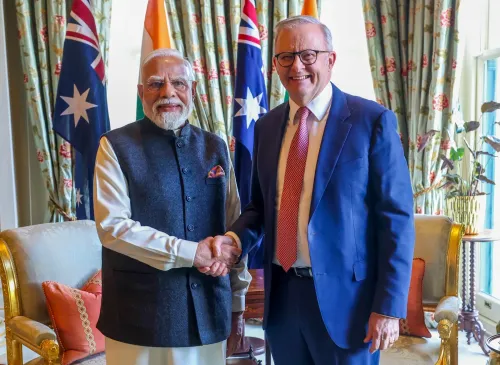
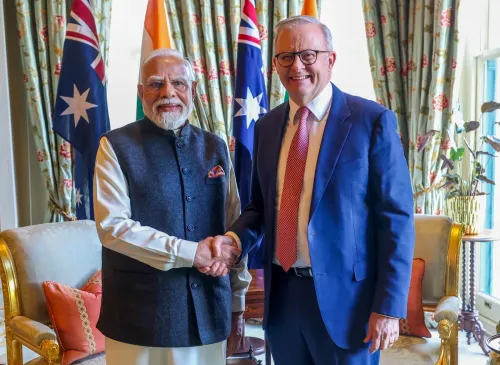
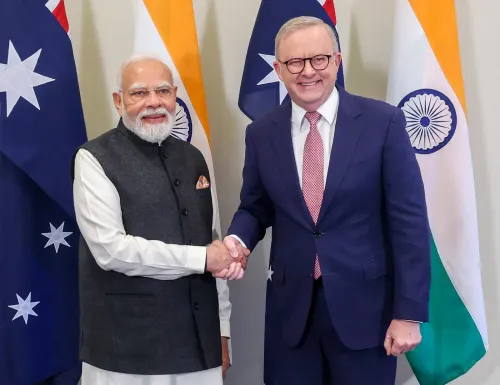
PM Narendra Modi's Australia visit produced the India–Australia Joint Declaration on Defence and Security Cooperation , covering military exercises, interoperability, and aircraft deployments.
A new space tracking terminal has been commissioned on Australia's Cocos (Keeling) Islands for India's human spaceflight programme.
Both countries will conclude a Maritime Security Collaboration Roadmap and expanded cybersecurity cooperation under the PACTS framework.
India co-produces Apache helicopter and F-16 aircraft components for the US, and has production lines in Gujarat (C-295 aircraft) and Telangana (V-BAT drones).
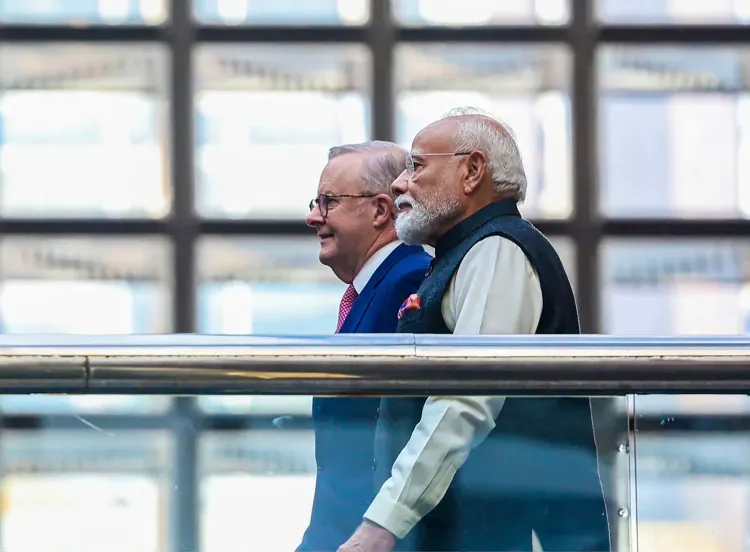
India's surging defence manufacturing output — with exports crossing US$4 billion last year — is creating concrete opportunities for Australia to deepen strategic and industrial cooperation with New Delhi, according to an analysis published by the Australia-based policy journal The Interpreter. The assessment comes in the wake of Prime Minister Narendra Modi's visit to Australia, which delivered substantive outcomes across investment, energy, and defence alongside the widely covered diaspora event in Melbourne.
The Joint Defence Declaration
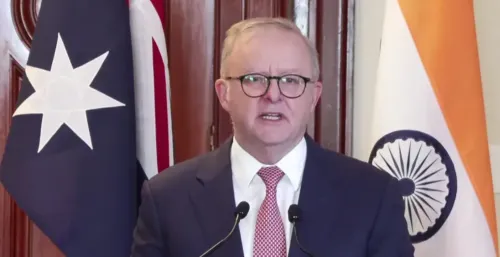
A key outcome of Modi's Australia visit was the signing of a wide-ranging India–Australia Joint Declaration on Defence and Security Cooperation. According to The Interpreter, the declaration 'tended to be undervalued in Australian commentary,' overshadowed by domestic debates around AUKUS, China's military build-up, and the conflicts in the Middle East and Ukraine.
The declaration sets out an ambitious agenda: both sides agreed to deepen cooperation by increasing the complexity of military exercises, accelerating interoperability, broadening professional military education, and expanding aircraft deployments from each other's territories. The two countries have also pledged to conclude a Maritime Security Collaboration Roadmap, building on existing cooperation in humanitarian assistance, disaster relief, logistics evacuation operations, and undersea domain awareness.
PACTS, Space, and Cyber Cooperation
Beyond conventional defence, the two nations incorporated a significant defence and cybersecurity component under their new Partnership on Cyber, Critical Technologies and Supply Chains (PACTS). A new space tracking terminal has also been commissioned on Australia's Cocos (Keeling) Islands to support India's human spaceflight programme — a development that signals the breadth of the bilateral relationship moving well beyond traditional security frameworks.
India's Defence Industrial Rise
The Interpreter's analysis underscores that India's defence industrial credentials have strengthened considerably over the past five years. Recent export milestones include BrahMos cruise missiles to the Philippines, surface-to-air missile systems to Armenia, high-speed patrol boats to Vietnam, and a refurbished Kilo-class submarine to Myanmar. An Indian defence firm has also established an armoured vehicle production facility in Morocco.
The United States has emerged as the largest market for India's 145 defence exporters. Indian firms now produce components for Apache helicopters, F-16 aircraft, and MQ-9 UAVs, while smaller companies supply missiles, sensors, drones, and propellants to international customers — increasingly in collaboration with American, French, and Israeli defence firms to scale production at lower costs.
Joint Ventures as a Model
The Interpreter highlighted the K9 Thunder self-propelled artillery system — known as the Vajra in India — as a template for successful international co-production. The platform is a joint venture between South Korean conglomerate Hanwha Aerospace and Indian manufacturer Larsen and Toubro. India has similarly established production lines in Gujarat for the Spanish-origin C-295 transport aircraft and in Telangana for the US-designed V-BAT drones.
Why Australia Should Take Notice
For Australia, which is navigating fiscal constraints alongside growing capability requirements, collaboration through joint production with India's defence sector is described as 'real and worth pursuing.' India's ability to manufacture affordable arms and ammunition makes it a compelling partner for countries seeking to diversify supply chains away from traditional Western vendors. Notably, security cooperation between India and Australia has 'broadened and deepened more than many appreciate' over the past decade, the report stated.
With the joint declaration now in place and both governments signalling intent, the next phase will test whether the ambitious framework translates into actual co-production agreements and technology transfers — the metrics by which this partnership will ultimately be judged.
Point of View
Missing a partnership that has quietly matured into co-production, space cooperation, and cyber collaboration. India's US$4 billion export figure is not a vanity metric — it reflects a defence industrial base now integrated into US, French, and Israeli supply chains. For Australia, the question is not whether India is a credible partner, but whether Canberra has the bureaucratic bandwidth to move from declarations to actual procurement and co-production deals before the window of India's early-mover advantage closes.
NationPress
17 Oct 2026
Frequently Asked Questions
What did the India–Australia Joint Declaration on Defence and Security Cooperation cover?
The declaration commits both countries to deeper military cooperation including more complex joint exercises, accelerated interoperability, expanded professional military education, and aircraft deployments from each other's territories. It also includes a Maritime Security Collaboration Roadmap and a significant cybersecurity component under the PACTS framework.
How large are India's defence exports?
India exported defence equipment worth US$4 billion last year, supplied by 145 defence exporters. Key exports have included BrahMos cruise missiles to the Philippines, surface-to-air missile systems to Armenia, patrol boats to Vietnam, and a refurbished Kilo-class submarine to Myanmar.
Why is Australia interested in India's defence sector?
Australia is balancing fiscal pressures with growing capability requirements. India's ability to manufacture affordable arms and ammunition, combined with its proven co-production track record with the US, South Korea, France, and Israel, makes it an attractive partner for diversifying supply chains beyond traditional Western vendors.
What is the significance of the Cocos (Keeling) Islands space terminal?
A new space tracking terminal commissioned on Australia's Cocos (Keeling) Islands will support India's human spaceflight programme. It signals that the bilateral relationship has expanded well beyond conventional security into space cooperation.
What are examples of India's successful defence co-production ventures?
The K9 Thunder self-propelled artillery system — called the Vajra in India — is a joint venture between South Korea's Hanwha Aerospace and India's Larsen and Toubro. India has also set up C-295 transport aircraft production lines in Gujarat and V-BAT drone production in Telangana, and produces components for Apache helicopters and F-16 aircraft for the US market.