Did Rubio Congratulate Tarique Rahman on His Historic Election Win in Bangladesh?
Synopsis
In an important diplomatic gesture, US Secretary of State Marco Rubio congratulated Tarique Rahman and the BNP on their election victory, highlighting the new government's potential role in regional stability and economic growth. What does this mean for US-Bangladesh relations moving forward?
Key Takeaways
Marco Rubio congratulated Tarique Rahman and the BNP on their election win.
The US is eager to work with Bangladesh's new government.
Bangladesh's strategic importance in South Asia was emphasized.
The US aims to enhance economic ties with Bangladesh.
The Trump administration recently signed a trade deal with Bangladesh.
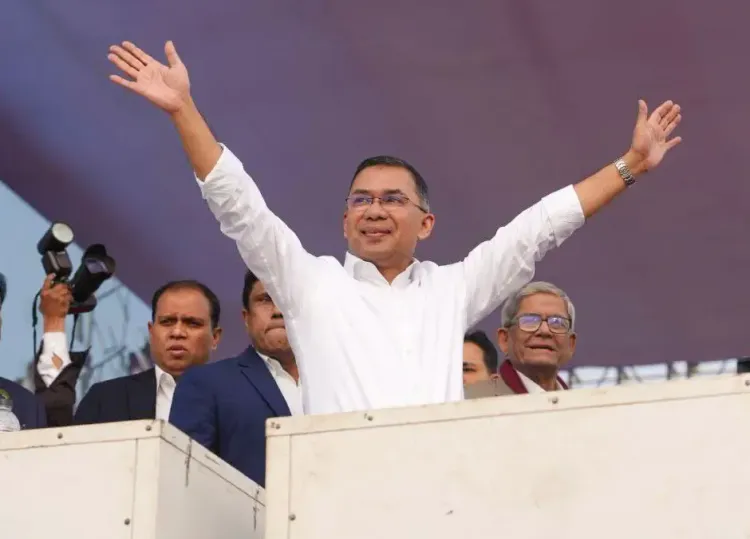
Washington, Feb 13 (NationPress) US Secretary of State Marco Rubio extended his congratulations to the Bangladesh Nationalist Party (BNP) and its leader Tarique Rahman on their recent electoral success, indicating a willingness from Washington to collaborate with the new leadership in Dhaka.
In a statement posted on the social media platform X, Rubio expressed, “Congratulations to the Bangladesh Nationalist Party and its leader, Tarique Rahman, as well as the people of Bangladesh.”
He further noted, “The United States looks forward to working with the newly elected government to advance prosperity and the security of the region.”
This statement aligns with remarks from senior administration officials who underscored Bangladesh's strategic significance in South Asia during a recent Congressional hearing.
During testimony before the US House Foreign Affairs Subcommittee on South and Central Asia, Assistant Secretary of State for South and Central Asian Affairs Paul Kapur expressed positivity about the electoral proceedings.
“We’re excited about it,” Kapur remarked.
He added, “We’ve been in touch with the interim government. They have a strong sense of their responsibility in making this go forward in a way that is secure and peaceful.”
Kapur remarked, “We hope that is indeed what happens; we expect it will be. We look forward to collaborating with whatever government is elected there.”
He also mentioned the growing economic ties between Washington and Dhaka.
“Recently, the Trump administration finalized a trade agreement with Bangladesh, granting American exporters access to a market of approximately 175 million people,” he informed lawmakers.
In contextualizing Bangladesh within a broader regional perspective, Kapur stated, “Bangladesh, Nepal, Maldives, Sri Lanka, and Bhutan hold strategic significance, but they can also be susceptible to coercive tactics.”
He emphasized that US engagement aims to bolster the autonomy and resilience of its partners.
Defense collaboration with the United States, he explained, “assists them in safeguarding their borders and waterways from encroaching powers, and strategically targeted investment can furnish these nations with high-quality, transparent, non-coercive support for critical infrastructure such as ports, telecom networks, and energy portals, thereby helping them evade the pitfalls of debt trap diplomacy.”
Point of View
I see this election victory as a pivotal moment for Bangladesh, reflecting the people's will and the implications it holds for international relations, particularly with the United States. The focus on collaboration and shared goals is crucial in navigating the complexities of regional dynamics. We stand with the nation at this significant juncture.
NationPress
7 Oct 2026
Frequently Asked Questions
What was the significance of Rubio's congratulatory message?
Rubio's message signifies the USA's intention to engage constructively with the newly elected government in Bangladesh, emphasizing regional security and economic collaboration.
How does this election impact US-Bangladesh relations?
The election victory opens avenues for enhanced cooperation, particularly in areas like trade, security, and economic development, reinforcing Bangladesh's strategic importance in South Asia.
What role does the US see for Bangladesh in South Asia?
The US recognizes Bangladesh's strategic location and aims to bolster its autonomy and resilience against external pressures while fostering strong bilateral ties.