US-China AI safeguards talks 'work in progress', says Rubio ahead of APEC, G20
Synopsis
US Secretary of State Marco Rubio confirmed that Washington and Beijing have held only technical-level AI safety talks with nothing concrete to show — and that the real push will happen at APEC and G20 summits. With both sides explicitly prioritising national interests over a shared framework, the gap between the world's two AI superpowers is as much ideological as it is technical.
Key Takeaways
Secretary of State Marco Rubio confirmed on Tuesday that US-China artificial intelligence safeguards talks remain 'a work in progress' with nothing to announce.
Rubio said the AI governance issue should be raised at the upcoming APEC summit and would also feature at the G20 , where China participates.
Both governments have presented their national positions at a technical level but have not converged on a shared framework.
Rubio framed US policy in explicit 'America First' terms, saying Washington 'does not work for the global order.' Rubio also confirmed intentions to organise a US-Russia-China trilateral meeting on nuclear weapons, with no date yet set.
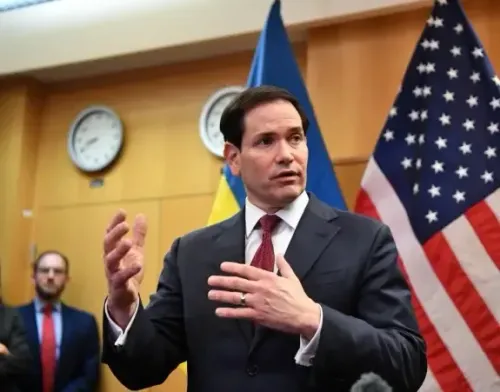
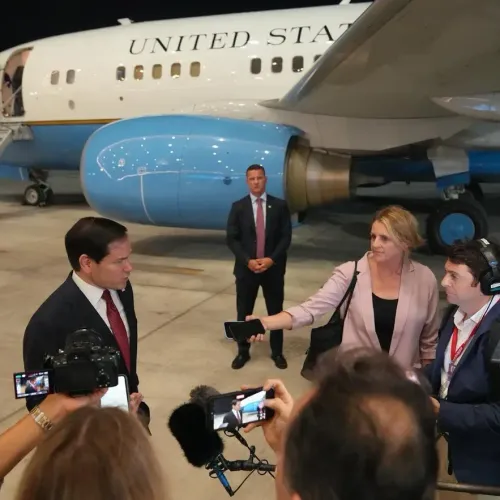
Secretary of State Marco Rubio confirmed on Tuesday that the United States and China have held technical-level discussions on artificial intelligence safeguards but have yet to reach any formal agreement, describing the talks as 'still a work in progress' ahead of key multilateral summits. The remarks came after a G7 ministerial meeting and signal that one of the most consequential technology-governance disputes between the world's two largest powers remains unresolved.
What Rubio Said
'I know there's been conversations with them sort of at a — at a technical level, but we don't have anything to announce on it,' Rubio told reporters. He added: 'Obviously, we've heard their perspective, they've heard ours, but that's still a work in progress.' The comments came in response to questions about whether Washington and Beijing had held substantive discussions on AI guardrails since their last presidential-level meeting.
Rubio was explicit that the two governments had each laid out their positions without converging on a shared framework. He declined to characterise the talks as a breakthrough, instead framing them as preliminary exchanges at the working level.
Multilateral Forums in Focus
Rather than limiting the AI safety debate to a bilateral channel, Rubio indicated that the issue would be elevated to broader international platforms. 'It should be an issue that we raise at the summit,' he said, referencing the forthcoming Asia-Pacific Economic Cooperation (APEC) gathering, where he expected AI governance to feature prominently. The subject is also expected to be on the agenda at the Group of 20 (G20), where China holds a seat.
This comes amid a wider global push to establish norms around advanced AI systems, with the United Kingdom, the European Union, and several Asian economies having already convened their own AI safety forums. The absence of a binding US-China framework is widely seen as a gap in the emerging international architecture.
America-First Framing on AI Policy
Rubio linked Washington's approach to AI governance to a broader 'America First' foreign policy posture. 'The Chinese system is always going to act in the best interest of the Chinese system, and the United States will always act in the best interests of the United States,' he said. He acknowledged that this alignment of national interests would at times put the two countries in direct conflict.
'We don't work for the global order. We don't work for other countries. We work for the United States,' Rubio said, underscoring that the Trump administration would measure its positions on AI — and other issues — by what it deemed beneficial to Americans, even when that created disagreements with Beijing.
Prospect of US-Russia-China Nuclear Talks
Separately, Rubio addressed questions about a potential trilateral meeting involving the United States, Russia, and China on nuclear weapons and proliferation. He said there was an intention to hold such a meeting and that officials were working on its organisation, but offered no date or formal announcement. He noted that President Donald Trump wanted the meeting to take place if possible and viewed the global status of nuclear weapons as a subject worth addressing at the highest levels.
Rubio declined to speculate on what China might be willing to accept in such a format, keeping expectations deliberately low-key.
What to Watch
With APEC and G20 summits approaching, AI governance is set to become a live diplomatic flashpoint. Whether Washington and Beijing can move beyond technical-level exchanges to a concrete joint statement — or even a bilateral mechanism — will be a key indicator of how much room exists for US-China cooperation in an otherwise strained relationship. All eyes will be on whether the two sides use the multilateral platform to narrow differences or harden positions.
Point of View
The administration makes a binding bilateral agreement structurally harder to achieve. The nuclear trilateral hint, meanwhile, is the kind of geopolitical signal that tends to generate headlines without timelines — a pattern worth watching.
NationPress
11 Nov 2026
Frequently Asked Questions
What did Marco Rubio say about US-China AI talks?
Rubio said the two countries have held technical-level discussions on AI safeguards but have nothing concrete to announce, describing the process as 'still a work in progress.' He made the remarks after a G7 ministerial meeting on Tuesday.
Where will the US-China AI governance issue be discussed next?
Rubio indicated the issue should be raised at the upcoming APEC summit and said it would also feature at the G20, where China is represented. He expects leaders at both forums to discuss artificial intelligence governance.
What is the US position on AI safety relative to China?
Rubio framed the US stance in explicit national-interest terms, saying the Chinese system will act in China's interest and the United States will act in America's interest. He acknowledged this will often put the two countries in conflict or disagreement.
Is a US-Russia-China nuclear meeting being planned?
Rubio said there is an intention to hold a trilateral meeting involving the United States, Russia, and China on nuclear weapons and proliferation, with officials working on its organisation. No date or formal announcement has been made.
Why do US-China AI talks matter globally?
The absence of a binding US-China framework on AI safety is widely seen as a critical gap in emerging international governance, given that the two countries lead global AI development. Without bilateral convergence, multilateral norms risk remaining fragmented.