Taiwan needs a sustained India strategy, Taipei Times report warns
Synopsis
A report in the Taipei Times delivers a pointed diagnosis: Taiwan’s India strategy is outdated, reactive, and filtered through a US-China binary that India itself rejects. With India’s strategic autonomy deepening and the Indo-Pacific construct evolving, Taipei’s failure to update its analytical framework could cost it one of the region’s most consequential partnerships.
Key Takeaways
A Taipei Times report warns that Taiwan views India through a ‘traditional and outdated lens,’ leading to misreads of Indian foreign policy.
Taiwan reportedly interprets India’s efforts to manage ties with China as a strategic reset — a reading the report calls ‘flawed.’ The report argues Taiwan still analyses global affairs primarily through the US-China competition prism, missing India’s emphasis on strategic autonomy .
Taiwan’s broader economic and strategic focus on India has ‘diminished’ despite India being a priority under the New Southbound Policy Plus framework.
The report asserts that ‘there can be no meaningful Indo-Pacific strategy without India,’ calling New Delhi’s role ‘indispensable.’
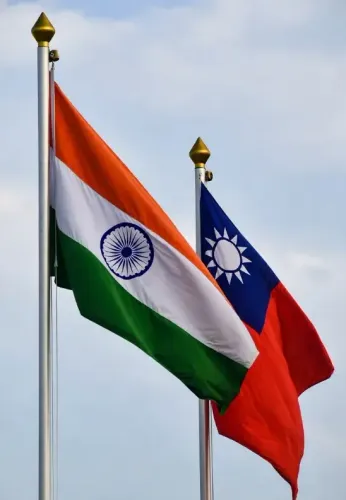
A report published in the Taipei Times has called on Taiwan to develop a sustained and evidence-based strategy toward India, warning that Taipei continues to view New Delhi through a “traditional and outdated lens” that risks misreading India’s foreign policy trajectory. The report, flagged on 20 August, comes as Taiwan’s broader economic and strategic focus on India appears to have quietly diminished despite New Delhi being designated a priority country under multiple Taipei-led frameworks.
Where Taiwan’s India Reading Goes Wrong
The report argues that Taiwan’s understanding of India’s foreign policy posture is “more reactive than evidence-based.” A key example cited is Taipei’s tendency to interpret India’s efforts to manage and stabilise ties with China as a strategic reset — and by extension, as evidence that India is drawing closer to Beijing.
“Managing ties with China does not mean abandoning engagement with Taiwan,” the report stated, pushing back against what it described as a flawed binary reading. It also noted that India itself has consistently refrained from viewing its Taiwan engagements through a China-centric prism.
Strategic Autonomy and the US-China Prism
The report underscores a deeper analytical gap: Taiwan, it argues, still tends to assess international relations primarily through the lens of US-China competition, even as the global order grows more multipolar. “It is never simply a question of China versus the US for India,” the report stressed, pointing to India’s growing emphasis on strategic autonomy as the international system becomes less unipolar and middle powers assert greater agency.
This matters because a Taiwan strategy premised on the US-China binary will consistently misread Indian decision-making, which is shaped by a distinct civilisational and geopolitical calculus rather than alliance loyalty.
The Indo-Pacific Misread
Another concern raised in the report is the perception — apparently circulating in some Taiwanese policy circles — that the Indo-Pacific construct is weakening due to growing friction between India and the United States. The report firmly rejects this reading.
“The Indo-Pacific is not disappearing. Rather, the credibility and reliability of the US are being questioned by an increasing number of countries. Many regional states are either doubling down on the Indo-Pacific construct or placing greater emphasis on regional agency and their own strategic interests,” the report said. It urged Taipei to pay closer attention to how US allies and partners are reassessing Washington’s transactional approach.
India’s Indispensable Role
Despite the critique of Taipei’s analytical framework, the report is unambiguous about India’s centrality to any viable Indo-Pacific vision. “There is no doubt that there can be no meaningful Indo-Pacific strategy without India. As one of the region’s largest economies and a critical strategic actor, India’s role is indispensable to any vision of a free, open, inclusive and resilient Indo-Pacific region,” it noted.
Notably, India had been a stated priority for Taiwan under the New Southbound Policy Plus initiative, Taipei’s integrated diplomacy approach, and its broader Indo-Pacific framework. The report’s warning suggests that declaratory priority has not translated into sustained strategic engagement or updated analytical frameworks.
What Needs to Change
The report implicitly calls for a structural upgrade in how Taiwan tracks and interprets Indian foreign policy — moving from reactive commentary to proactive, evidence-driven engagement. As India’s global footprint expands and its strategic autonomy deepens, the cost of misreading New Delhi will only grow for Taipei. Whether this report prompts a formal policy review within Taiwan’s foreign ministry remains to be seen.
Point of View
Not just a policy paper. Meanwhile, India’s own ambiguity about formalising Taiwan ties — constrained by its One China posture — means the relationship will remain asymmetrically managed until both sides build the analytical infrastructure to navigate it honestly.
NationPress
20 Aug 2026
Frequently Asked Questions
What does the Taipei Times report say about Taiwan’s India strategy?
The report says Taiwan needs a sustained, evidence-based India strategy and currently views India through a ‘traditional and outdated lens.’ It warns that Taipei’s understanding of Indian foreign policy is more reactive than analytical, leading to strategic miscalculations.
Why does the report call Taiwan’s reading of India’s China ties ‘flawed’?
The report argues that India managing and stabilising ties with China does not signal a strategic reset or a drift toward Beijing. It states clearly that ‘managing ties with China does not mean abandoning engagement with Taiwan,’ and that India views its Taiwan engagements independently of the China relationship.
What is the New Southbound Policy Plus and how does it relate to India?
The New Southbound Policy Plus is a Taiwanese government initiative aimed at deepening economic and strategic ties with South and Southeast Asian countries, with India designated as a priority. The report notes, however, that Taiwan’s actual strategic focus on India has diminished despite this official priority status.
How does the report address the perceived weakening of the Indo-Pacific framework?
The report pushes back against the view that the Indo-Pacific is weakening due to India-US friction, arguing that regional states are either reinforcing the Indo-Pacific construct or asserting greater strategic agency. It urges Taiwan to track how US allies are reassessing Washington’s transactional approach rather than reading regional shifts as a collapse of the framework.
Why does the report call India indispensable to the Indo-Pacific?
The report states that India, as one of the region’s largest economies and a critical strategic actor, is essential to any vision of a free, open, inclusive, and resilient Indo-Pacific. It argues no meaningful Indo-Pacific strategy can be constructed without India’s active participation.