Trump claims 20% fee to guard Hormuz Strait, reinstates Iran blockade
Synopsis
Trump has declared the US the self-appointed 'Guardian of the Hormuz Strait' and is demanding a 20% cut on all cargo transiting one of the world's most critical energy chokepoints — while simultaneously reinstating an Iran-only blockade. With no legal framework disclosed and the White House silent on implementation, the announcement raises urgent questions for every oil-importing nation on the planet.
Key Takeaways
Donald Trump announced on 14 July that the US would become the 'Guardian of the Hormuz Strait' via a Truth Social post.
Countries using the waterway would be charged a 20% fee on all cargo shipped as reimbursement for US security costs.
Trump reinstated the 'Iranian blockade' , barring Iran and its customers from the Strait while keeping it open to all other nations.
He claimed Iran broke a recently negotiated deal and that its military — navy, air force, and air defences — had been 'all gone' following US strikes.
No legal framework, collection mechanism, or implementation timeline was provided; the White House released no additional details.
The Strait of Hormuz carries roughly 20% of global oil supply, making the announcement a potential flashpoint for energy-importing nations worldwide.
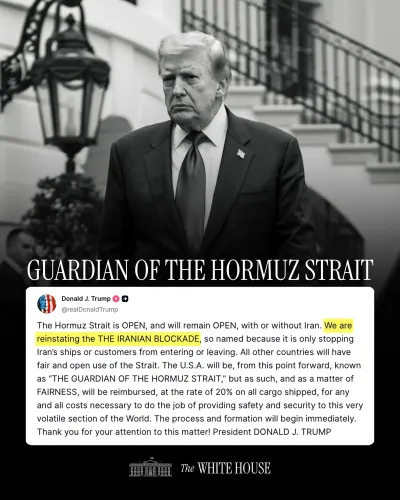
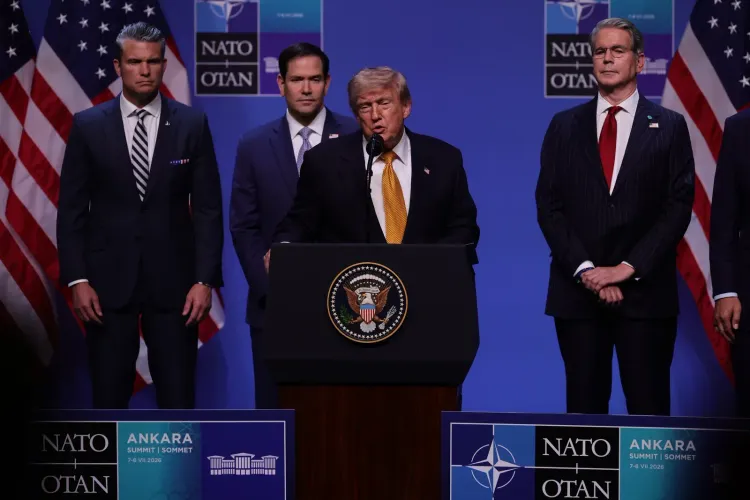
US President Donald Trump on Monday, 14 July declared that the United States would henceforth serve as the 'Guardian of the Hormuz Strait' — and that nations transiting the strategic waterway would be required to reimburse Washington at a rate of 20% on all cargo shipped as payment for American security provision. The announcement, made via Trump's Truth Social platform, also reinstated what he termed the 'Iranian blockade', barring Iran and its trading partners from using the passage while allowing all other nations free and open access.
What Trump Announced
In his Truth Social post, Trump wrote: 'The U.S.A. will be, from this point forward, known as ‘THE GUARDIAN OF THE HORMUZ STRAIT,’ but as such, and as a matter of FAIRNESS, will be reimbursed, at the rate of 20% on all cargo shipped, for any and all costs necessary to do the job of providing safety and security to this very volatile section of the World.'
He added that 'the process and formation will begin immediately,' signalling an intent to operationalise the arrangement without delay. Hours before the post, Trump had previewed the move in a Fox News interview, saying the US would 'become the guardian of the strait' and should be reimbursed because 'the other nations are very wealthy, they're on our side, and we can't be expected to do that for nothing.'
The Iranian Blockade Claim
Trump declared the Strait of Hormuz would remain open 'with or without Iran,' framing the blockade as targeted exclusively at Iranian vessels and their customers. 'All other countries will have fair and open use of the Strait,' he said. He also alleged that Iran had reneged on a recently negotiated agreement: 'We had a deal. It was a done deal, and then they broke it. They always break it. We've had 10 deals with these people, and so we're just going to hit them very hard.'
Trump further claimed Iran's military capacity had been severely degraded, asserting: 'They have no navy, they have no air force, it's all gone. Their anti-aircraft is gone. Their leaders have all been killed.' He credited recent US military action with preventing Tehran from acquiring a nuclear weapon.
Decades of Uncompensated Guarding, Trump Argues
Central to Trump's justification was the claim that the US had protected Hormuz shipping lanes for more than 50 years without financial compensation. 'We guarded the strait for 50 years, more, and we never got paid for it... now we're going to guard it, and we're going to get paid for guarding it, a lot of money,' he said. The argument mirrors his broader 'America First' framing — that US security commitments to allies and global trade routes must come with a financial return.
Key Questions Left Unanswered
Trump's announcement left critical implementation details unaddressed. It did not explain how the proposed 20% levy would be collected, whether it would apply uniformly to all commercial cargo transiting the Strait, or under what legal or international framework such a system would operate. The White House did not immediately release further details on enforcement or implementation mechanisms.
Notably, the Strait of Hormuz is one of the world's most consequential energy chokepoints — roughly 20% of global oil supply passes through it — making any shift in its governance arrangements a matter of acute concern for energy-importing nations, including India, Japan, South Korea, and European states. How those countries respond to the proposed levy, and whether Washington has the legal authority to impose it under international maritime law, remains to be seen.
Point of View
But the absence of any implementation framework suggests this may be negotiating theatre rather than an executable policy. The real risk is that allied nations — including India, Japan, and South Korea, all heavily dependent on Hormuz oil flows — are now forced to publicly respond to a demand that has no legal grounding, complicating their diplomatic posture with both Washington and Tehran simultaneously.
NationPress
12 Oct 2026
Frequently Asked Questions
What did Trump announce about the Strait of Hormuz?
On 14 July, Trump declared the US the 'Guardian of the Hormuz Strait' and said all countries using the waterway must reimburse Washington at a rate of 20% on all cargo shipped through it. He also reinstated what he called an 'Iranian blockade,' restricting access for Iran and its trading partners while keeping the Strait open to all other nations.
What is the Iranian blockade Trump reinstated?
Trump described the 'Iranian blockade' as a measure that stops only Iranian ships or Iranian customers from entering or leaving the Strait of Hormuz. All other countries retain free and open access to the waterway under his announcement.
How will the 20% Hormuz fee be collected?
Trump's announcement did not specify a collection mechanism, legal framework, or enforcement process for the proposed 20% levy on cargo. The White House released no additional implementation details following the Truth Social post.
Why does the Strait of Hormuz matter globally?
The Strait of Hormuz is one of the world's most critical energy chokepoints, with roughly 20% of global oil supply passing through it. Any disruption or new toll regime directly affects energy costs for major importers including India, Japan, South Korea, and European nations.
What did Trump say about Iran's military and recent negotiations?
Trump claimed Iran's navy, air force, and air defence systems had been destroyed by recent US military action, and that Iran's leaders had been killed. He also alleged Iran had broken a recently concluded deal, saying 'We've had 10 deals with these people' — and warned of a strong US response.