Trump Warns: Back Out Again, Face Hard Hits — No Nuclear Weapon

Synopsis
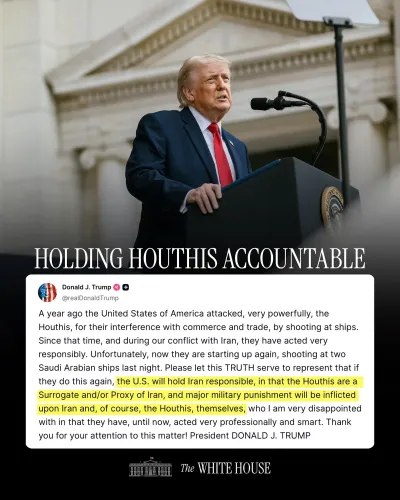
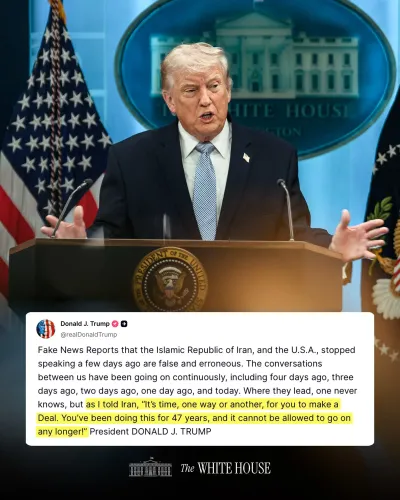
President Donald Trump, via The White House on August 5, 2026, issued a blunt public ultimatum: if the unnamed party backs out of nuclear talks again, it will face severe consequences — and acquiring a nuclear weapon is categorically off the table.
Key Takeaways
The White House posted a direct quote from President Donald J.
Trump on August 5, 2026 , issuing a nuclear ultimatum.
Trump warned that if the unnamed party 'backs out again,' they will be 'hit really hard.' The word 'again' confirms a prior breakdown in negotiations has already taken place.
Trump stated plainly that the unnamed party 'can't have a nuclear weapon — it's very simple.' The post included a video, suggesting the remarks were delivered verbally before being amplified officially.
No country was named, but the language mirrors US posture toward nations pursuing nuclear capability against Washington's objections.
A blunt ultimatum from the Oval Office — and this time, President Donald J. Trump is not mincing words. In a post shared by The White House on Wednesday, August 5, 2026, Trump issued a stark warning to an unnamed party: back out of negotiations again, and the consequences will be severe — and a nuclear weapon is simply off the table.
The statement, clipped and unambiguous, reads: 'If they back out again, they're going to get hit really hard… they can't have a nuclear weapon, it's very simple.' The phrasing — 'again' — signals that this is not a first warning. A prior breakdown in talks has already occurred, and Trump is drawing a hard line against any repeat.
The 'Again' That Changes Everything
That single word — again — carries enormous weight. It tells us a negotiating process was already underway, that it collapsed at least once, and that the United States is now operating in a second-chance framework with explicit consequences attached. Trump's language strips away diplomatic ambiguity entirely: no hedging, no 'we urge restraint', no 'we call upon.' The message is a direct threat of punitive action.
The reference to a nuclear weapon narrows the field of likely subjects considerably. The post does not name the country, but the combination of stalled nuclear talks and the threat of being 'hit really hard' places this squarely in the language Washington has historically reserved for adversaries pursuing nuclear capability — nations where the United States has long maintained that proliferation is a red line.
Trump's 'Hit Really Hard' — What That Means in Practice
In the Trump administration's diplomatic vocabulary, being 'hit really hard' has typically meant a combination of sweeping economic sanctions, diplomatic isolation, and, in extreme scenarios, the threat of military pressure. The formulation is deliberately broad — it preserves maximum flexibility for the White House while signalling zero tolerance for nuclear ambition.
The video attached to the post — not an image, but a clip — suggests this statement was delivered verbally, likely in remarks to reporters or in a formal address, adding the weight of spoken presidential authority to the written record.
Why the World Is Watching
For countries in South Asia and the broader Indo-Pacific — including India — any shift in US posture on nuclear proliferation carries immediate strategic consequence. Washington's willingness to issue hard public ultimatums, rather than pursue quiet back-channel diplomacy, signals an administration comfortable with pressure as a primary tool. The message is as much for observers as it is for the unnamed party: the US under Trump will not absorb repeated diplomatic failures quietly.
The unnamed adversary now faces a binary: return to the table and deliver, or absorb consequences the White House has publicly promised will be severe. Trump has made the cost of walking away explicit — and made it very, very public.
Point of View
Not just the adversary. The 'again' framing is politically significant; it positions the unnamed party as the repeat offender and the US as the patient but now-exhausted partner. For India and the broader region, the statement reinforces that the Trump White House views nuclear proliferation as a non-negotiable red line and is willing to threaten punitive action openly to enforce it. Whether this escalatory public posture accelerates or derails a return to negotiations will define the next chapter of this standoff.
NationPress
5 Aug 2026
Frequently Asked Questions
Who is Trump warning in his nuclear weapon statement?
Trump's statement does not name a specific country. The reference to backing out 'again' and the prohibition on nuclear weapons suggests an adversary involved in stalled nuclear negotiations with the United States, though no party is identified in the post.
What does Trump mean by 'hit really hard'?
In the Trump administration's diplomatic language, 'hit really hard' has typically referred to sweeping economic sanctions, diplomatic pressure, and potential military posturing — though the statement deliberately leaves the specific measures unspecified.
When did Trump make this nuclear warning?
The White House posted the statement on Wednesday, August 5, 2026 . The accompanying video suggests Trump delivered the remarks verbally before they were shared officially.
What does 'back out again' mean in Trump's nuclear statement?
The word 'again' confirms that the unnamed party has already walked away from negotiations at least once before. Trump is warning that a second breakdown will trigger severe consequences.
How does Trump's nuclear ultimatum affect India?
While India is not directly referenced, any shift in US nuclear policy posture has strategic implications for South Asia. Washington's hard public line against nuclear proliferation signals the kind of pressure framework that shapes regional security calculations for all players in the Indo-Pacific.