Trump outlines 3 options for Iran's enriched uranium disposal
Synopsis
Trump publicly outlined three options for disposing of Iran's enriched uranium — transfer to the US, destruction in place, or at a third location — while Tehran flatly denied agreeing to remove any nuclear materials. The public contradiction between Washington's demands and Iran's stated MoU text reveals a significant gap at the heart of ongoing negotiations, with a reported $12 billion asset-release deal on the table that explicitly excludes a nuclear agreement.
Key Takeaways
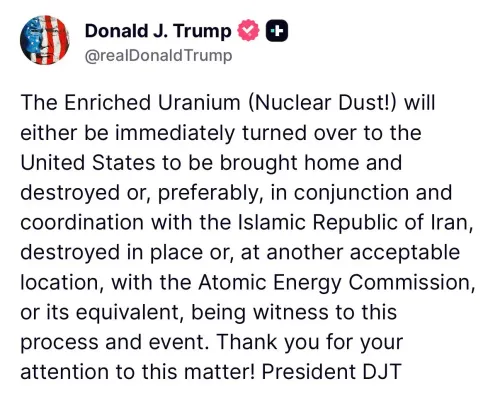
Donald Trump posted on Truth Social outlining three options for destroying Iran's enriched uranium stockpile.
Options include transfer to the United States , destruction in place in Iran , or disposal at another location, with the IAEA or equivalent as witness.
Iran's Tasnim news agency denied Tehran had agreed to remove enriched uranium abroad, saying the current MoU contains no such commitment.
The Washington Post reported a first-phase deal could release $12 billion in frozen Iranian assets and ease the Strait of Hormuz blockade — but without a nuclear agreement.
Trump did not specify the quantity of enriched uranium under discussion.
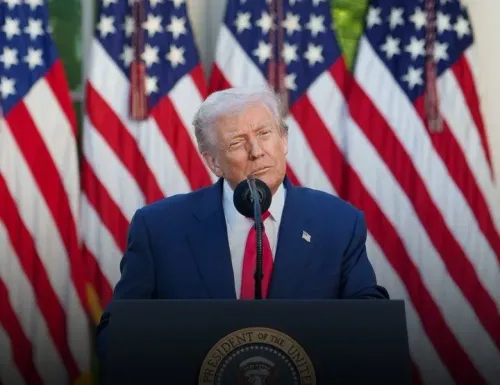
US President Donald Trump has stated that Iran's enriched uranium must be destroyed — either handed over to the United States, eliminated on-site in Iran, or disposed of at another mutually acceptable location. The declaration, posted on Truth Social, marks one of the clearest public articulations of Washington's nuclear demands on Tehran amid ongoing diplomatic negotiations.
What Trump Said
In his Truth Social post, Trump outlined three specific pathways for handling Iran's stockpile of enriched uranium. “The Enriched Uranium (Nuclear Dust!) will either be immediately turned over to the United States to be brought home and destroyed or, preferably, in conjunction and coordination with the Islamic Republic of Iran, destroyed in place or, at another acceptable location, with the Atomic Energy Commission, or its equivalent, being witness to this process and event,” he wrote.
Notably, Trump did not specify the quantity of enriched uranium under discussion. The International Atomic Energy Agency (IAEA) has previously overseen Iran's nuclear activities under various inspection frameworks.
Iran's Position on the Ground
Iran has pushed back sharply against reports suggesting it had agreed to transfer enriched uranium abroad. The semi-official Tasnim news agency on Monday rejected a claim by Saudi-based broadcaster Al Hadath that Tehran was prepared to remove its highly enriched uranium from its territory.
Tasnim cited what it described as the actual text of a potential memorandum of understanding (MoU) between the two governments. “In the text of the MoU that exists to this day, there is no statement declaring (Iran's) readiness to remove nuclear materials, and Iran has essentially made no commitment regarding nuclear actions in the memorandum,” Tasnim reported, according to the agency.
Broader Deal Framework
Separately, The Washington Post, citing an unnamed Iranian official, reported that the first phase of a possible US-Iran deal would involve Washington releasing $12 billion in frozen Iranian assets, the start of minesweeping operations in the Strait of Hormuz, and the lifting of a US blockade. However, the Iranian official was quoted as saying the deal does not include a nuclear agreement at this stage.
This comes amid a broader pattern of stop-start diplomacy between Washington and Tehran that has stretched across multiple administrations, with nuclear enrichment levels and stockpile disposal remaining the central sticking points.
What This Means for Negotiations
The public gap between Trump's stated demands and Tehran's publicly disclosed MoU text underscores the fragility of any emerging framework. Iran's insistence that no nuclear commitments have been made in the current MoU directly contradicts the impression Trump's post sought to project. Analysts have noted that public posturing on both sides can complicate back-channel diplomacy, particularly on issues as sensitive as uranium disposal.
With the IAEA positioned as a potential witness to any destruction process, the coming weeks will test whether the two sides can bridge the gap between their public statements and any private understandings.
Point of View
While Washington's posture implies the opposite. If the $12 billion asset-release phase proceeds without locking in nuclear terms, the US risks handing Iran economic relief with nothing verifiable on enrichment. The IAEA-as-witness proposal is procedurally sound, but it is meaningless without a prior agreement on what exactly is being destroyed and when.
NationPress
10 Oct 2026
Frequently Asked Questions
What did Trump say about Iran's enriched uranium?
Trump stated on Truth Social that Iran's enriched uranium must be destroyed through one of three methods: transferred to the United States, destroyed on-site in Iran, or eliminated at another mutually acceptable location, with the IAEA or an equivalent body present as witness.
Has Iran agreed to hand over its enriched uranium?
No. Iran's semi-official Tasnim news agency denied that Tehran had agreed to remove enriched uranium from its territory. It stated that the current MoU text contains no commitment by Iran regarding nuclear materials or actions.
What is the reported first-phase US-Iran deal?
According to The Washington Post, citing an Iranian official, the first phase of a possible deal involves the US releasing $12 billion in frozen Iranian assets, minesweeping in the Strait of Hormuz, and lifting a US blockade. The Iranian official said this phase does not include a nuclear agreement.
What role would the IAEA play?
Trump proposed that the International Atomic Energy Agency, or an equivalent body, serve as a witness to the destruction of Iran's enriched uranium, regardless of which disposal location is chosen. The IAEA has previously monitored Iran's nuclear activities under various inspection arrangements.
Why is the enriched uranium disposal question significant?
Iran's enriched uranium stockpile is the central issue in nuclear negotiations, as high levels of enrichment bring Tehran closer to weapons-grade material. Any deal that does not address disposal or verified reduction of the stockpile would leave the core proliferation concern unresolved.