Iran nuclear talks: Trump pressure strategy, says Treasury Secretary Bessent
Synopsis
The Trump administration is claiming a diplomatic milestone: getting Iran to discuss — and potentially commit to abandoning — its nuclear programme, something Washington says no previous administration achieved. But the price is steep: enriched uranium surrender, no nuclear weapons, and an open Strait of Hormuz. And the warning is explicit — if talks fail, military action returns.
Key Takeaways
Treasury Secretary Scott Bessent on 29 May said US pressure has brought Iran to nuclear talks for the first time.
Washington's demands include Iran surrendering highly enriched uranium , abandoning nuclear weapons pursuit, and keeping the Strait of Hormuz open.
Bessent described Iran's leadership as internally divided across three pillars: the elected government, the IRGC , and the clerics.
The administration declined to confirm reports of a tentative agreement, saying negotiations are ongoing.
Bessent warned that military action — 'kinetic' — remains on the table if diplomacy fails.
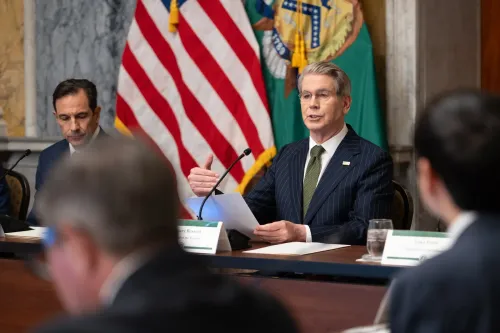
Treasury Secretary Scott Bessent on 29 May claimed that the Trump administration's sustained campaign of military and economic pressure has succeeded in bringing Iran to the negotiating table over its nuclear programme — achieving, he argued, what no previous US administration had managed. Speaking at a White House news conference in Washington, Bessent described the development as a significant shift in Tehran's position.
What Bessent Said
'President Trump has done something that no other administration is able to do,' Bessent told reporters. 'We have gotten the Iranians to talk about their nuclear program and to perhaps commit to not having one. That has never happened before. It had been off the table.'
The Treasury Secretary attributed the breakthrough to a combination of what he called 'kinetic action' — a reference to military operations — and sweeping economic sanctions. 'I think when you look at the results of the kinetic action, of our economic pressure, it has worked to bring them to the table and have a discussion on this,' he said.
US Demands on the Table
Bessent was unambiguous about Washington's conditions for any eventual deal. He said sanctions relief would remain contingent on Iran surrendering its highly enriched uranium, abandoning any pursuit of a nuclear weapon, and restoring free navigation through the Strait of Hormuz. 'Nothing is going to be on the table until we see the Strait of Hormuz open and the Iranians agree that they have to turn over the highly enriched uranium and that they can't have a nuclear program,' he said.
The administration declined to confirm reports of a tentative agreement, with officials signalling cautious optimism while stressing that negotiations remain ongoing.
Iran's Internal Divisions, as Washington Sees It
Bessent also suggested that Iran's leadership is internally fragmented and struggling to present a unified response. 'The Iranian government, such as it is, is three pillars. It is the elected government, it is the IRGC, and it is the clerics, and they are having trouble communicating,' he said. This framing positions Tehran as negotiating from a position of weakness — a characterisation Iran has historically rejected.
Notably, this comes amid a broader pattern of the Trump administration framing its coercive tools — sanctions and military posture — as diplomatic enablers rather than obstacles to a deal.
The Warning: Patience Has Limits
While stressing that President Donald Trump preferred a diplomatic resolution, Bessent issued a pointed warning. 'President Trump always prefers a peace deal. We do not have unlimited patience. If President Trump doesn't think he can get a peace deal, then kinetic is back,' he said.
The remarks reflect Washington's stated strategy of maintaining maximum pressure as leverage while keeping a diplomatic channel open — a posture that critics argue risks miscalculation if either side misreads the other's red lines. How Tehran responds publicly to Bessent's characterisation of its internal divisions is likely to shape the next phase of contacts.
Point of View
Washington is applying reputational pressure on Tehran to concede before the narrative hardens. But the claim that 'no previous administration' achieved this glosses over the 2015 JCPOA, which did secure binding nuclear limits — limits the Trump administration itself abandoned in 2018. The real question is not whether Iran is talking, but whether any agreement can survive the same domestic political volatility that killed its predecessor. Bessent's 'kinetic is back' line is also a double-edged signal — useful as leverage, dangerous if Tehran reads it as an ultimatum rather than a negotiating posture.
NationPress
12 Oct 2026
Frequently Asked Questions
What did Treasury Secretary Scott Bessent say about Iran nuclear talks?
Bessent said the Trump administration's military and economic pressure has succeeded in bringing Iran to the negotiating table on its nuclear programme — something he claimed no previous US administration had achieved. He made the remarks at a White House news conference on 29 May.
What are the US conditions for a nuclear deal with Iran?
Washington has set three core conditions: Iran must surrender its highly enriched uranium, abandon any pursuit of a nuclear weapon, and restore free navigation through the Strait of Hormuz. Bessent said no sanctions relief would be offered until these demands are met.
Has a tentative Iran nuclear agreement been reached?
The Trump administration has declined to confirm reports of a tentative agreement. Officials have signalled cautious optimism but say negotiations are still ongoing and no deal has been finalised.
Why does Bessent say Iran is in a weak negotiating position?
Bessent argued that Iran's government is divided among three pillars — the elected government, the IRGC, and the clerics — and that they are 'having trouble communicating.' He also pointed to the impact of US military actions and sanctions as having significantly weakened Tehran's position.
What happens if Iran nuclear talks fail, according to the US?
Bessent warned that if President Trump concludes a peace deal is not achievable, military action — which he referred to as 'kinetic' — would return as an option. He stressed the administration does 'not have unlimited patience.'