US envoy warns Spain on Chinese role in telecom, defence sectors
Synopsis
Washington's envoy to Madrid has gone public with a pointed warning: let China into Spain's critical infrastructure and the US-Spain intelligence relationship is at risk. Coming just months after Spain blocked US military operations from its bases and refused NATO's 5% defence-spending target, Leon's remarks expose a transatlantic alliance under real stress — with Beijing watching closely.
Key Takeaways
US Ambassador Benjamin Leon warned Spain to keep China out of telecommunications , data management , and defence sectors during his first public appearances since taking office in February 2025 .
Leon specifically flagged contracts involving Huawei technology as a threat to the security threshold required for US-Spain intelligence sharing.
Spain has refused to back a NATO commitment to raise defence spending to 5% of GDP , straining ties with Washington .
In March 2025 , Spain denied the US use of its bases for Iran-linked operations, prompting the Pentagon to withdraw 12 KC-135 tanker aircraft from Moron de la Frontera and Rota .
Defence Minister Margarita Robles maintained that the US-Spain basing agreement cannot be used for unilateral actions outside UN , NATO , or EU authorisation.
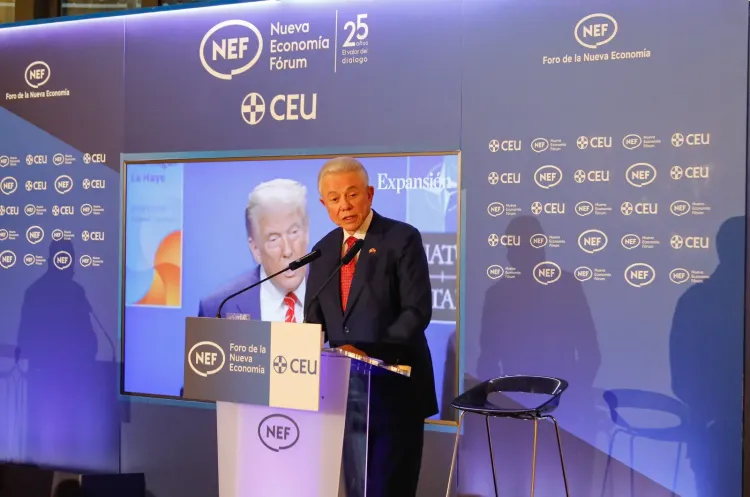
US Ambassador to Spain Benjamin Leon has called on Madrid to exercise extreme caution over China's growing footprint in sensitive sectors including telecommunications, data management, and defence, warning that unchecked access could compromise national security and bilateral intelligence-sharing with Washington. The remarks, made during Leon's first public appearances since taking office in February 2025, signal deepening American anxiety over Chinese strategic penetration in a key NATO ally.
Key Concerns Raised by the US Ambassador
Leon specifically flagged the risks of awarding public contracts to firms using technology from Huawei, the Chinese telecommunications giant that the United States has long designated a security threat. He argued that Spain's use of Huawei-linked infrastructure could fall below the security threshold required for the two allies to safely exchange sensitive information.
'I don't think that attains the level of security at which Spain and the United States are exchanging information,' Leon was quoted as saying. He also warned that China is actively seeking to dominate critical technologies globally, and that its unfair trade practices and economic coercion create systemic risks for supply chains, scientific research, and national security.
Where Leon Drew the Line
Notably, the ambassador stopped short of demanding a full economic decoupling. Leon acknowledged that Spain could maintain commercial ties with China, but stressed that robust safeguards were non-negotiable in sectors deemed critical to national security. 'If Spain ensures that China is kept out of critical areas, why not negotiate,' he stated, before adding, 'But I see that they are starting to penetrate into critical areas and Spain must be really careful about this.'
A Strained Bilateral Backdrop
Leon's warning arrives against a backdrop of notable friction between Madrid and Washington. Spain has declined to endorse a NATO commitment to raise defence spending to 5 per cent of GDP, a stance that has drawn criticism from US officials. The tension escalated further in March 2025, when Spain refused to allow the US to use its military bases and airspace for operations linked to the conflict with Iran.
That refusal prompted the Pentagon to withdraw a dozen KC-135 tanker aircraft from bases at Moron de la Frontera in Seville and Rota in Cadiz. Spanish Defence Minister Margarita Robles defended the decision, stating that the cooperation agreement with Washington must operate within international law and cannot be invoked for unilateral actions lacking the backing of a multilateral body such as the United Nations, NATO, or the European Union (EU).
'The bases will not provide support unless it is necessary from a humanitarian point of view. Until there is a resolution, the treaty does not apply,' Robles stated.
Broader Implications for Europe
Spain is not alone in navigating this tension. Several European governments have faced similar US pressure to limit Huawei's role in 5G infrastructure, with Germany, France, and the United Kingdom having already moved to restrict or phase out the firm's equipment. Spain's position is complicated by its economic ties with Beijing and its domestic political calculus, making it one of the more contested battlegrounds in the West's broader technology-security debate.
With NATO's next summit approaching and US-Europe relations under strain over defence burden-sharing, Leon's public remarks are likely to intensify pressure on the Spanish government to clarify its posture on Chinese technology in critical infrastructure.
Point of View
Not quiet diplomacy — and the timing is deliberate. With Spain resisting NATO's spending targets and having already blocked US military operations from its soil, Washington is signalling that the cost of strategic drift includes scrutiny of Madrid's technology choices. The Huawei question is a proxy for a larger argument: how far can a NATO ally lean toward Beijing before it affects the alliance's intelligence architecture? Spain's domestic politics make a sharp pivot unlikely, but the US has now made the stakes explicit and on the record.
NationPress
11 Oct 2026
Frequently Asked Questions
What did US Ambassador Benjamin Leon warn Spain about?
Leon urged Spain to be extremely cautious about allowing China into critical sectors such as telecommunications, data management, and defence, warning that infrastructure linked to Huawei could fall below the security standard required for US-Spain intelligence sharing. He made the remarks during his first public appearances since assuming office in February 2025.
Why is the US concerned about Huawei in Spain?
The United States considers Huawei a national security risk and has long pushed allies to exclude its technology from critical infrastructure, particularly 5G networks. Leon argued that Spanish public contracts involving Huawei-linked technology could compromise the confidentiality of information exchanged between Washington and Madrid.
What is the current state of US-Spain relations?
Relations are under strain on multiple fronts. Spain has declined to support NATO's 5% GDP defence-spending target and, in March 2025, refused to allow the US to use its military bases for operations linked to the Iran conflict, prompting the Pentagon to withdraw 12 KC-135 tanker aircraft from Spanish bases.
Did Leon say Spain must cut all ties with China?
No. Leon explicitly said Spain could maintain economic relations with China, but stressed that safeguards preventing Chinese access to critical national security sectors were essential. His position was conditional: engagement is acceptable only if sensitive sectors are effectively ring-fenced.
How does Spain's situation compare with other European countries on Huawei?
Several European nations including Germany, France, and the United Kingdom have already moved to restrict or phase out Huawei equipment from their 5G networks under similar US pressure. Spain has yet to adopt a comparably firm position, making it an outlier among major Western European NATO members.