White House Backs Rogers: Democrats Failed Michigan Workers
Synopsis
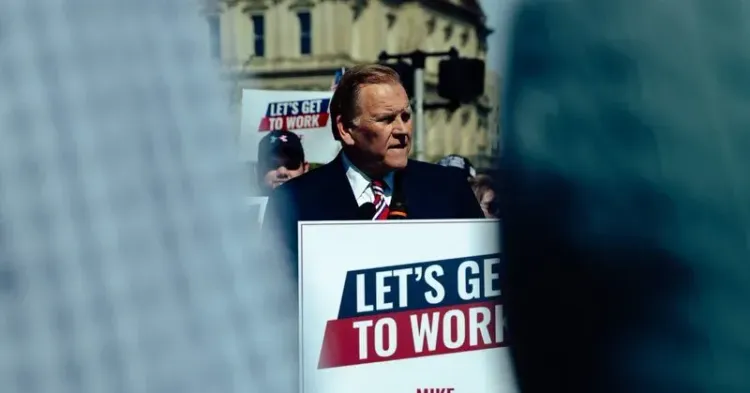
The White House amplified a statement by former Michigan Representative Mike Rogers on 8 July 2026, accusing Democrats of turning their backs on working families, intensifying Republican economic messaging in a key Rust Belt battleground ahead of the 2026 midterms.
Key Takeaways
The White House reposted a statement from Mike Rogers on 8 July 2026 , giving his critique a national platform.
Rogers accused Democrats of abandoning working families, warning that ' Michiganders won't forget.' Michigan is a major Midwestern battleground with a large automotive and manufacturing workforce central to both parties' electoral strategies.
The messaging builds on Republican criticism of Democratic trade and spending policies that emerged prominently in the 2024 Michigan Senate race .
The move signals coordinated GOP efforts to consolidate working-class support in Rust Belt states ahead of the 2026 midterm elections .
The White House, the official communications account of the Executive Office of the President of the United States, on Wednesday, 8 July 2026, reposted a statement from former Republican Representative Mike Rogers accusing Democrats of abandoning working families in Michigan.
Context
The reposted message from Mike Rogers, a former Republican U.S. Representative for Michigan's 8th congressional district, declared that 'Democrats turned their backs on working families — and Michiganders won't forget.' By amplifying the statement, the White House lent its official platform to a pointed electoral critique aimed at Democratic candidates in the state.
Michigan is a perennial Midwestern battleground, home to a large manufacturing and automotive workforce whose economic anxieties have long shaped national political messaging. Concerns over trade policy, industrial employment, and energy costs have made the state a focal point for both parties heading into the 2026 midterm elections.
Policy Backdrop
The message builds on a line of Republican criticism that gained momentum during the 2024 Michigan Senate race, when GOP candidates repeatedly attacked Democratic-backed spending and trade measures for their perceived negative effects on industrial employment. That cycle established a template of 'Rust Belt betrayal' messaging that Republican campaigns have continued to deploy.
Rogers himself built his congressional career around intelligence and homeland security issues, but his public profile in Michigan has increasingly been tied to economic concerns resonant with manufacturing communities. The White House's decision to amplify his voice signals a coordinated effort to keep that narrative prominent ahead of the midterms.
Stakeholders and Impact
Working families and Michigan voters are the primary audiences invoked in the message. For households in the state's automotive and manufacturing belt, economic policy — particularly on trade and energy — has direct implications for wages and job security.
Michigan Democratic campaigns are expected to face pressure to respond to the framing, particularly on their records regarding industrial policy and labor protections. The White House's amplification raises the stakes by giving the critique a national platform rather than keeping it confined to a state-level exchange.
What's Next
Political observers will be watching for coordinated responses from Michigan Democratic campaigns as the 2026 midterm cycle intensifies. Candidate positioning on economic policy — especially manufacturing, trade, and energy — is likely to become a defining fault line in the state's competitive races.
The broader pattern of Rust Belt messaging suggests that Michigan will remain a central arena for both parties to contest the loyalties of working-class voters, with each side framing its economic record as the more credible alternative for families feeling financial pressure.
Point of View
With working-class economic anxiety as the central mobilising theme. The move puts Michigan Democrats on the defensive, forcing them to rebut a narrative now stamped with presidential-level visibility. More broadly, it reflects a long-running Republican strategy of tying Democratic governance to industrial decline in states where manufacturing identity remains electorally decisive.
NationPress
8 Jul 2026
Frequently Asked Questions
Why did the White House repost Mike Rogers' statement about Michigan?
The White House reposted the statement to amplify Republican messaging that Democrats have failed Michigan's working families, lending the executive platform's visibility to the critique ahead of the 2026 midterm elections.
Who is Mike Rogers and why does he matter in Michigan politics?
Mike Rogers is a former Republican U.S. Representative for Michigan's 8th congressional district, known for his work on intelligence and homeland security. He has become a prominent voice on economic issues affecting Michigan's manufacturing communities.
What are the 2026 midterm elections and why is Michigan important?
The 2026 midterm elections are the U.S. congressional elections scheduled for November 2026. Michigan is a key battleground state with a large automotive and manufacturing workforce, making it a critical arena for both parties' economic messaging.
What does 'Democrats turned their backs on working families' mean in this context?
The phrase reflects a recurring Republican argument that Democratic trade, energy, and spending policies have harmed industrial and manufacturing workers in Rust Belt states like Michigan, costing jobs and suppressing wages.
How have Michigan Democrats responded to this criticism?
As of the date of the post, no specific coordinated response from Michigan Democratic campaigns had been publicly reported. Political observers expect the party to rebut the framing by highlighting its own record on labor and industrial policy.