White House Claims $230B Fraud Identified, $56B Halted
Synopsis
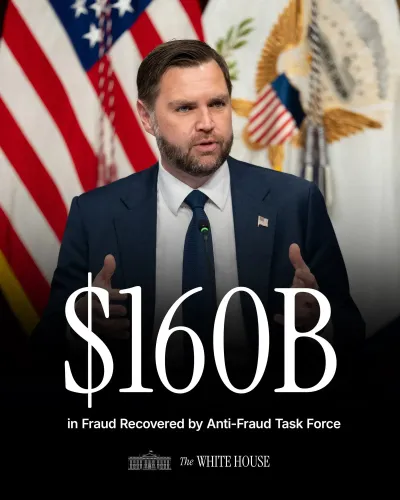
The White House announced its presidentially directed Fraud Task Force has identified $230 billion in fraud against American taxpayers and halted $56 billion in disbursements, with congressional oversight and independent audits expected to test the figures.
Key Takeaways
The White House announced on July 31, 2026 that its Fraud Task Force has identified $230 billion in fraud against American taxpayers.
Of that total, $56 billion has already been halted — meaning payments were stopped before leaving the Treasury.
The Task Force operates under direct presidential leadership and direction, according to the official quoted.
The figures have not yet been verified by an independent inspector general or audited report.
Congressional oversight hearings are expected to probe the methodology behind the claimed numbers.
A sweeping anti-fraud push inside the U.S. federal government has surfaced a staggering number: $230 billion in fraud identified against American taxpayers — and $56 billion of that already stopped cold. The White House shared the claim on Friday, July 31, 2026, quoting an official speaking under the banner of a presidentially directed Fraud Task Force.
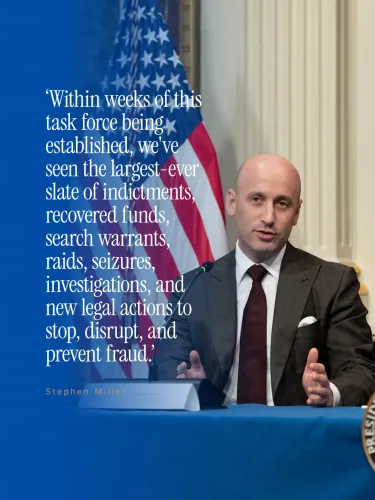
The statement, attributed to a senior official, credited the effort directly to presidential leadership: 'Just since the beginning of the Fraud Task Force that I started under the President's leadership and direction, we have identified $230 billion of fraud that's being perpetrated against the American people, and we have halted, already, $56 billion of that.'
What the Fraud Task Force is targeting
U.S. administrations have long grappled with improper payments and fraudulent disbursements across federal programs — from entitlement schemes and pandemic relief to defence procurement. Inspector general offices and special task forces have periodically surfaced losses in the tens or hundreds of billions, making the scale cited here consistent with the broader pattern of federal fraud exposure, even if the specific figures are new.
The claim of $56 billion already halted is the sharper number — it implies active interdiction, not just accounting. Stopping a disbursement before it leaves the Treasury is categorically different from recovering funds already paid out, a distinction that will matter when Congress and oversight bodies begin scrutinising the methodology.
The accountability question Congress will ask
Figures of this magnitude — announced via social media rather than an audited inspector general report — are almost certain to draw congressional oversight hearings. Lawmakers on both sides will want to know how 'identified fraud' is defined, what share has been formally adjudicated, and whether the $56 billion halted represents confirmed fraud or flagged payments pending review. The credibility of the headline number will hinge on those answers.
For American taxpayers, the promise is direct: money that would have been stolen is being kept in the public purse. Whether the Task Force's numbers hold up under independent audit is the next test — and the one that will determine whether this becomes a lasting governance legacy or a disputed talking point.
Point of View
And the White House is clearly framing it as a signature governance achievement. The gap between 'identified' and 'halted' — $174 billion — is the political vulnerability: it signals much of the fraud is still flowing or unrecovered. Historically, such task-force announcements have served dual purposes: genuine enforcement signalling and political messaging ahead of budget or appropriations battles. Independent audits will determine which this is.
NationPress
1 Aug 2026
Frequently Asked Questions
What is the White House Fraud Task Force?
It is a presidentially directed initiative aimed at identifying and stopping fraud perpetrated against the American people across federal programs. The White House announced it has identified $230 billion in fraud since the Task Force began.
How much fraud has the US government halted so far?
According to the White House, $56 billion in fraudulent payments has already been halted, meaning those disbursements were stopped before reaching bad actors.
Has the $230 billion fraud figure been independently verified?
Not yet. The figures were announced by the White House and have not been confirmed by an independent inspector general report or congressional audit as of the announcement date.
What kinds of fraud does the US federal government typically target?
Federal fraud task forces have historically targeted improper payments in entitlement programs, pandemic relief disbursements, and defence procurement — areas where losses can run into the hundreds of billions over multi-year periods.
What happens next after the White House fraud announcement?
Congressional oversight committees are expected to hold hearings demanding audited figures, a breakdown of how 'identified fraud' is defined, and confirmation of whether halted payments were formally adjudicated as fraudulent.