57th GST Council: Auto-refunds, lower penalties, e-commerce rules for small sellers
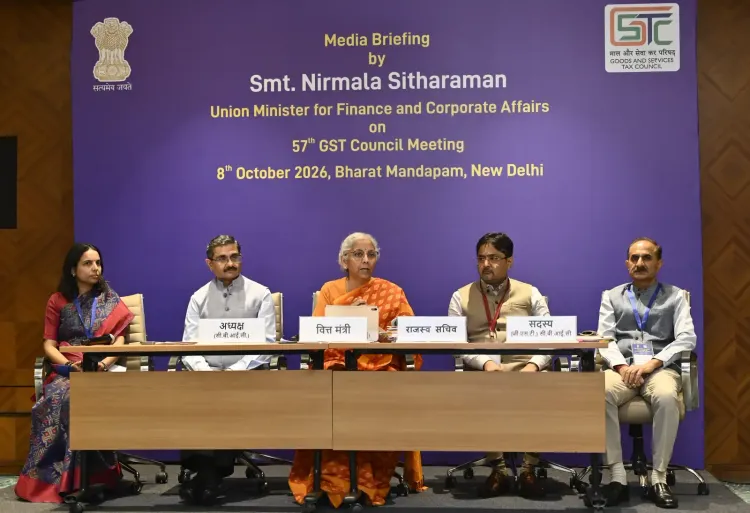
Synopsis
The 57th GST Council's GST 2.0 recommendations go well beyond incremental tweaks — automatic refunds, halved acknowledgement windows, near-zero penalties for small defaults, and a simplified e-commerce registration path collectively amount to the most taxpayer-friendly overhaul since GST's 2017 launch. With ₹12.46 lakh crore collected in just six months, the Centre now has the fiscal headroom to ease compliance without sacrificing revenue.
Key Takeaways
The 57th GST Council released GST 2.0 reform recommendations on 10 October 2026 , covering registration, refunds, ITC, and dispute resolution.
Gross GST collections hit ₹12.46 lakh crore in April–September 2026 , up 11.6% year-on-year; registered taxpayers grew from 60 lakh (2017) to 1.70 crore .
Excess cash ledger refunds will be processed automatically ; acknowledgement window cut from 15 to 10 days ; 90% of zero-rated/inverted duty refunds expected to be sanctioned via risk-based processing.
No show-cause notice where tax involved is below ₹10,000 ; minimum penalty removed in non-fraud cases; maximum general penalty reduced from ₹25,000 to ₹10,000 .
Simplified registration introduced for small taxpayers on e-commerce platforms ; registration amendments to be accepted automatically, including for PPoB on the automatic route.
Pre-deposit cap of ₹40 crore set for penalty-only appeals before the Appellate Authority or Appellate Tribunal.
The 57th GST Council meeting has recommended sweeping reforms across registration, returns, refunds, input tax credit (ITC), and dispute resolution, with the government releasing a detailed factsheet on Saturday, 10 October 2026. The measures, collectively branded GST 2.0, are designed to ease compliance burdens, accelerate refunds, and expand opportunities for small sellers and service exporters.
Scale of GST: Where India Stands Today
The reforms come against a backdrop of significant system growth. Registered taxpayers have surged from approximately 60 lakh in 2017 to 1.70 crore as of September 2026. The GST system has cumulatively processed 3,053 crore invoice uploads and 833.82 crore e-way bills. Gross GST collections reached ₹12.46 lakh crore during April–September 2026, a year-on-year increase of 11.6 per cent — signalling the tax base's continued expansion.
Registration and Cancellation: Faster, More Automatic
The Council has recommended near real-time processing of registration changes. Amendments to registration particulars will now be accepted automatically on the GST portal, except for changes to the Principal Place of Business (PPoB). For taxpayers registered through the automatic route, even PPoB changes will be processed automatically.
Cancellation applications will also be handled automatically once pending returns are filed and dues are cleared. This facility applies to taxpayers who have not passed on ITC exceeding ₹2.5 lakh in any single month, and to those who have, provided the final return is filed within the specified timeframe.
Notably, a simplified registration mechanism has been introduced specifically for small taxpayers supplying through e-commerce platforms — a long-pending demand from the gig and digital commerce ecosystem.
Refunds and ITC: Faster Funds for Businesses
Excess cash ledger balances will now be refunded automatically, allowing businesses faster access to idle funds. The acknowledgement period for refund claims has been reduced from 15 days to 10 days, with deemed acknowledgement applying where no response is issued within that window.
For refund claims arising from zero-rated supplies and inverted duty structure, 90 per cent of the claimed amount is expected to be sanctioned based on risk assessment — a significant shift toward trust-based processing.
Dispute Resolution: Lower Thresholds, Reduced Penalties
The Council has recommended that no show-cause notice be issued where the tax amount involved is less than ₹10,000. Pending notices and appeals involving amounts below this threshold will be decided as if the limit had been in place when the notice was originally issued.
On penalties, the recommendations introduce a graduated and more lenient framework. A reduced penalty of 5 per cent will apply where tax and interest are discharged within 30 days (under Section 73) or 60 days (under Section 74A) of the adjudication order. In non-fraud cases, the minimum penalty of ₹10,000 is proposed to be removed entirely, while the maximum general penalty would be cut from ₹25,000 to ₹10,000.
Where a taxpayer voluntarily pays the full tax amount with interest and penalty within the specified time, the penalty will be reclassified as a 'Charge' — a terminology shift with implications for business credit assessments. For appeals where the order involves only a penalty and no tax demand, an upper pre-deposit limit of ₹40 crore has been set for filings before the Appellate Authority or Appellate Tribunal.
What These Reforms Mean Going Forward
According to the government factsheet, these recommendations build on GST's track record and represent a further step in its structural refinement. This comes amid broader calls from industry bodies for reducing compliance friction, particularly for micro and small enterprises navigating multiple return filings and ITC reconciliation requirements.
With GST collections on a strong trajectory and the taxpayer base nearly tripling since the tax's 2017 rollout, the GST 2.0 reforms signal a pivot from enforcement-first to compliance-facilitation — a direction that trade bodies and tax professionals have long advocated. Implementation timelines for individual recommendations are expected to be detailed in subsequent circulars from the Central Board of Indirect Taxes and Customs (CBIC).
Point of View
000 minimum penalty in non-fraud cases and raising the show-cause threshold to the same figure are tacit admissions that the original design over-penalised honest error. The risk-assessment-based 90% refund sanction is a meaningful trust signal, but its credibility will depend entirely on how narrowly 'risk' is defined in practice — a detail the factsheet does not address. Meanwhile, the e-commerce registration simplification, though welcome, arrives years after platforms and small sellers have been pressing for it; the question is whether implementation will match the intent or introduce new layers of portal-level friction.
NationPress
10 Oct 2026
Frequently Asked Questions
What are the key outcomes of the 57th GST Council meeting?
The 57th GST Council recommended automatic processing of registration amendments and cancellations, automatic refunds of excess cash ledger balances, a reduced 10-day acknowledgement window for refunds, lower penalties in non-fraud cases, and simplified GST registration for small e-commerce sellers. These measures collectively form the GST 2.0 reform package announced on 10 October 2026.
How will GST refunds become faster under the new recommendations?
Excess cash ledger balances will be refunded automatically without requiring a manual application. The acknowledgement period for refund claims has been cut from 15 to 10 days, with deemed acknowledgement where no response is issued. For zero-rated supplies and inverted duty structure claims, 90% of the claimed amount is expected to be sanctioned based on risk assessment.
What changes have been made to GST penalties?
The minimum penalty of ₹10,000 is proposed to be removed in non-fraud cases, and the maximum general penalty has been reduced from ₹25,000 to ₹10,000. A reduced penalty of 5% applies if tax and interest are paid within 30 days (Section 73) or 60 days (Section 74A) of the adjudication order. No show-cause notice will be issued where the tax amount is below ₹10,000.
Who benefits from the simplified e-commerce registration under GST?
Small taxpayers supplying goods or services through e-commerce platforms will benefit from a simplified registration mechanism recommended by the 57th GST Council. This addresses a longstanding compliance barrier for micro-sellers and digital commerce participants who found the standard registration process burdensome.
How large has GST collections grown since the tax's rollout?
Gross GST collections reached ₹12.46 lakh crore during April–September 2026, up 11.6% year-on-year. Registered taxpayers have grown from approximately 60 lakh in 2017 to 1.70 crore as of September 2026, while the system has processed 3,053 crore invoice uploads and 833.82 crore e-way bills cumulatively.