Assam CM Office: 46 Lakh Screened as Cancer Network Grows

Synopsis
The Chief Minister's Office of Assam declared on 15 July 2026 that the state is building a network of specialised cancer centres and has screened over 46 lakh people, marking a significant push to decentralise oncology care across the northeast.
Key Takeaways
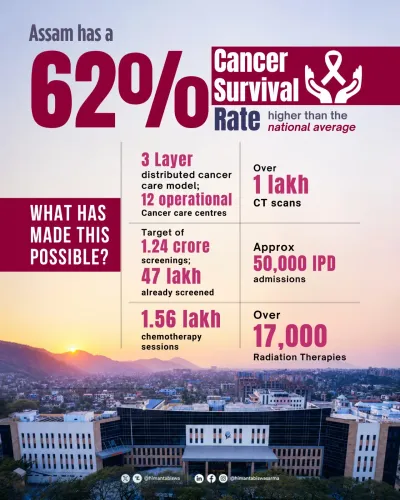
The Chief Minister's Office of Assam announced on 15 July 2026 that over 46 lakh people have been screened for cancer under the state's outreach programme.
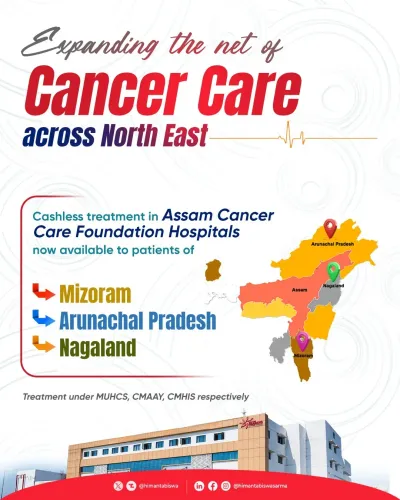
Assam is building a network of specialised cancer care centres to reduce dependence on the single tertiary hub at Dr.
Borooah Cancer Institute, Guwahati .
The expansion aligns with the central NPCDCS (launched 2010 ) and Ayushman Bharat PMJAY (launched 2018 ), which together fund screening and cashless cancer treatment.
Tobacco-related cancers — oral, oesophageal, and cervical — are disproportionately prevalent in Assam , making early detection infrastructure especially critical.
Chief Minister Himanta Biswa Sarma has prioritised oncology infrastructure as a key governance focus since taking office in 2021 .
Future steps include potential tie-ups with AIIMS campuses in the northeast and dedicated state health budget allocations for cancer infrastructure.
The Chief Minister's Office of Assam announced on Wednesday, 15 July 2026 that the state is expanding a network of specialised cancer care centres, with more than 46 lakh people already screened under its oncology outreach programme.
Context
The post, shared from the official CMO Assam account, states: 'Assam is strengthening cancer care with a growing network of specialised centres while over 46 lakh people have already been screened.' The announcement signals a deliberate push to decentralise oncology services across a state where tobacco-related cancers — oral, oesophageal, and cervical — carry a disproportionately high burden among the population.
Assam has historically relied on a handful of tertiary facilities, most notably the Dr. B. Borooah Cancer Institute in Guwahati, established in 1974, which serves as the premier regional oncology referral hub for northeastern India. Expanding beyond that single node has long been a policy priority for successive state governments.
Policy Backdrop
The state's cancer care drive aligns with two major central frameworks. The National Programme for Prevention and Control of Cancer, Diabetes, Cardiovascular Diseases and Stroke (NPCDCS), launched in 2010, mandates that states build screening and early-detection capacity at the district level. Assam's growing network of specialised centres is a direct expression of that mandate.
Separately, the Ayushman Bharat Pradhan Mantri Jan Arogya Yojana, rolled out in 2018, provides cashless coverage for cancer treatment at empanelled hospitals, reducing the financial barrier for patients who are referred from district-level screening to higher-care facilities. Together, these schemes create an end-to-end pathway — from community screening to insured treatment — that Assam is working to operationalise across its geography.
Chief Minister Himanta Biswa Sarma, who has helmed the state since 2021, has positioned health infrastructure — particularly oncology — as a signature governance priority, with repeated references to early detection as the most cost-effective intervention in high-burden settings.
Stakeholders and Impact
The most direct beneficiaries are cancer patients and rural populations in Assam's districts who previously had to travel to Guwahati or outside the state for diagnosis and treatment, incurring significant costs and delays. A distributed network of specialised centres can compress the time between symptom onset and diagnosis — a critical variable in cancer survival outcomes.
The screening figure of over 46 lakh is significant in scale: it represents a substantial share of Assam's population of roughly 3.5 crore, and suggests the programme has moved well beyond pilot-stage coverage. Early detection at this volume, if followed by timely referral and treatment, can meaningfully shift the state's cancer mortality curve over the medium term.
What's Next
Analysts and health administrators will watch whether Assam follows this announcement with specific budget allocations for additional cancer care infrastructure in the next state health budget cycle. Potential memoranda of understanding with national institutions — including AIIMS campuses being developed in the northeast — could further anchor the state's oncology network to national research and training pipelines.
The broader pattern across India suggests that states which combine community-level screening with insured tertiary care tend to see improved treatment uptake. Assam's trajectory will be a closely watched model for other high-burden northeastern states navigating similar infrastructure constraints.
Point of View
Where late-stage diagnosis has historically driven poor survival rates. For Chief Minister Himanta Biswa Sarma, health infrastructure doubles as a governance dividend: tangible, measurable, and directly felt by rural constituencies. The alignment with NPCDCS and Ayushman Bharat also signals that the state is leveraging central funding architecture rather than building parallel systems, which is fiscally prudent but means Assam's ambitions are partly contingent on Union budget flows. Whether the screening numbers translate into treatment uptake — the harder, costlier half of the equation — will determine whether this programme delivers on its public health promise.
NationPress
15 Jul 2026
Frequently Asked Questions
How many people have been screened for cancer in Assam?
Over 46 lakh people have been screened for cancer in Assam as of the announcement made by the Chief Minister's Office on 15 July 2026 .
What is Assam doing to improve cancer care?
Assam is building a network of specialised cancer care centres across the state to decentralise oncology services, supplementing the existing tertiary hub at Dr. B. Borooah Cancer Institute in Guwahati .
Which central government schemes support cancer treatment in Assam?
Two central schemes underpin Assam's cancer care push: the NPCDCS (launched 2010), which funds screening and early detection, and Ayushman Bharat PMJAY (launched 2018), which provides cashless coverage for cancer treatment at empanelled hospitals.
Who is the Chief Minister of Assam overseeing health initiatives?
Himanta Biswa Sarma has been the Chief Minister of Assam since 2021 and has made oncology infrastructure a key health governance priority during his tenure.
Why is cancer screening especially important in Assam?
Assam has a high prevalence of tobacco-related cancers — including oral, oesophageal, and cervical cancers — making early detection through community-level screening critical to improving survival outcomes and reducing treatment costs.