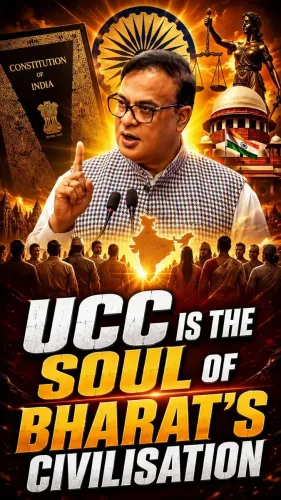
CM Assam Office backs UCC for gender justice, economic growth

Synopsis
The Chief Minister's Office of Assam publicly endorsed the Uniform Civil Code on 30 May 2026, arguing it will advance legal certainty, gender justice and economic growth — extending a pattern of BJP-ruled state advocacy ahead of potential central legislation.
Key Takeaways
The Chief Minister's Office of Assam endorsed the Uniform Civil Code on 30 May 2026 , citing economic and gender-justice benefits.
Article 44 of the Constitution has directed the State to pursue a UCC since 1950 , but it has never been enacted at the national level.
Uttarakhand became the first state to pass a UCC law in February 2024 , creating a legislative model for other states.
The Assam government's framing links legal uniformity to reduced family-court litigation and a stronger investment climate.
Women and religious communities with distinct personal law traditions are the primary stakeholders affected by any UCC implementation.
Possible next steps include an Assam -specific UCC bill and coordination with the Union Law Ministry on model legislation.
The Chief Minister's Office of Assam on Saturday, 30 May 2026, publicly backed the Uniform Civil Code (UCC), arguing it can deliver greater legal certainty, gender justice, and a stronger foundation for economic growth in India.
Context
The official CMO Assam handle shared what it described as 'a special coverage' making an economic case for a common civil code. The post quoted directly: 'A Uniform Civil Code can pave the way for greater legal certainty, gender justice and a stronger foundation for economic growth.' The endorsement signals the Assam government's continued alignment with UCC advocacy at the state level.
Policy backdrop
Article 44 of the Indian Constitution (1950) places the UCC under the Directive Principles of State Policy, directing the State to endeavour to secure a uniform civil code for citizens. The provision has remained aspirational for over seven decades, with personal laws on marriage, divorce, inheritance, and adoption continuing to vary by religion.
The debate moved from principle to practice in February 2024, when Uttarakhand became the first Indian state to enact a UCC law, setting a legislative precedent for other states. Since 2019, multiple BJP-ruled states have advanced UCC discussions as part of a broader national integration agenda aimed at replacing faith-specific personal laws with a common framework.
Stakeholders and impact
Proponents argue a UCC would most directly benefit women by standardising rights around marriage, divorce, and inheritance across religious communities, reducing the legal asymmetry that currently disadvantages women under certain personal law regimes. Reduced litigation in family courts is also cited as a downstream economic benefit.
Religious communities with distinct personal law traditions — including Muslim, Christian, Parsi, and Hindu sub-communities governed by customary law — remain the most directly affected stakeholders. Civil society groups have historically raised concerns about cultural autonomy, while women's rights organisations have generally supported uniform protections. The economic framing adopted by the Assam CMO represents a newer strand of argument linking legal uniformity to investment climate and productivity.
What's next
Attention will now turn to whether Assam tables its own UCC bill in the state assembly, and whether the state coordinates with the Union Law Ministry on model legislation. The CMO's public endorsement, amplified through its official social media presence, adds political momentum to the conversation ahead of any potential central legislation. The framing of UCC as an economic enabler — not merely a social reform — may also shape how the debate is positioned in upcoming legislative and electoral cycles.
Point of View
A rhetorical shift that broadens the coalition of potential supporters beyond ideological allies. Coming after Uttarakhand's landmark 2024 enactment, it fits a clear pattern of BJP-governed states building state-level consensus ahead of a possible central push. The economic lens also insulates the argument somewhat from communal-sensitivity critiques by emphasising gender parity and legal efficiency. Analysts will watch whether Assam follows Uttarakhand's legislative path or limits its role to political signalling for now.
NationPress
15 Oct 2026
Frequently Asked Questions
What is the Uniform Civil Code and why is Assam supporting it?
The Uniform Civil Code is a proposed set of common personal laws — covering marriage, divorce, inheritance and adoption — applicable to all citizens regardless of religion. The Assam CMO has backed it, arguing it will deliver legal certainty, gender justice and economic growth.
Has any Indian state already implemented the Uniform Civil Code?
Yes. Uttarakhand became the first Indian state to enact a UCC law in February 2024, setting a precedent for other states considering similar legislation.
What does Article 44 of the Indian Constitution say about UCC?
Article 44, under the Directive Principles of State Policy, directs the State to endeavour to secure a Uniform Civil Code for all citizens, but it is non-justiciable, meaning it cannot be enforced by a court.
How does a Uniform Civil Code benefit women?
A UCC would standardise rights around marriage, divorce and inheritance across religious communities, reducing the legal asymmetry that currently disadvantages women under certain personal law regimes.
Is Assam planning to introduce its own UCC bill?
The Assam CMO's public endorsement raises the possibility of a state-level UCC bill, but no draft or tabling date has been officially confirmed as of 30 May 2026.