CM Himanta pushes UCC Assam for equal civil rights
Synopsis
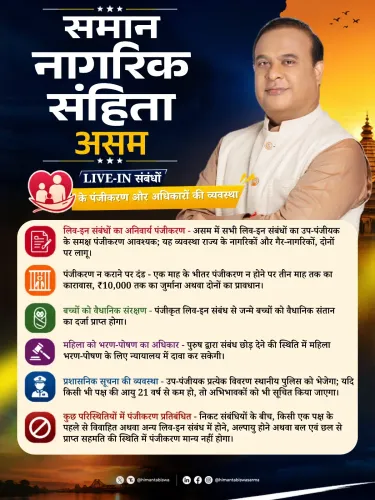
Assam Chief Minister Himanta Biswa Sarma has reaffirmed that the proposed Uniform Civil Code for Assam will guarantee all citizens equal legal standing in marriage, divorce and inheritance, free from religion-based personal laws — advancing a key BJP policy commitment.
Key Takeaways
CM Himanta Biswa Sarma stated on 27 May 2026 that #UCCAssam will ensure equal legal standing for every citizen regardless of religion.
The UCC would replace separate religion-based personal laws governing marriage, divorce, and inheritance in Assam .
Article 44 of the Indian Constitution directs the state to endeavour for a Uniform Civil Code across India.
Uttarakhand enacted India's first state-level UCC in 2024 , serving as a legislative precedent for Assam .
An expert committee was constituted by the Assam government in 2023 to draft UCC provisions.
The bill's passage is expected to face potential legal challenges before the Gauhati High Court or the Supreme Court of India .
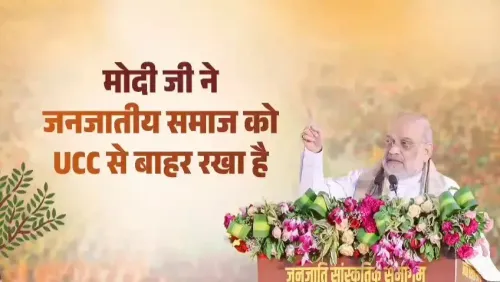
Assam Chief Minister Himanta Biswa Sarma on Wednesday, 27 May 2026, reaffirmed his government's commitment to the Uniform Civil Code (UCC) for Assam, stating that the proposed law will guarantee every citizen equal standing before the law regardless of religion in matters of marriage, divorce, and inheritance.
Context
In his post on X, CM Sarma stated that #UCCAssam 'will ensure that every citizen, irrespective of their religion, will have equal standing before the law and not be dependent on the whims and fancies of religious leaders in matters of marriage, divorce or inheritance.' He added that the code 'ensures everyone has equal protection from law.'
The statement comes as the Assam government presses ahead with its effort to replace religion-based personal laws with a single, uniform framework — a reform that has gathered pace across several BJP-governed states in recent years.
Policy Backdrop
Article 44 of the Indian Constitution (1950) lists a Uniform Civil Code among the Directive Principles of State Policy, directing the state to 'endeavour to secure' such a code for all citizens. The BJP included the UCC in its 2014 and 2019 national election manifestos, framing it as a measure of gender justice and legal equality.
Uttarakhand became the first Indian state to enact a Uniform Civil Code in 2024, providing a legislative template for other states. The Assam government constituted an expert committee to draft UCC provisions in 2023, setting the groundwork for a formal bill. Similar proposals have been under active discussion in Gujarat and other states governed by the ruling alliance.
Currently, personal law matters in India are governed by separate codes for different religious communities — the Hindu Marriage Act, the Muslim Personal Law (Shariat) Application Act, and others — meaning that rights and remedies in family disputes vary significantly by religion.
Stakeholders and Impact
If enacted, UCC Assam would directly affect all residents of the state, cutting across religious lines. Proponents argue it would strengthen protections for women who currently face unequal treatment under certain religious personal laws, particularly in divorce and inheritance proceedings.
Religious minority communities and their representative bodies have historically raised concerns that a uniform code could erode constitutionally protected religious freedoms. Civil society groups and legal experts remain divided on how to balance the constitutional directive under Article 44 with the protections guaranteed under Articles 25–28.
What's Next
The immediate milestone to watch is the tabling of a formal UCC bill in the Assam Legislative Assembly. Should the bill pass, it is widely expected to face legal scrutiny before the Gauhati High Court or the Supreme Court of India, where questions of constitutional validity and the rights of religious communities will be tested.
CM Sarma's public reaffirmation signals that the Assam government intends to keep the UCC at the centre of its legislative agenda, reinforcing a broader national pattern of BJP-ruled states translating a long-standing party commitment into state law ahead of future electoral cycles.
Point of View
Pre-empting the standard objection that it targets minority communities. The timing follows Uttarakhand's successful enactment in 2024 and fits a wider BJP strategy of advancing state-level UCCs to normalise the reform ahead of any central legislation. By anchoring the argument in protection from 'whims and fancies of religious leaders,' Sarma is specifically targeting intra-community gatekeeping, particularly in divorce and inheritance, to build a gender-justice coalition around the bill. How Assam's religious minority communities and the courts respond will set a significant precedent for the remaining states where similar legislation is pending.
NationPress
11 Oct 2026
Frequently Asked Questions
What did CM Himanta Biswa Sarma say about UCC Assam?
CM Sarma stated that UCC Assam will ensure every citizen has equal standing before the law in matters of marriage, divorce, and inheritance, and will not leave them dependent on the decisions of religious leaders.
Which Indian state first enacted a Uniform Civil Code?
Uttarakhand became the first Indian state to enact a Uniform Civil Code, doing so in 2024, providing a legislative model for other states including Assam.
Does the Indian Constitution support a Uniform Civil Code?
Yes. Article 44 of the Indian Constitution lists a Uniform Civil Code as a Directive Principle of State Policy, directing the state to endeavour to secure such a code for all citizens, though it is not a justiciable right.
What happens after the UCC Assam bill is passed?
If passed by the Assam Legislative Assembly, the UCC is widely expected to face legal challenges before the Gauhati High Court or the Supreme Court of India on questions of constitutional validity and religious freedoms.