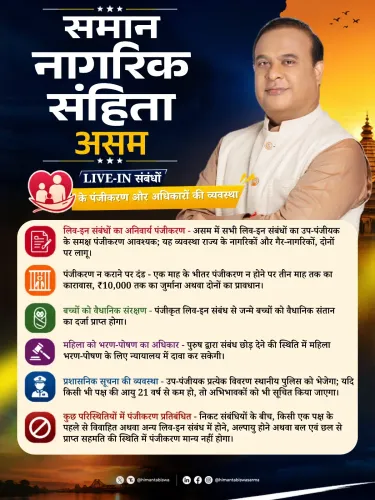
Assam CM Office backs UCC for gender justice, economic growth
Synopsis
The Chief Minister's Office of Assam has publicly backed the Uniform Civil Code, arguing it can deliver legal certainty, gender justice, and economic growth — broadening the reform's appeal beyond ideology as BJP-governed states watch Uttarakhand's UCC implementation closely.
Key Takeaways
The Chief Minister's Office of Assam endorsed the Uniform Civil Code on 31 May 2026 , citing legal certainty, gender justice, and economic growth.
Article 44 of the Constitution has directed the State to secure a UCC since 1950 , but it has never been made judicially enforceable.
Goa is currently the only Indian state operating under a functioning common civil code, inherited from Portuguese civil law.
Uttarakhand was the first state in independent India to pass a UCC bill, setting a legislative precedent that other BJP-ruled states are watching.
Tribal communities in Assam have raised concerns about customary land and inheritance rights that could be affected by any UCC framework.
The CMO's framing links UCC to economic growth — a notable shift that positions the reform as a governance and investment-climate issue, not only a social one.
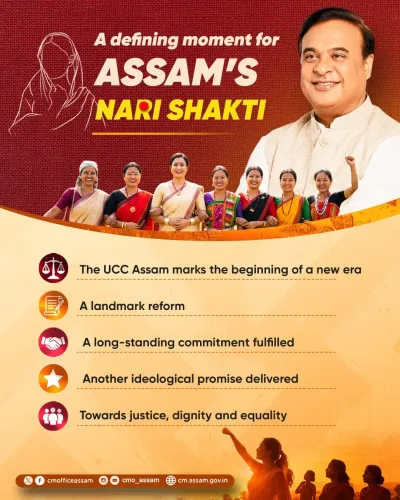
The Chief Minister's Office of Assam on Saturday, 31 May 2026 publicly backed the Uniform Civil Code, stating it can deliver greater legal certainty, gender justice, and a stronger foundation for economic growth — framing the long-debated reform as a governance imperative rather than solely an ideological position.
The official account posted: 'A Uniform Civil Code can pave the way for greater legal certainty, gender justice and a stronger foundation for economic growth,' alongside a link to what it described as a special coverage piece on the subject.
Context
The Uniform Civil Code (UCC) proposes a single, religion-neutral framework governing personal matters — marriage, divorce, inheritance, and adoption — for all Indian citizens. The debate is not new: Article 44 of the Constitution of India (1950) already directs the State to 'endeavour to secure' such a code as a Directive Principle of State Policy, though it has never been made enforceable by courts.
At present, Goa remains the only Indian state operating under a functioning common civil code, a legacy of Portuguese civil law that survived the state's liberation and integration into India. Every other state applies religion-specific personal laws — Hindu, Muslim, Christian, and Parsi — for family matters.
Policy Backdrop
The Bharatiya Janata Party (BJP) has included UCC as a manifesto commitment at successive general elections and in several state campaigns. Uttarakhand became the first state in independent India to pass a UCC bill through its assembly, a move that energised similar conversations in other BJP-governed states.
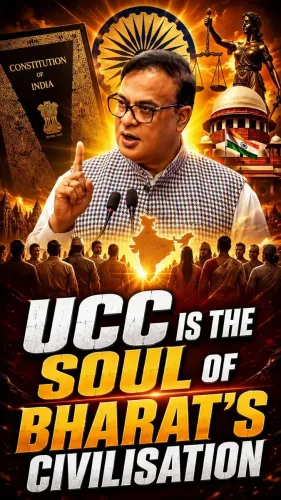
Assam Chief Minister Himanta Biswa Sarma, who has led the state since 2021, has previously voiced support for the code. The CMO's framing on Saturday — linking UCC to economic growth alongside the more familiar gender-justice argument — signals an effort to broaden the reform's appeal beyond its traditional cultural and religious contours.
Proponents argue that uniform personal laws reduce legal ambiguity in property succession and contract enforcement, lowering transaction costs for businesses and individuals alike. Critics, however, contend that a centrally imposed code risks overriding constitutionally protected religious freedoms and the customary rights of tribal and minority communities.
Stakeholders and Impact
Women are consistently cited as the primary beneficiaries of UCC reform, particularly in matters of equitable divorce rights, inheritance shares, and protection from polygamous marriages under certain personal law regimes. Civil society groups working on gender rights have broadly supported the principle, even as they debate the specifics of any draft legislation.
Religious communities — especially Muslim personal law bodies and several Christian denominations — have historically opposed a uniform code, arguing it would erase distinct cultural identities. Tribal communities in the Northeast, including in Assam itself, have raised concerns about the protection of customary land and inheritance practices that fall outside mainstream personal law systems.
For Assam specifically, the tribal dimension is particularly sensitive: scheduled tribe communities in the state enjoy constitutional protections that could intersect in complex ways with any UCC framework, making the legislative drafting process a delicate exercise.
What's Next
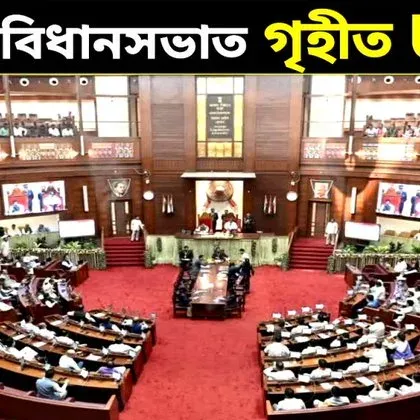
Attention will now turn to whether the Assam Legislative Assembly moves toward a formal resolution or bill on UCC, and whether the state government coordinates with the Union Law Ministry on model provisions. The CMO's post, amplified through official channels, is likely to intensify that legislative conversation both in Guwahati and in New Delhi.
With several BJP-governed states watching Uttarakhand's implementation closely, Assam's public endorsement adds political momentum to what could become a coordinated multi-state push — keeping the UCC debate firmly on India's governance agenda ahead of future electoral cycles.
Point of View
It fits a visible pattern of BJP-governed states building political and legal groundwork for a eventual central UCC push. The tribal-rights dimension in Assam, however, adds a complication absent in Uttarakhand, meaning any Assam bill would face harder drafting challenges. The CMO's public positioning at this moment reads less as an imminent legislative announcement and more as a signal of alignment with the national party's long-term agenda.
NationPress
14 Oct 2026
Frequently Asked Questions
What is the Uniform Civil Code and why is Assam talking about it?
The Uniform Civil Code is a proposed single set of personal laws — covering marriage, divorce, inheritance, and adoption — applicable to all Indian citizens regardless of religion. The Assam Chief Minister's Office publicly supported it on 31 May 2026, framing it as a path to legal certainty, gender justice, and economic growth.
Has any Indian state already implemented a Uniform Civil Code?
Yes. Goa is the only state currently operating under a common civil code, a legacy of Portuguese civil law. Uttarakhand became the first state in independent India to pass a UCC bill through its assembly, though implementation details continue to be worked out.
What does Article 44 of the Indian Constitution say about UCC?
Article 44 is a Directive Principle of State Policy that directs the State to 'endeavour to secure' a Uniform Civil Code for all citizens. It has been part of the Constitution since 1950 but is not judicially enforceable, meaning Parliament or state legislatures must act to give it effect.
How does UCC affect tribal communities in Assam?
Tribal communities in Assam have constitutional protections over customary land and inheritance practices. A Uniform Civil Code could intersect with these protections in complex ways, making any Assam-specific legislation particularly sensitive and requiring careful drafting to avoid overriding tribal rights.
What is the BJP's position on the Uniform Civil Code?
The Bharatiya Janata Party has included UCC as a manifesto commitment at successive general elections and in state campaigns. BJP Chief Ministers in several states, including Himanta Biswa Sarma of Assam, have publicly supported the reform, framing it as a secular governance measure that advances gender equality.