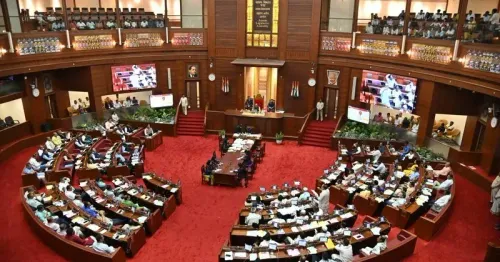
Assam CM Office: State passes UCC, becomes third in India

Synopsis
Assam has passed the Uniform Civil Code, the Chief Minister's Office announced on 28 May 2026, making it the third Indian state after Uttarakhand and Goa to enact a common civil law framework replacing religion-based personal laws on marriage, divorce, inheritance, and adoption.
Key Takeaways
The Chief Minister's Office of Assam announced on 28 May 2026 that Assam has passed the Uniform Civil Code (UCC) .
Assam is the third state in India to enact a UCC, after Uttarakhand (February 2024) and Goa (which retains a Portuguese-era uniform civil code).
The UCC replaces religion-based personal laws with a common framework covering marriage, divorce, inheritance, and adoption .
Article 44 of the Indian Constitution has directed the state to secure a Uniform Civil Code since 1950 .
The development is part of a broader legislative push by BJP-governed states to standardise personal laws.
Legal challenges before the Supreme Court of India and a possible national UCC bill in Parliament are expected to follow.
The Chief Minister's Office of Assam announced on Thursday, 28 May 2026, that Assam has passed the Uniform Civil Code (UCC), making it the third state in India to enact such legislation.
Context
The CMO Assam posted on X: 'Assam becomes third state to pass UCC.' The announcement marks a significant legislative development in the northeastern state, which is governed by the Bharatiya Janata Party (BJP). The UCC seeks to replace religion-based personal laws with a common civil framework governing matters such as marriage, divorce, inheritance, and adoption for all citizens regardless of faith.
Policy Backdrop
Article 44 of the Indian Constitution (1950) lists a Uniform Civil Code as a Directive Principle of State Policy, directing the state to 'secure for the citizens a uniform civil code throughout the territory of India.' The provision has remained aspirational for over seven decades, with successive governments citing social and religious sensitivities as reasons for inaction at the national level.
Uttarakhand became the first Indian state to enact a state-level UCC law in February 2024, following recommendations by a government-appointed committee. Goa is recognised as the second jurisdiction, having retained a Portuguese-era civil code that has historically functioned as a uniform law for all communities in the state. Assam's passage of the UCC now places it alongside these two as the only states with such a framework in force.
Stakeholders and Impact
The legislation directly affects Assam's diverse population, which includes Hindu, Muslim, Christian, and tribal communities, each governed by distinct personal law regimes. Women's rights groups have long argued that a uniform code would address inequities embedded in certain personal laws, particularly on questions of marriage age, divorce rights, and inheritance. Religious organisations and minority communities, however, have historically raised concerns about the erosion of faith-based legal traditions.
The move aligns with a broader pattern among BJP-ruled states, which have advanced UCC legislation as part of an agenda to standardise personal laws and, proponents argue, strengthen gender equality and legal uniformity across communities.
What's Next
Assam's UCC passage is expected to intensify national debate on whether the central government will table a corresponding bill in Parliament. Legal challenges before the Supreme Court of India — similar to petitions filed following Uttarakhand's enactment — are a likely next step, with opponents expected to contest the constitutional validity of state-level UCC laws. The trajectory of these judicial proceedings could shape whether other states move to follow suit or await a national framework.
Point of View
Testing whether the Supreme Court will allow a patchwork of state UCCs or demand a unified national answer. For minority and tribal communities in Assam, the law's implementation details will determine whether its impact is experienced as equity or imposition.
NationPress
11 Oct 2026
Frequently Asked Questions
Which states have passed the Uniform Civil Code in India?
As of May 2026, three states have a Uniform Civil Code in force: Goa, which retained a Portuguese-era civil code; Uttarakhand, which enacted India's first state-level UCC in February 2024; and Assam, which passed its UCC on 28 May 2026.
What does the Uniform Civil Code mean for Assam residents?
The UCC replaces separate religion-based personal laws with a single common framework governing marriage, divorce, inheritance, and adoption for all residents of Assam, regardless of their religion or community.
What is Article 44 of the Indian Constitution?
Article 44 is a Directive Principle of State Policy that directs the Indian state to secure a Uniform Civil Code for all citizens. It has been part of the Constitution since 1950 but was not enacted as national law for over seven decades.
Will Assam's UCC face legal challenges?
Legal challenges before the Supreme Court of India are widely anticipated, similar to petitions filed after Uttarakhand passed its UCC in 2024. Courts are expected to examine whether state-level UCCs are constitutionally valid.
Is there a national Uniform Civil Code in India?
As of May 2026, there is no national UCC enacted by Parliament. The Directive Principle under Article 44 remains aspirational at the central level, though multiple BJP-ruled states have moved ahead with their own legislation.