Assam CMO flags sharp drop in child marriage, teen pregnancy in NFHS-6

Synopsis
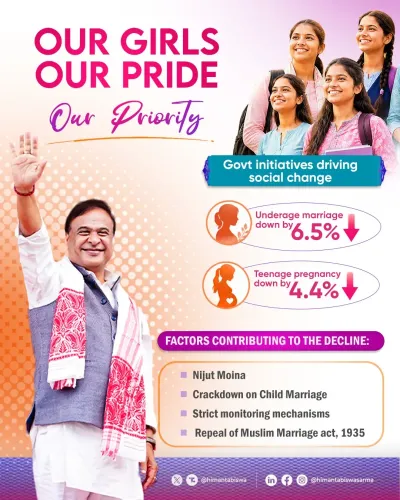
The Chief Minister's Office of Assam has highlighted NFHS-6 findings indicating a sharp decline in child marriage and teenage pregnancy among women in the state, framing it as evidence of social progress driven by sustained enforcement and awareness drives under the state's women's welfare push.
Key Takeaways
Assam CMO cited NFHS-6 findings showing a sharp decline in child marriage and teenage pregnancy.
The post was shared on 3 June 2026 from the official Dispur handle.
NFHS-5 (2019-21) had placed Assam's child marriage rate above the national average.
State has pursued an enforcement-led crackdown under the Prohibition of Child Marriage Act, 2006.
Trend aligns with India's Sustainable Development Goal 5.3 target to end child marriage by 2030.
Complete NFHS-6 state fact sheets are awaited for district-wise comparisons.
The Chief Minister's Office of Assam on Wednesday, 3 June 2026, drew attention to a report indicating substantial social gains in the state, citing fresh National Family Health Survey (NFHS-6) findings that point to a sharp decline in child marriage and teenage pregnancy among women. The post, shared from the official handle in Dispur, framed the trend as evidence of broader social progress under sustained state-level interventions.
The CMO's message stated that 'a report highlights significant social progress in Assam, with child marriage and teenage pregnancy witnessing a sharp decline among women, as reflected in NFHS-6 findings.' The post linked to a detailed write-up on the survey's Assam chapter, but did not itself cite specific percentage figures.
Context
The National Family Health Survey is the country's principal demographic and health study, conducted by the International Institute for Population Sciences under the Union Ministry of Health and Family Welfare. Its sixth round, NFHS-6, follows the previous NFHS-5 (2019-21), which had placed Assam's child marriage prevalence above the national average and triggered intensified enforcement and awareness drives across the state's districts.
Assam, home to over 3.5 crore residents, has since 2023 pursued a high-visibility crackdown on under-age marriages, combining prosecutions under the Prohibition of Child Marriage Act, 2006 with awareness campaigns aimed at parents, religious leaders and panchayats. The CMO's framing of NFHS-6 as a marker of 'social progress' aligns with the state government's broader political narrative on women's welfare.
Policy backdrop
The decline cited by the CMO sits within a longer policy arc that began with the Beti Bachao Beti Padhao scheme launched nationally in 2015, which provided the framework for Assam's district-level campaigns against early marriage. Subsequent state initiatives have layered school-retention incentives, adolescent health outreach and conditional cash transfers onto that base.
Health economists note that reductions in teenage pregnancy typically follow gains on two fronts: delayed age at marriage and improved access to reproductive health services. Both indicators are tracked in the NFHS instrument, allowing comparisons across survey rounds and against the all-India average.
Stakeholders and impact
The immediate beneficiaries flagged by the data are adolescent girls and rural women, for whom early marriage has historically curtailed schooling and elevated maternal health risks. A sustained drop in teenage pregnancy is also linked in public-health literature to lower infant and maternal mortality, both of which remain priority indicators for Assam's health department.
For the state administration, the survey provides quantitative backing for an enforcement-led approach that has drawn both support and criticism. Civil-society groups have welcomed declines in early marriage while urging that prosecutions be paired with social-support measures for affected families.
For the central government, Assam's reported trajectory feeds into India's commitment to Sustainable Development Goal 5.3, which targets the elimination of child marriage by 2030. Several northeastern states have reported gradual reductions in early marriage in successive survey rounds, suggesting a regional pattern shaped by legal enforcement and expanded schooling.
What's next
Attention now turns to the release of the complete state-level NFHS-6 fact sheets, which will allow district-wise disaggregation and comparison with NFHS-5 baselines. Any fresh state government orders extending enforcement mechanisms under the Prohibition of Child Marriage Act, or expanding adolescent health outreach, will indicate whether Dispur intends to consolidate the reported gains through additional administrative measures.
If sustained, the trends highlighted by the CMO could reshape Assam's standing on key women's welfare metrics and strengthen the state's claim to a replicable model for other high-prevalence regions.
Point of View
And quantitative survey backing strengthens the administration's defence of that strategy. The broader test will be whether declines are uniform across districts and communities, or concentrated in already-improving pockets. Sustained progress will also depend on pairing enforcement with schooling and economic-support measures.
NationPress
18 Oct 2026
Frequently Asked Questions
What did the Assam CMO say about child marriage?
The Assam CMO said NFHS-6 findings show a sharp decline in child marriage and teenage pregnancy among women in the state, describing it as evidence of significant social progress.
Why has Assam focused on child marriage?
Assam's child marriage rate in NFHS-5 (2019-21) was above the national average, prompting the state to intensify enforcement under the Prohibition of Child Marriage Act, 2006, along with awareness drives at the district level.
How does this link to national goals?
The reported decline supports India's commitment to Sustainable Development Goal 5.3, which targets the elimination of child marriage by 2030.
When will full NFHS-6 Assam data be available?
The complete state-level NFHS-6 fact sheets, including district-wise disaggregation, are awaited and will allow direct comparisons with NFHS-5 baselines.