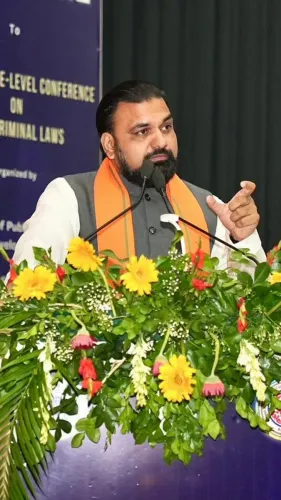
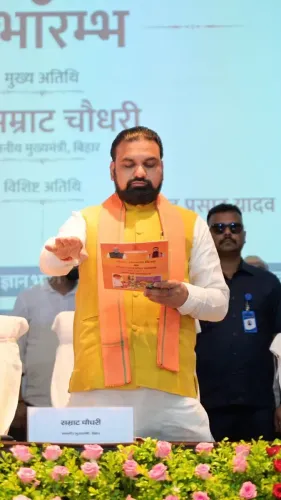
Bihar CM Samrat Choudhary calls for equal justice on International Justice Day
Synopsis
Bihar Chief Minister Samrat Choudhary marked International Justice Day on 17 July 2026 by calling for equal, accessible justice for all citizens, describing it as the cornerstone of a strong and democratic nation. His post invokes constitutional values and connects to Bihar's ongoing legal aid and judicial reform efforts.
Key Takeaways
Bihar Chief Minister Samrat Choudhary posted on 17 July 2026 to mark International Justice Day .
He stated that 'justice is meaningful only when it is equal and accessible to all,' calling for a pledge to build a just and democratic society.
International Justice Day is observed on 17 July each year to commemorate the 1998 adoption of the Rome Statute establishing the International Criminal Court .
India's constitutional framework — including the Legal Services Authorities Act (1987) and NALSA — underpins the country's formal commitment to accessible justice.
Bihar , with a population exceeding 100 million , continues to work on reducing court case pendency and expanding legal aid infrastructure.
The statement may inform future Bihar Legislative Assembly debates on justice sector budgets and legal aid expansion.
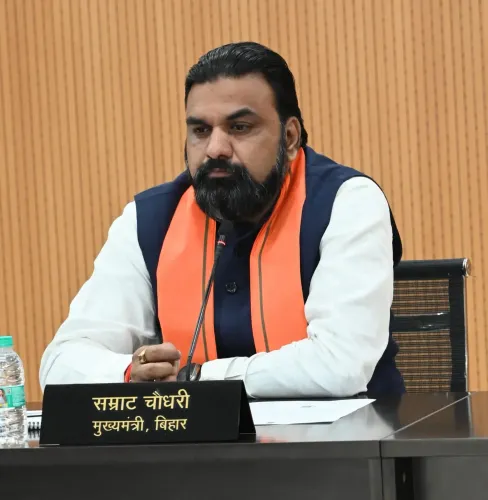
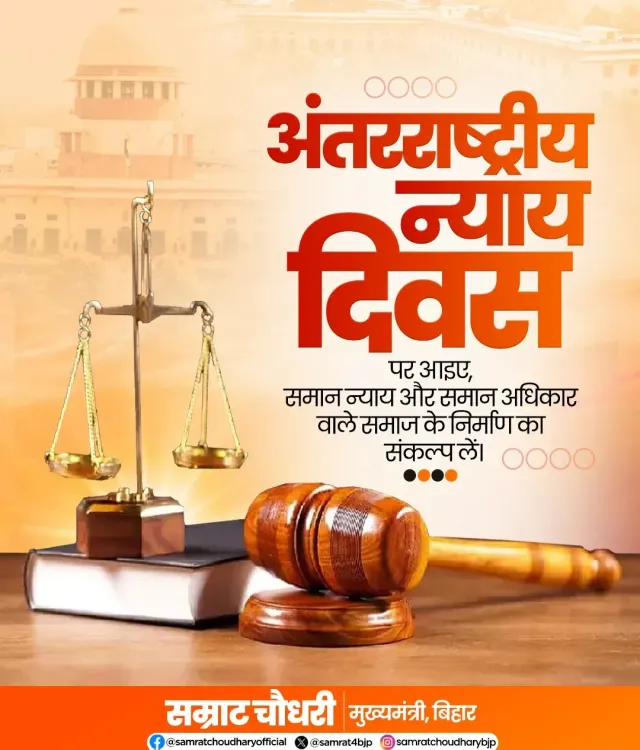
Bihar Chief Minister Samrat Choudhary on Friday, 17 July 2026, marked International Justice Day with a call for equal and accessible justice for all citizens, urging the nation to commit to building a just, harmonious, and democratic society.
Posting in Hindi on X, Choudhary wrote: 'न्याय तभी सार्थक है, जब वह सभी के लिए समान और सुलभ हो' — 'Justice is meaningful only when it is equal and accessible to all.' He called on citizens to pledge, on this day, to build a society grounded in equal justice, equal rights, and fairness, describing these as the foundation of a 'strong, harmonious, and democratic nation.'
Context
International Justice Day is observed every year on 17 July to mark the adoption of the Rome Statute in 1998, the treaty that established the International Criminal Court (ICC). The day has evolved into a broader occasion on which governments, institutions, and public figures reaffirm commitments to the rule of law, accountability, and access to justice at every level — local, national, and international.
For Indian leaders, the observance has become a platform to connect constitutional values with contemporary governance priorities. Choudhary's post aligns with this pattern, invoking the language of democratic consolidation and social equity rather than referencing any specific new scheme or policy announcement.
Policy Backdrop
India's commitment to equal justice has deep constitutional roots. The Constitution of India (1950) enshrines equal justice and access to justice among the Directive Principles of State Policy and Fundamental Rights, forming the bedrock of the republic's legal architecture. The Legal Services Authorities Act (1987) further institutionalised this commitment by creating the National Legal Services Authority (NALSA) and corresponding state-level bodies to provide free legal aid to marginalised and weaker sections of society.
In Bihar — an eastern Indian state with a population exceeding 100 million — access to justice remains a pressing concern. The state has ongoing efforts to reduce case pendency in courts and expand legal aid infrastructure, issues that lend particular weight to the Chief Minister's remarks on this occasion.
Stakeholders and Impact
The message speaks most directly to marginalised litigants, citizens with limited means, and communities historically underserved by the formal justice system. For such groups in Bihar, the gap between constitutional promise and lived reality remains a live political and administrative challenge.
The post also signals to the state's judicial and legal aid ecosystem — including district courts, lok adalats, and legal services committees — that the Chief Minister's office views justice sector strengthening as a governance priority. Observers will watch whether the messaging translates into concrete budget allocations for judicial infrastructure in Bihar's next fiscal cycle.
What's Next
Statements made on international observance days by state leaders often feed into legislative and budgetary conversations in the months that follow. Choudhary's emphasis on equal justice and democratic values could surface in Bihar Legislative Assembly debates on justice sector reforms and legal aid expansion. The broader BJP governance narrative at the national level has increasingly framed rule of law and institutional strengthening as pillars of development, and the Chief Minister's post reinforces that alignment. Whether this translates into announced programmes or policy directives remains to be seen.
Point of View
Reinforcing the BJP's broader governance narrative around constitutional values and institutional strengthening. By framing equal justice as the 'foundation of a democratic nation,' he positions Bihar's administration within a rights-based discourse that has electoral resonance in a state where access to courts and legal aid remains uneven. The statement carries no new policy commitment, but its timing on a formal international observance day gives it a platform beyond routine political messaging. Analysts will watch whether it precedes concrete announcements on judicial infrastructure or legal aid funding in Bihar's next budget cycle.
NationPress
17 Jul 2026
Frequently Asked Questions
Why did Bihar CM Samrat Choudhary post about International Justice Day?
Bihar Chief Minister Samrat Choudhary posted on 17 July 2026 to mark International Justice Day , calling for equal and accessible justice as the cornerstone of a democratic nation. The post reflects a broader pattern among Indian state leaders of using international observance days to reaffirm constitutional commitments.
What is International Justice Day and why is it observed on 17 July?
International Justice Day is observed on 17 July each year to mark the adoption of the Rome Statute on that date in 1998 , which established the International Criminal Court . It has grown into a global occasion to reaffirm commitments to rule of law, accountability, and access to justice.
What did Samrat Choudhary say on International Justice Day 2026?
Samrat Choudhary said that 'justice is meaningful only when it is equal and accessible to all,' and urged citizens to pledge to build a society grounded in equal justice and equal rights, calling this the foundation of a strong, harmonious, and democratic nation.
What is Bihar's track record on access to justice and legal aid?
Bihar , with a population exceeding 100 million , has ongoing state-level efforts to reduce court case pendency and expand legal aid infrastructure under frameworks like NALSA , established by the Legal Services Authorities Act (1987) . Access to justice for marginalised communities remains a live governance challenge in the state.
Is Samrat Choudhary the Chief Minister of Bihar?
Samrat Choudhary is a senior BJP leader serving as Chief Minister of Bihar . He posted on International Justice Day, 17 July 2026 , calling for equal justice and democratic values.