Cabinet Clears Green Energy Corridor Phase-III with Battery Storage
Synopsis
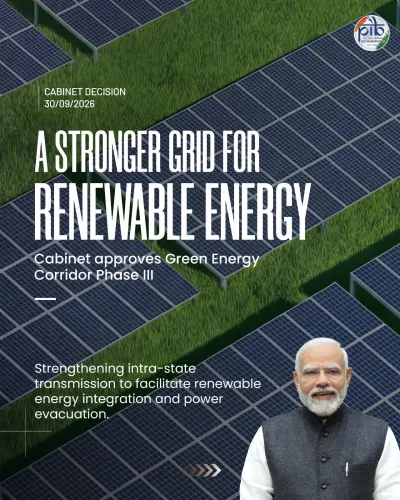
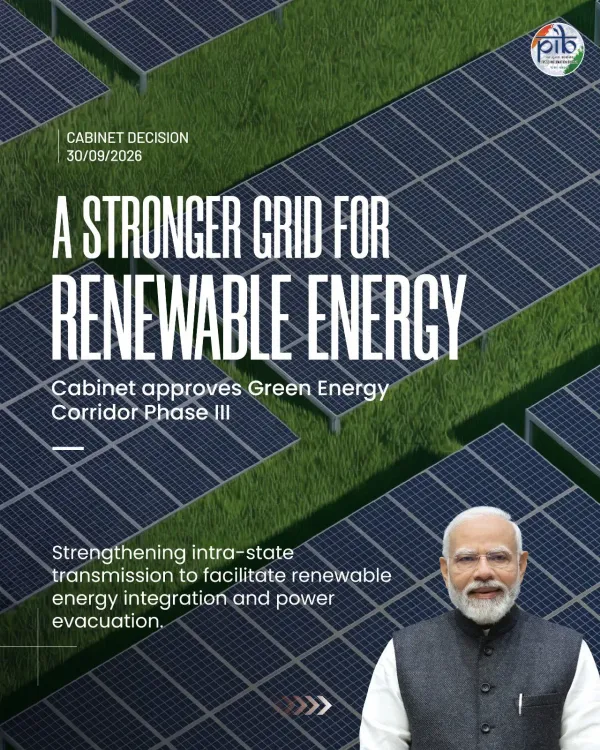
The Union Cabinet under PM Narendra Modi approved Green Energy Corridor Phase-III on 30 September 2026, sanctioning intra-state transmission systems with Battery Energy Storage Systems to support India's target of 900 GW installed non-fossil capacity by 2035.
Key Takeaways
The Union Cabinet under PM Narendra Modi approved the Green Energy Corridor Phase-III scheme on 30 September 2026 .
The scheme develops intra-state transmission systems integrated with Battery Energy Storage Systems (BESS) .
The goal is to help India achieve 900 GW of installed non-fossil fuel capacity by 2035 .
Green Energy Corridor Phase-I was originally sanctioned in 2015 for inter-state renewable power evacuation infrastructure.
Phase-III marks a shift from building transmission lines alone to integrating storage, addressing renewable energy variability.
State transmission utilities and renewable energy developers are the key stakeholders for ground-level execution.
India's power grid just got a major upgrade mandate. The Union Cabinet under Prime Minister Narendra Modi on Wednesday, 30 September 2026 approved the Green Energy Corridor Phase-III scheme, greenlighting the development of intra-state transmission systems integrated with Battery Energy Storage Systems (BESS) — a critical move to handle the surge of renewable power flowing into the national grid.
What Phase-III adds to the grid story
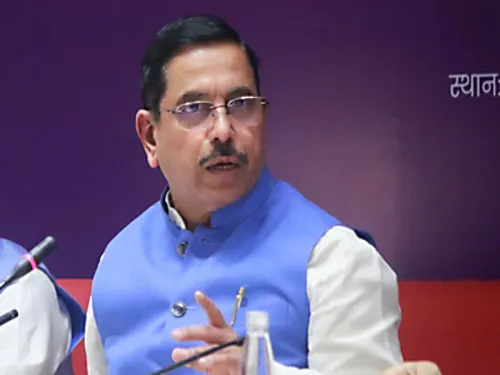
The approval, announced by Union Science and Technology Minister Dr. Jitendra Singh, targets a headline ambition: helping India achieve 900 GW of installed non-fossil fuel capacity by 2035. That is not a modest number. It would make India one of the largest clean-power economies on earth — but only if the electrons generated can actually travel from wind farms and solar parks to homes and factories. That is precisely the gap Phase-III is designed to close.
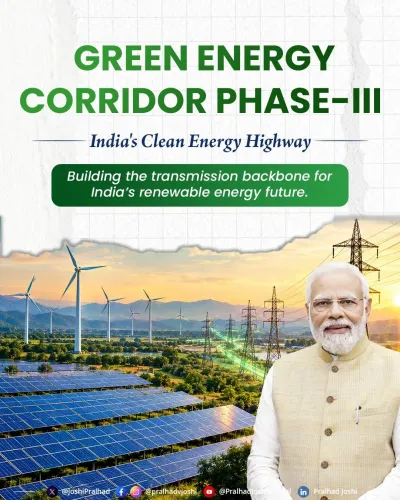
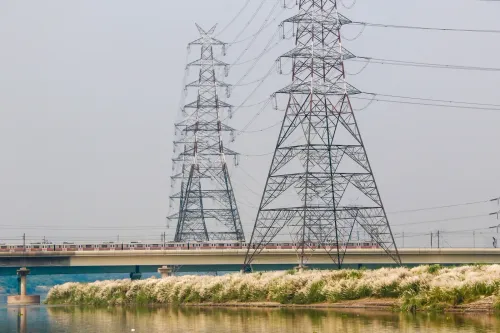
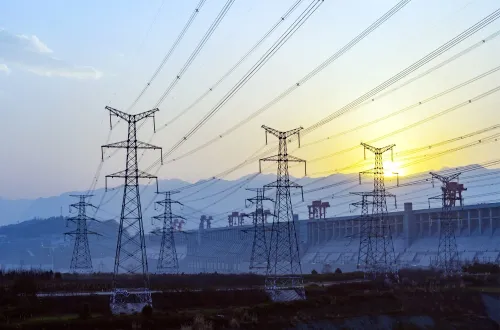
The scheme focuses on intra-state transmission lines — the arteries within state borders that prior corridor phases did not fully address. By pairing new lines with BESS, the design tackles renewable energy's chronic challenge: the sun does not always shine and the wind does not always blow when demand peaks. Storage bridges that gap.
A corridor built across a decade
This approval did not emerge from nowhere. Green Energy Corridor Phase-I was sanctioned in 2015 under the Modi government to construct dedicated inter-state transmission infrastructure for renewable power evacuation — the first systematic attempt to separate clean-energy traffic from the congested conventional grid. Successive phases have progressively pushed deeper into intra-state networks and, now, into storage integration.
The broader pattern is consistent: India has built dedicated transmission corridors since the early 2010s to keep pace with an explosion of solar and wind installations. Phase-III represents the maturation of that strategy — moving from 'build more lines' to 'build smarter lines with storage baked in.'
State utilities and developers in the spotlight next
State transmission utilities and renewable energy developers are the immediate stakeholders who will translate Cabinet approval into physical infrastructure. The next milestones to watch: state-level project sanctions, tendering for transmission lines, and procurement rounds for BESS capacity under the new scheme.
India's 2035 clean-power ambition now has its grid backbone on paper. The real test begins in the tendering rooms of state capitals.
Point of View
The Cabinet is acknowledging that variability — not capacity — is now the binding constraint. This fits a broader Modi government pattern of layering successive corridor phases to incrementally modernise grid architecture. The real policy test, however, will be how quickly states move from Cabinet sanction to tendering, given that intra-state projects have historically moved slower than their inter-state counterparts.
NationPress
30 Sept 2026
Frequently Asked Questions
What is Green Energy Corridor Phase-III?
Green Energy Corridor Phase-III is a Union Cabinet-approved scheme that funds the development of intra-state electricity transmission systems paired with Battery Energy Storage Systems (BESS) to evacuate renewable power more efficiently across India.
What is India's 900 GW non-fossil capacity target?
India has set a target of achieving 900 GW of installed non-fossil fuel power capacity by 2035. The Green Energy Corridor Phase-III scheme is designed to provide the grid infrastructure needed to support this goal.
How is Phase-III different from earlier Green Energy Corridor phases?
Phase-I, sanctioned in 2015, focused on inter-state transmission for renewable power evacuation. Phase-III targets intra-state networks and, critically, integrates Battery Energy Storage Systems to manage the variability of solar and wind power.
What role does battery storage play in the new scheme?
Battery Energy Storage Systems store excess renewable power when generation exceeds demand and release it during peak consumption periods, helping stabilise the grid and ensuring clean energy is available around the clock.
Who will implement Green Energy Corridor Phase-III on the ground?
State transmission utilities and renewable energy developers are the primary stakeholders. Implementation will involve state-level project approvals and tendering for both transmission lines and BESS capacity.