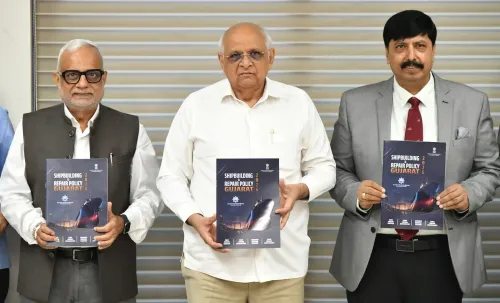
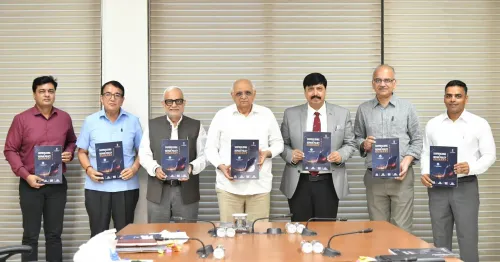
Shipbuilding projects in Gujarat get Centre's nod under SbDS: Porbandar cluster, Vadinar facility
Synopsis
The Centre has cleared two major maritime projects in Gujarat — a 2,000-acre greenfield shipbuilding cluster at Porbandar targeting up to 1.5 million GT annually, and a ₹1,570-crore ship repair facility at Vadinar capable of handling 300-metre vessels. Together, they represent one of the most concrete steps yet under Maritime Amrit Kaal Vision 2047 to reduce India's dependence on foreign shipyards.
Key Takeaways
The MoPSW granted in-principle approval to two Gujarat maritime projects under the Shipbuilding Development Scheme (SbDS) on 15 July .
A greenfield NSHIP-Gujarat cluster spanning nearly 2,000 acres at Kuchhadi, Porbandar will target annual output of 1.2–1.5 million gross tonnage .
A ₹1,570-crore ship repair facility at Vadinar will be jointly developed by Cochin Shipyard Ltd. and Deendayal Port Authority .
The Vadinar facility will service vessels up to 300 metres in length and receives 25% financial assistance on eligible capital costs under SbDS.
Both projects are anchored in the government's Maritime Amrit Kaal Vision 2047 strategy.
The Ministry of Ports, Shipping and Waterways (MoPSW) has granted in-principle approval to two strategic maritime infrastructure projects in Gujarat under the Shipbuilding Development Scheme (SbDS), the ministry confirmed in an official statement on Wednesday, 15 July. The approvals cover a greenfield shipbuilding cluster in Porbandar district and a ship repair facility at Vadinar in the Gulf of Kutch.
Greenfield Shipbuilding Cluster at Porbandar
The first project, to be developed through the National Shipbuilding and Heavy Industries Park-Gujarat (NSHIP-Gujarat), is a special purpose vehicle jointly promoted by the MoPSW and the Gujarat Maritime Board. Spread across nearly 2,000 acres at Kuchhadi in Porbandar district, the integrated maritime manufacturing cluster will house modern shipyards, ancillary manufacturing units, common infrastructure, and capability development centres.
The facility is designed to build large commercial vessels with an annual production capacity of 1.2 million to 1.5 million gross tonnage (GT), significantly expanding India's domestic shipbuilding footprint and positioning Gujarat as a hub for heavy-tonnage vessel construction.
Ship Repair Facility at Vadinar
The second approval covers a ₹1,570-crore ship repair facility at Vadinar, to be jointly developed by Cochin Shipyard Ltd. (CSL) and Deendayal Port Authority (DPA). The project had previously received clearance from the Cabinet Committee on Economic Affairs (CCEA) and has now additionally secured in-principle approval under the SbDS for 25 per cent financial assistance on eligible capital infrastructure.
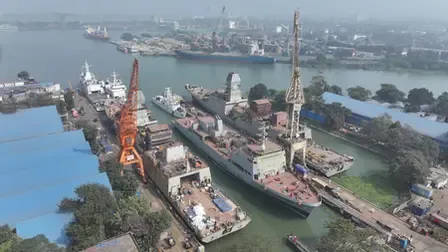
The brownfield expansion will include a 650-metre jetty, two large floating dry docks, workshops, and supporting marine infrastructure. Once operational, the facility will be capable of servicing commercial vessels of up to 300 metres in length, reducing India's reliance on overseas repair yards.
Government's Strategic Intent
The approvals are framed as part of the government's broader Maritime Amrit Kaal Vision 2047, aimed at strengthening indigenous shipbuilding and repair capabilities, attracting investment, and enhancing India's competitiveness in global maritime trade. This comes amid a sustained policy push to grow the domestic maritime manufacturing ecosystem and deepen supply chains.
Union Minister for Ports, Shipping and Waterways Sarbananda Sonowal stated that India's maritime sector has undergone significant transformation over the past 12 years under Prime Minister Narendra Modi. Sonowal said the two projects would enhance sectoral competitiveness, generate employment, and strengthen domestic supply chains. 'These projects reflect the vision of PM Modi towards empowering India's maritime ecosystem and advancing the goals of Atmanirbhar Bharat and Viksit Bharat,' he added.
What This Means for India's Maritime Ambitions
Notably, India currently handles a small fraction of global shipbuilding output, with South Korea, China, and Japan dominating the sector. The Porbandar cluster's targeted annual capacity of up to 1.5 million GT represents a meaningful step toward closing that gap, though analysts have long cautioned that execution timelines in large-scale maritime infrastructure projects in India have historically slipped. The Vadinar repair facility addresses a more immediate gap — Indian ship operators have routinely sent vessels abroad for dry-docking, a cost and logistics burden that a domestic facility could partially offset.
Both projects will be closely watched as bellwethers for the government's ability to translate Maritime Amrit Kaal Vision commitments into operational infrastructure.
Point of View
Not ground-breakings. The real measure will be whether NSHIP-Gujarat, a joint SPV between the Centre and state, avoids the land-acquisition and coordination delays that have stalled comparable industrial park projects. The Vadinar facility is the more immediately credible of the two: it has CCEA backing, named partners in CSL and DPA, and a specific brownfield scope. But India's share of global shipbuilding remains negligible, and closing that gap requires not just infrastructure but a competitive cost structure and a trained workforce pipeline that neither approval addresses yet.
NationPress
13 Oct 2026
Frequently Asked Questions
What are the two shipbuilding projects approved by the Centre in Gujarat?
The Centre has approved a greenfield shipbuilding cluster at Kuchhadi in Porbandar district and a ₹1,570-crore ship repair facility at Vadinar in the Gulf of Kutch. Both received in-principle approval under the Shipbuilding Development Scheme on 15 July.
What is the NSHIP-Gujarat project?
NSHIP-Gujarat (National Shipbuilding and Heavy Industries Park-Gujarat) is a special purpose vehicle jointly promoted by the Ministry of Ports, Shipping and Waterways and the Gujarat Maritime Board. It will develop a 2,000-acre integrated maritime manufacturing cluster at Kuchhadi, Porbandar, targeting annual production of 1.2 to 1.5 million gross tonnage.
Who is building the Vadinar ship repair facility and what will it include?
The Vadinar facility will be jointly developed by Cochin Shipyard Ltd. and Deendayal Port Authority. It will include a 650-metre jetty, two large floating dry docks, workshops, and supporting marine infrastructure, capable of repairing vessels up to 300 metres in length.
What financial support does the Shipbuilding Development Scheme provide?
Under the SbDS, the Vadinar project has secured in-principle approval for 25 per cent financial assistance on eligible capital infrastructure costs. The scheme is designed to incentivise investment in India's shipbuilding and repair sector.
What is the Maritime Amrit Kaal Vision 2047?
Maritime Amrit Kaal Vision 2047 is the Indian government's long-term strategy to strengthen indigenous shipbuilding and ship repair capabilities, attract maritime investment, and enhance India's competitiveness in global maritime trade by the centenary of independence.