Chhattisgarh CMO: PM Surya Ghar scheme drives solar gains
Synopsis
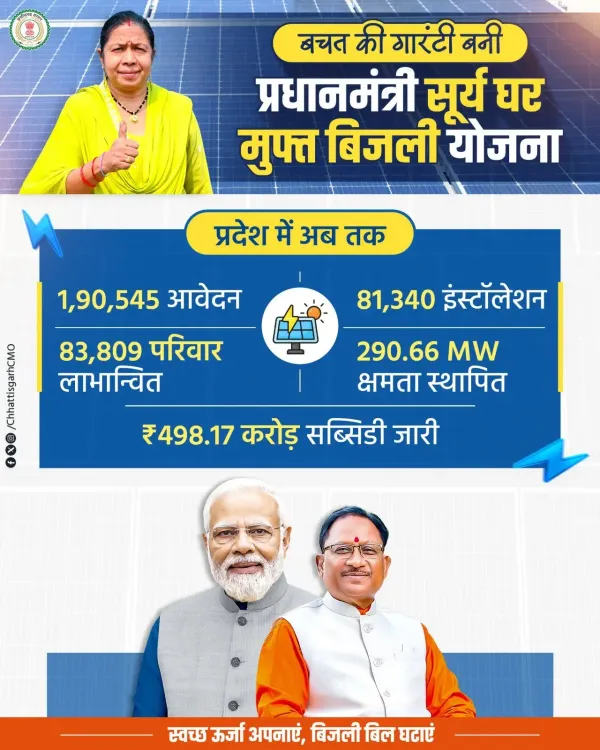
The Chief Minister's Office of Chhattisgarh on 24 July 2026 said the state is achieving continuous milestones in clean energy and energy self-reliance through effective implementation of the PM Surya Ghar Muft Bijli Yojana, the Centre's rooftop solar scheme targeting one crore households.
Key Takeaways
The Chief Minister's Office of Chhattisgarh credited the PM Surya Ghar Muft Bijli Yojana for driving new clean energy achievements in the state.
The Central scheme targets rooftop solar installation in one crore households and offers up to 300 units of free electricity per month .
The scheme was announced in the 2024-25 Union Budget as part of India's renewable energy expansion strategy.
Chhattisgarh , traditionally a coal-dependent state, is positioning itself toward energy self-reliance through household-level solar adoption.
India aims to reach 500 GW of non-fossil fuel capacity by 2030 and net-zero emissions by 2070 , with rooftop solar a key pillar.
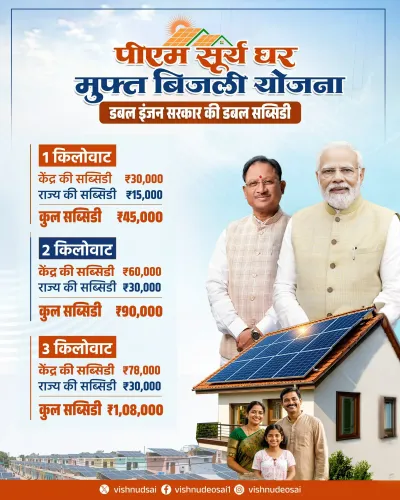
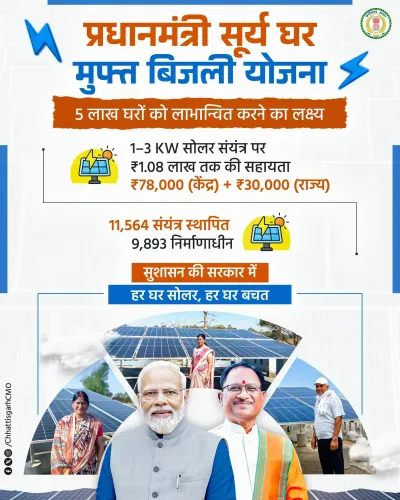
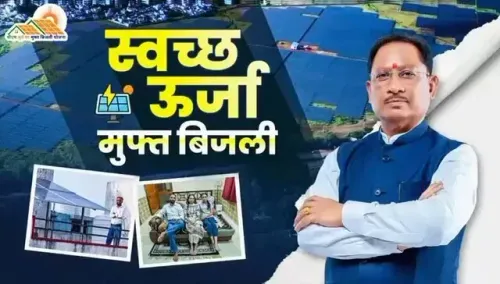
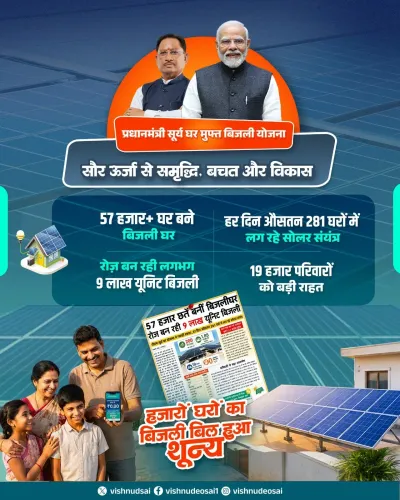
The Chief Minister's Office of Chhattisgarh on Friday, 24 July 2026 highlighted the state's growing achievements in clean energy and energy self-reliance, attributing progress to the effective implementation of the PM Surya Ghar Muft Bijli Yojana, the Central government's flagship rooftop solar scheme.
The official post stated that through the effective execution of the 'Pradhan Mantri Surya Ghar Muft Bijli Yojana' ('Prime Minister Solar Home Free Electricity Scheme'), Chhattisgarh is 'continuously achieving new milestones in the direction of clean energy and energy self-reliance.'
Context
The PM Surya Ghar Muft Bijli Yojana was announced in the 2024-25 Union Budget with the ambition of installing rooftop solar systems across one crore households nationwide. The scheme offers eligible beneficiaries up to 300 units of free electricity per month, directly reducing household energy costs while expanding distributed solar generation.
Chhattisgarh, a state historically associated with coal-based power, has been working to integrate this Central scheme into its local energy administration. The state's adoption of rooftop solar marks a notable diversification in its energy profile.
Policy Backdrop
India's push for household-level solar adoption is rooted in a long policy lineage. The National Solar Mission, launched in 2010, set the country on a trajectory of scaling both grid-connected and off-grid solar capacity. That framework has since evolved into more targeted subsidy-driven programmes aimed at direct beneficiary households.
The current scheme sits within India's broader commitment to reach 500 GW of non-fossil fuel capacity by 2030 and achieve net-zero emissions by 2070. Rooftop solar is considered a critical lever in this transition, enabling distributed generation without large land acquisition.
Stakeholders and Impact
The primary beneficiaries are residential households across Chhattisgarh who gain access to subsidised rooftop solar installations and reduced electricity bills. For a state with a significant rural population, the scheme's promise of free monthly units carries meaningful economic weight.
The renewable energy sector — including solar equipment manufacturers, installers, and grid operators — also stands to benefit as state-level implementation scales up demand. The model of combining Central subsidy support with state-level execution has emerged as the dominant approach across multiple Indian states pursuing similar targets.
What's Next
Attention will now turn to Chhattisgarh's energy department reports and forthcoming budget allocations, which will indicate how many households have been covered, the quantum of subsidy disbursed, and the installed capacity added under the scheme. The state's performance on these metrics will be a key indicator of how effectively Central scheme funds are being translated into on-ground solar adoption.
As more states compete to demonstrate implementation efficiency under national renewable programmes, Chhattisgarh's trajectory under PM Surya Ghar will be closely watched as a benchmark for energy self-reliance in coal-belt states pivoting to clean power.
Point of View
Positioning the state government as an active and effective delivery partner under the BJP-led Union government's flagship energy programme. For a coal-belt state, publicly championing rooftop solar milestones also serves a dual purpose: it reinforces the ruling dispensation's green credentials while addressing a domestic political narrative around energy access and affordability. The framing of 'energy self-reliance' echoes the broader Atmanirbhar Bharat vocabulary, suggesting a conscious effort to embed state-level achievements within the national policy story. Tracking actual installation and subsidy data will be essential to assess whether the milestones cited reflect substantive progress or aspirational positioning.
NationPress
24 Jul 2026
Frequently Asked Questions
What is PM Surya Ghar Muft Bijli Yojana?
PM Surya Ghar Muft Bijli Yojana is a Central government scheme announced in the 2024-25 Union Budget to install rooftop solar systems in one crore households across India, providing eligible beneficiaries up to 300 units of free electricity per month.
How is Chhattisgarh implementing the PM Surya Ghar scheme?
The Chief Minister's Office of Chhattisgarh has stated that the state is achieving new milestones in clean energy and energy self-reliance through effective implementation of the scheme, though specific installation figures are subject to official energy department reports.
How many units of free electricity does PM Surya Ghar scheme provide?
The PM Surya Ghar Muft Bijli Yojana offers eligible households up to 300 units of free electricity per month through subsidised rooftop solar installations.
What is India's renewable energy target by 2030?
India has set a target of achieving 500 GW of non-fossil fuel energy capacity by 2030, with rooftop solar under schemes like PM Surya Ghar forming a key part of this push.
Why is Chhattisgarh's solar adoption significant?
Chhattisgarh is traditionally a coal-rich and coal-dependent state, making its active adoption of rooftop solar under a Central scheme a notable shift toward distributed clean energy generation and household-level energy self-reliance.