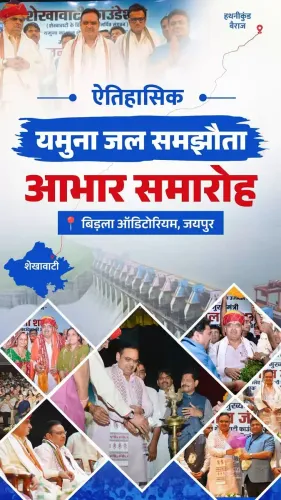
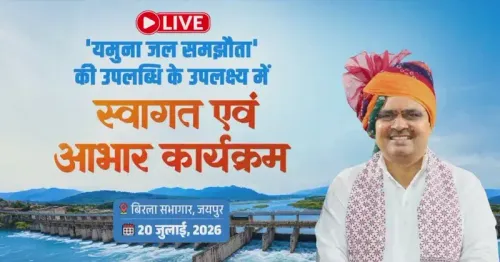
CM Bhajan Lal Hails Historic Yamuna Water Deal for Rajasthan
Synopsis
Rajasthan CM Bhajan Lal Sharma announced on 25 October 2026 that a historic path has been paved for a Yamuna water agreement, crediting PM Modi's guidance. The deal promises irrigation relief for the state's arid farming communities and future generations.
Key Takeaways
Rajasthan CM Bhajan Lal Sharma announced on 25 October 2026 that a historic Yamuna water agreement path has been paved for Rajasthan.
CM Sharma credited Prime Minister Narendra Modi's guidance as central to unlocking the agreement.
The agreement is framed as bringing 'new hope of prosperity' for Rajasthan's farmers, villages, and future generations .
The foundational reference is the 1994 Upper Yamuna Agreement , the last major interstate compact governing Yamuna water sharing.
The announcement must still be formalised through interstate talks, MoU signing, and integration into Rajasthan's irrigation project pipelines .
Northern India's arid zones have long pursued Yamuna allocations; this marks a potentially significant step in a decades-long campaign.
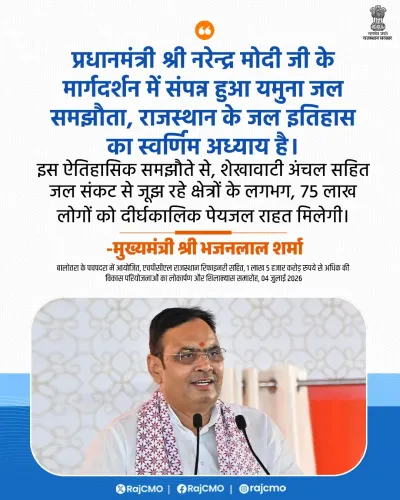
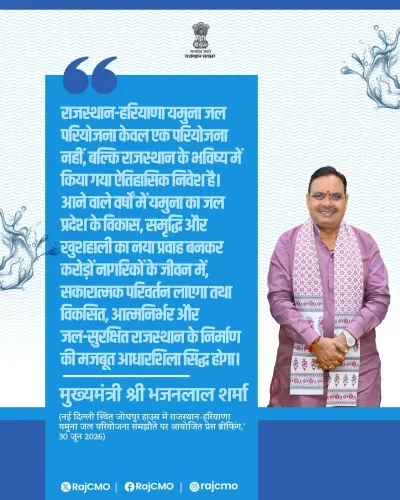
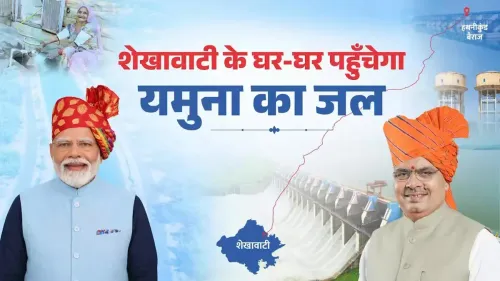
A decades-old water aspiration for one of India's most arid states moved closer to reality on Sunday, 25 October 2026, as Rajasthan Chief Minister Bhajan Lal Sharma declared that a historic path had been paved for a Yamuna water agreement — crediting the guidance of Prime Minister Narendra Modi for the breakthrough.
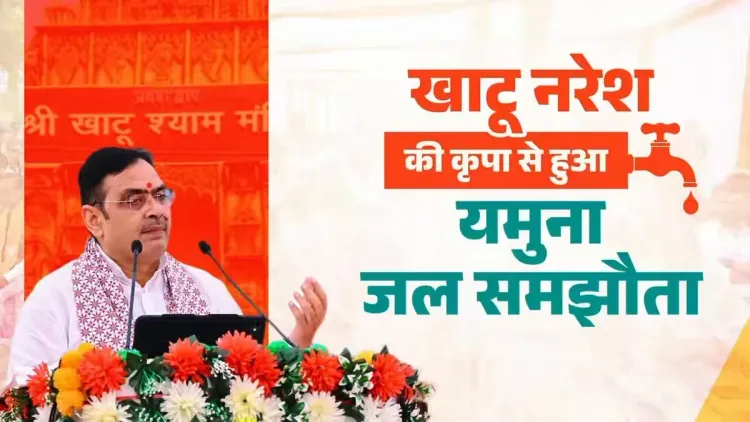
Posting in Hindi, CM Sharma wrote: 'खाटू नरेश की असीम कृपा और आदरणीय प्रधानमंत्री श्री नरेंद्र मोदी जी के मार्गदर्शन में राजस्थान के लिए यमुना जल समझौते का ऐतिहासिक मार्ग प्रशस्त हुआ है।' ('With the infinite grace of Khatu Naresh and the guidance of respected Prime Minister Narendra Modi, a historic path has been paved for a Yamuna water agreement for Rajasthan.') He added that the agreement carries 'new hope of prosperity and well-being for the farmers, villages, and future generations of the state.'
What the Yamuna Agreement Means for Rajasthan's Farmers
Rajasthan has long sat at the tail end of northern India's water politics. The state is largely arid, and its agricultural communities — particularly in the eastern districts that drain toward the Yamuna basin — have pushed for a formal, legally-backed allocation of Yamuna waters for irrigation. A structured agreement would open the door to canal infrastructure, groundwater recharge, and crop diversification in villages that currently depend on erratic monsoons and depleting aquifers.
The foundational reference point for any such deal is the 1994 Upper Yamuna Agreement, which set initial water-sharing principles among basin states including Haryana, Uttar Pradesh, Himachal Pradesh, Delhi, and Uttarakhand. Rajasthan's share under that arrangement has historically been a point of negotiation. A new interstate compact — or an amendment to the existing framework — would represent the first significant update in over three decades.
Centre's Role in Brokering Interstate River Disputes
State leaders publicly crediting the Centre for unlocking interstate water disputes has become a recognisable pattern in Indian federal politics — but that framing also reflects a structural reality. Formally, interstate river disputes are governed by the Inter-State River Water Disputes Act, and the Union government plays the convening role in bringing basin states to the table. When the political will aligns at the Centre, deals that have languished for years can move quickly.
CM Sharma's invocation of PM Modi's 'guidance' signals that this agreement was not purely a technocratic negotiation — it carried political momentum from the top. What comes next will be critical: the announcement must translate into a signed Memorandum of Understanding between the relevant states, followed by an engineering and irrigation project pipeline that actually delivers water to Rajasthan's fields.
The Road from Announcement to Water in the Fields
Interstate water agreements in India have a well-documented gap between declaration and delivery. Tribunal awards have gone unimplemented for years; MoUs have stalled in bureaucratic pipelines. The genuine test for this agreement will be whether it clears the three critical gates: formal sign-off by all signatory states, inclusion in Rajasthan's irrigation project budgets, and construction of conveyance infrastructure to carry Yamuna allocations to demand zones.
For the farmers CM Sharma invoked — the ones tilling semi-arid land under an uncertain sky — the answer is not in a post or a press conference. It is in the canal that eventually carries water to their fields. That chapter is still being written.
Point of View
Ahead of potential electoral cycles. By crediting PM Modi's personal guidance, CM Sharma reinforces the Centre-state synergy narrative that the BJP has used consistently to showcase cooperative federalism. However, the real policy test arrives post-announcement: interstate water compacts in India are notoriously slow to translate into infrastructure, and the 1994 Upper Yamuna Agreement itself remains a source of unresolved grievances among basin states. Whether this 'historic path' becomes a historic pipe — one that actually irrigates Rajasthan's fields — will define its legacy.
NationPress
25 Oct 2026
Frequently Asked Questions
What is the Yamuna water agreement for Rajasthan?
It is an interstate arrangement to secure a formal allocation of Yamuna river waters for Rajasthan, aimed at providing irrigation water to the state's farmers and villages. CM Bhajan Lal Sharma announced on 25 October 2026 that a historic path has been paved for such an agreement.
What is the 1994 Upper Yamuna Agreement?
The 1994 Upper Yamuna Agreement set the foundational water-sharing principles among basin states including Haryana, Uttar Pradesh, Himachal Pradesh, Delhi, and Uttarakhand. It remains the key reference point for any new Yamuna water-sharing arrangement involving Rajasthan.
How will the Yamuna water deal benefit Rajasthan's farmers?
A formalised Yamuna water allocation would enable canal infrastructure, groundwater recharge, and more reliable irrigation in Rajasthan's arid eastern districts, reducing farmers' dependence on erratic monsoons and depleting aquifers.
What role did PM Modi play in the Rajasthan Yamuna water agreement?
CM Bhajan Lal Sharma credited Prime Minister Narendra Modi's guidance as central to paving the historic path for the Yamuna water agreement, reflecting the Centre's convening role in interstate river water negotiations.
What needs to happen next for the Yamuna water deal to be implemented?
The announcement must be formalised through a signed Memorandum of Understanding between signatory states, integrated into Rajasthan's irrigation project budgets, and followed by construction of conveyance infrastructure to deliver water to demand zones.