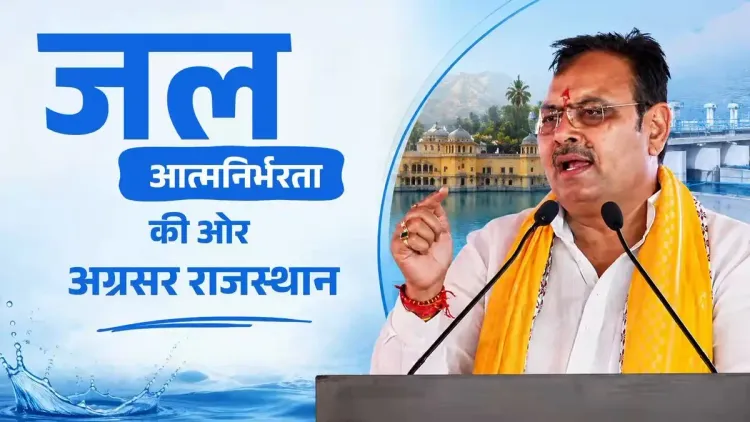
CM Bhajan Lal Pledges Water Self-Reliance for Rajasthan
Synopsis
Rajasthan Chief Minister Bhajan Lal Sharma has pledged to make the state water self-reliant, outlining efforts in conservation, harvesting, irrigation infrastructure, and securing the state's share from interstate rivers to ensure water security for every citizen.
Key Takeaways
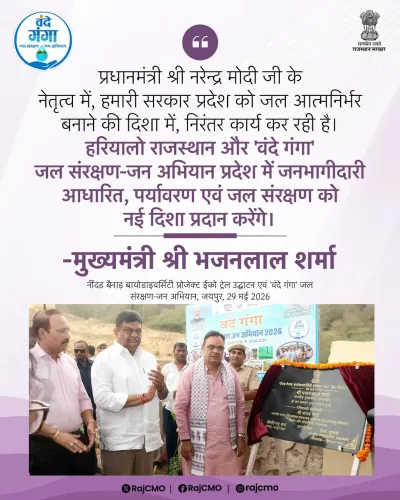
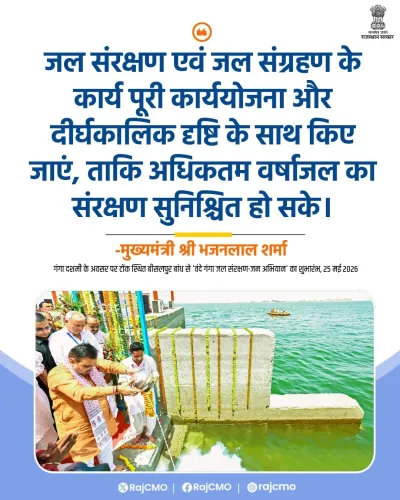
Rajasthan CM Bhajan Lal Sharma on 24 June 2026 committed to making Rajasthan water self-reliant ( aatmanirbhar ) in water resources.
The government's strategy covers water conservation, rainwater harvesting, and irrigation infrastructure expansion .
Securing Rajasthan's rightful share of water from other states through interstate negotiations is a stated priority.
The Indira Gandhi Canal and the 1981 Ravi-Beas accord remain the backbone of the state's interstate water framework.
The Jal Jeevan Mission (2019) and the Mukhya Mantri Jal Swavalamban Abhiyan (2016) form key policy pillars underpinning this commitment.
Farmers and rural households in arid and semi-arid regions are the primary intended beneficiaries.
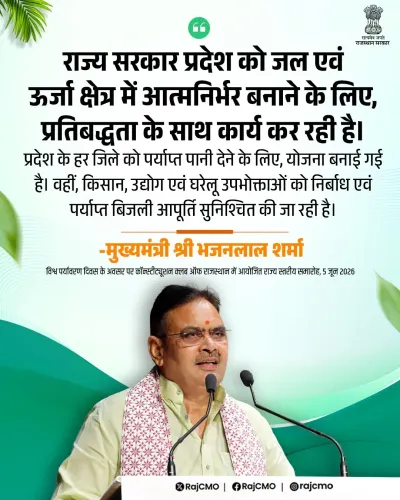
Rajasthan Chief Minister Bhajan Lal Sharma on Wednesday, 24 June 2026, reaffirmed his government's commitment to making Rajasthan self-reliant in water, stating that every citizen must benefit from water security. The Chief Minister outlined a multi-pronged approach spanning conservation, harvesting, irrigation infrastructure expansion, and securing the state's rightful share from interstate river allocations.
Posting in Hindi on X, Sharma wrote: 'हमारी सरकार का संकल्प है कि राजस्थान जल के क्षेत्र में आत्मनिर्भर बने और प्रत्येक नागरिक को जल सुरक्षा का लाभ मिले' ('It is our government's resolve that Rajasthan become self-reliant in water and every citizen receives the benefit of water security'). He added that efforts are ongoing to ensure the state's share of water from other states is made available, so that every region can be connected to the current of development and prosperity.
Context
Rajasthan is India's largest state by area and is characterised by vast arid and semi-arid zones that receive among the lowest average annual rainfall in the country. The state has historically depended on canal networks and interstate water-sharing agreements to meet agricultural and domestic needs. Water scarcity remains a persistent challenge for both rural households and farmers across the state's western and central districts.
The Chief Minister's statement signals a continued policy focus on water as a development priority, framing it in the language of aatmanirbharta (self-reliance) — a term that has gained wide currency in national policy discourse since 2020.
Policy Backdrop
Rajasthan's water governance rests on several foundational pillars. The Indira Gandhi Canal, expanded significantly since the 1980s, remains the lifeline of irrigation in western Rajasthan, channelling waters from the Ravi-Beas river system under the 1981 Ravi-Beas accord that governs allocations between Rajasthan, Punjab, and Haryana. The state launched the Mukhya Mantri Jal Swavalamban Abhiyan in 2016 to promote decentralised water conservation and rainwater harvesting in rural areas.
At the national level, the Jal Jeevan Mission, launched in 2019, has driven the expansion of functional household tap connections across rural Rajasthan, complementing state-level infrastructure investments. Sharma's remarks suggest the current government intends to build on these frameworks while pressing for Rajasthan's full entitlement from shared river basins.
Stakeholders and Impact
Farmers across Rajasthan's agricultural belt stand to gain most directly from any expansion of irrigation infrastructure and secured water allocations, as crop yields in the state are heavily contingent on canal water availability during sowing seasons. Rural households, particularly in arid western districts, face seasonal drinking water shortages that improved conservation and storage infrastructure could mitigate.
The emphasis on interstate water availability also has federal dimensions. Rajasthan's ability to access its full allocated share from rivers flowing through neighbouring states has been a recurring point of negotiation at the central level, making this a politically and economically significant commitment by the Chief Minister.
What's Next
Observers will watch for concrete announcements in upcoming Rajasthan Legislative Assembly sessions or central ministry reviews — particularly any new irrigation project approvals, budget allocations for water infrastructure, or fresh interstate water-sharing negotiations. Progress benchmarks under the Jal Jeevan Mission and the revival or expansion of the Mukhya Mantri Jal Swavalamban Abhiyan will be key indicators of how the government translates this resolve into measurable outcomes. Rajasthan's water security record will likely feature prominently in the state's political narrative ahead of future electoral cycles.
Point of View
Extending it from economic policy into natural-resource management in a state where water scarcity is an electoral flashpoint. The explicit mention of securing water from other states is a pointed signal to the Centre and to neighbouring state governments that Rajasthan will press its river-water entitlements more assertively. Coming as climate variability intensifies pressure on arid regions, the statement also positions the ruling party as proactive on an issue that could define rural voter sentiment. Whether policy intent translates into funded, time-bound projects will determine the credibility of this commitment.
NationPress
24 Jun 2026
Frequently Asked Questions
What did Rajasthan CM Bhajan Lal Sharma say about water policy?
On 24 June 2026, CM Bhajan Lal Sharma stated that his government's resolve is to make Rajasthan self-reliant in water and ensure every citizen benefits from water security, through conservation, harvesting, irrigation expansion, and securing the state's share from interstate rivers.
What is Rajasthan's main source of irrigation water?
The Indira Gandhi Canal, expanded since the 1980s, is the primary irrigation lifeline for western Rajasthan, channelling water from the Ravi-Beas river system under the 1981 interstate accord involving Punjab and Haryana.
What is the Mukhya Mantri Jal Swavalamban Abhiyan?
It is a Rajasthan state scheme launched in 2016 to promote decentralised water conservation and rainwater harvesting in rural areas, aimed at reducing dependence on external water sources.
How does the Jal Jeevan Mission help Rajasthan?
The Jal Jeevan Mission, launched by the central government in 2019, funds the creation of functional household tap connections in rural areas and has been significantly implemented across Rajasthan to improve drinking water access.
Why is water security a major issue in Rajasthan?
Rajasthan is India's largest state by area and covers vast arid and semi-arid zones with low average annual rainfall, making it heavily dependent on canal networks and interstate water allocations for agriculture and domestic use.