CM Bhajanlal: Rajasthan now a leading renewable energy state
Synopsis
The Chief Minister's Office of Rajasthan on June 23, 2026, declared that the state has emerged among India's leading renewable energy producers, citing CM Bhajanlal Sharma. Backed by the Bhadla Solar Park and the 2019 Solar Energy Policy, Rajasthan's Thar Desert geography has made it a national benchmark in clean power generation.
Key Takeaways
The Chief Minister's Office of Rajasthan on June 23, 2026 , declared Rajasthan among India's leading renewable energy producing states.
CM Bhajanlal Sharma , heading the BJP government since December 2023 , has made renewable energy a centrepiece of the state's development narrative.
The Bhadla Solar Park in Jodhpur district , the world's largest solar park, contributes over 2 GW to Rajasthan's renewable capacity.
The Rajasthan Solar Energy Policy 2019 set a target of 30 GW of solar capacity and introduced incentives for project developers.
Rajasthan participates in the PM-KUSUM scheme and the central National Solar Mission , aligning with India's goal of 500 GW non-fossil capacity by 2030 .
Wind-solar hybrid projects and upcoming budget revisions to solar targets are the key developments to watch next.
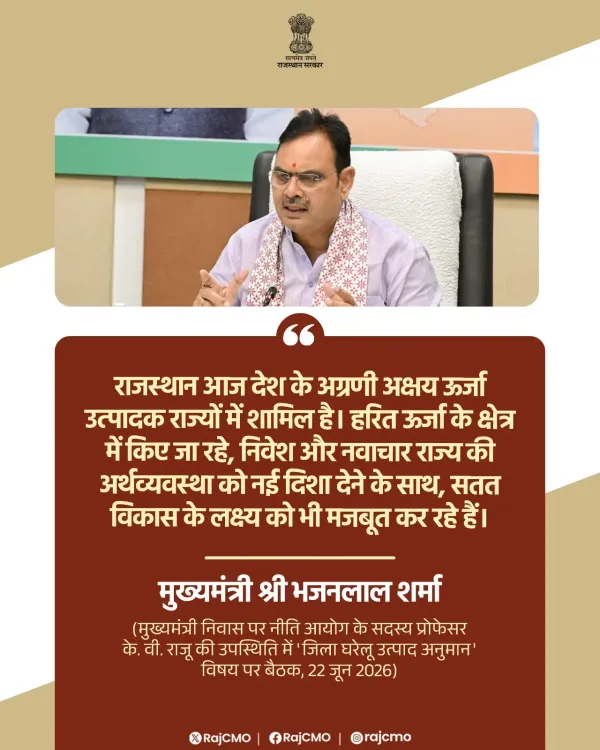
The Chief Minister's Office of Rajasthan on Tuesday, June 23, 2026, declared that Rajasthan has established itself among India's leading renewable energy producing states, highlighting the state's growing stature in the country's clean energy landscape.
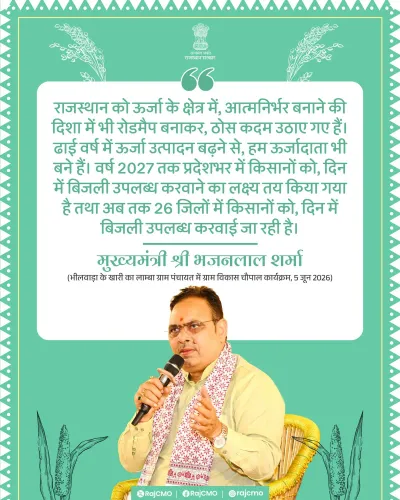
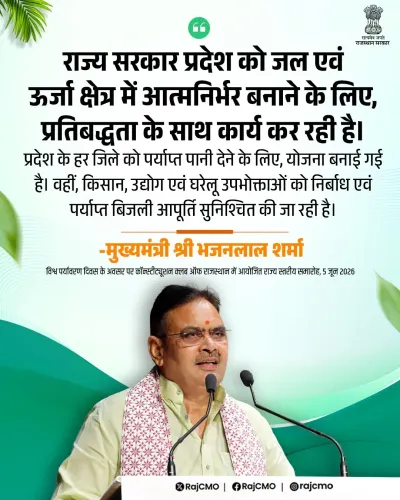
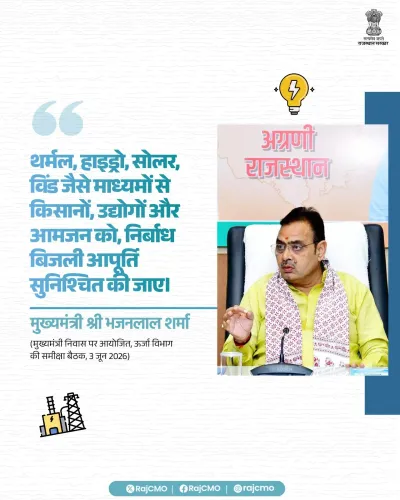
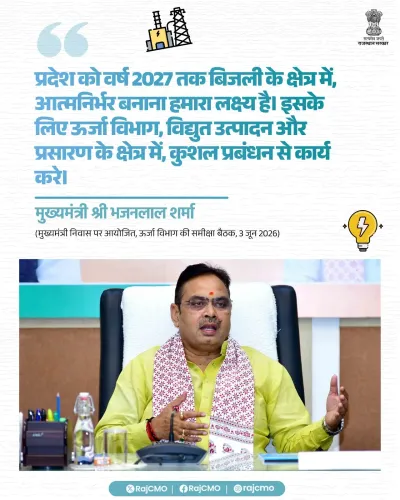
Posting on X with the hashtag #आपणो_अग्रणी_राजस्थान ('Our Leading Rajasthan'), the CMO cited Chief Minister Bhajanlal Sharma in affirming that 'Rajasthan today is among the country's leading renewable energy producing states.' The post underscores the BJP government's push to position the desert state as a national benchmark in clean power generation.
Context
Rajasthan has long held a structural advantage in renewable energy owing to the Thar Desert, which gives the state one of the highest solar irradiation levels in India. Vast tracts of low-cost land and consistent sunshine have made it a preferred destination for utility-scale solar projects. The state's geography has translated directly into installed capacity, with Rajasthan consistently ranking among India's top three states in solar power. The crown jewel of this infrastructure is the Bhadla Solar Park in Jodhpur district, recognised as the world's largest solar park, contributing over 2 GW to the state's renewable portfolio. Projects of this scale have anchored Rajasthan's identity as a solar powerhouse well beyond its borders.Policy Backdrop
The foundation for this growth was laid through the Rajasthan Solar Energy Policy 2019, which set an ambitious target of 30 GW of solar capacity and introduced developer-friendly incentives including land facilitation and transmission support. The policy aligned Rajasthan with the central government's National Solar Mission, launched in 2010, under which the state has been a major beneficiary. Rajasthan also participated in the PM-KUSUM scheme from 2019 onward, extending solar adoption to rural households and farmers through solar pumps and distributed generation models. Successive state governments, irrespective of political affiliation, have maintained continuity on renewable energy targets, reflecting the cross-party consensus on the sector's economic importance. The broader national goal of achieving 500 GW of non-fossil fuel capacity by 2030 has further incentivised states like Rajasthan to accelerate competitive bidding and park-based development. The state's discoms and private developers have together driven capacity addition through this framework.Stakeholders and Impact
The beneficiaries of Rajasthan's renewable energy push span multiple segments. Renewable energy developers gain access to one of India's most solar-rich geographies with supportive state policy. Rural households benefit from improved electricity access and reduced dependence on diesel-based alternatives through distributed solar schemes. State electricity distribution companies (discoms) stand to lower their power purchase costs as solar tariffs have fallen sharply over the past decade. The CM Bhajanlal Sharma-led government has framed renewable energy leadership as central to its broader infrastructure and investment narrative, using milestones in this sector to attract industrial interest and project a forward-looking image for the state.What's Next
Attention will now turn to how Rajasthan advances wind-solar hybrid projects, which offer more consistent generation profiles than standalone solar installations. Any revision to solar policy targets in the state's upcoming budget sessions will be closely watched by developers and investors. As India races toward its 2030 clean energy goals, Rajasthan's ability to translate geographic advantage into grid-connected capacity at scale will remain a key indicator of national progress on the energy transition.Point of View
Using renewable energy credentials to reinforce the Bhajanlal Sharma government's infrastructure narrative ahead of potential investor summits and policy reviews. Rajasthan's solar leadership is not new — it predates the current administration — but the BJP government is clearly seeking to own that legacy and project continuity with national clean energy ambitions. The hashtag 'Our Leading Rajasthan' signals a broader communications campaign aimed at positioning the state as a model for development-oriented governance. The timing, mid-year 2026, suggests groundwork is being laid for policy announcements or investment pitches in the months ahead.
NationPress
23 Jun 2026
Frequently Asked Questions
Is Rajasthan the top renewable energy state in India?
Rajasthan is among India's top renewable energy producing states, consistently ranking in the top three for installed solar capacity, though the exact current ranking as of 2026 has not been independently verified.
What is the Bhadla Solar Park in Rajasthan?
The Bhadla Solar Park, located in Jodhpur district, is the world's largest solar park and contributes over 2 GW to Rajasthan's renewable energy capacity.
What is Rajasthan's solar energy policy target?
The Rajasthan Solar Energy Policy 2019 set a target of 30 GW of solar capacity and introduced incentives for renewable energy developers.
What did CM Bhajanlal Sharma say about renewable energy?
The Chief Minister's Office cited CM Bhajanlal Sharma as stating that 'Rajasthan today is among the country's leading renewable energy producing states.'
How does Rajasthan contribute to India's 2030 clean energy goal?
Rajasthan contributes through large-scale solar parks, competitive bidding, the PM-KUSUM scheme for rural solar adoption, and alignment with the National Solar Mission, supporting India's target of 500 GW non-fossil capacity by 2030.