CM Himanta flags early detection as Assam boy recovers from cataract surgery
Synopsis
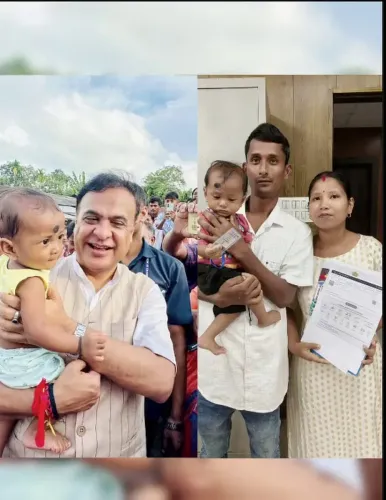
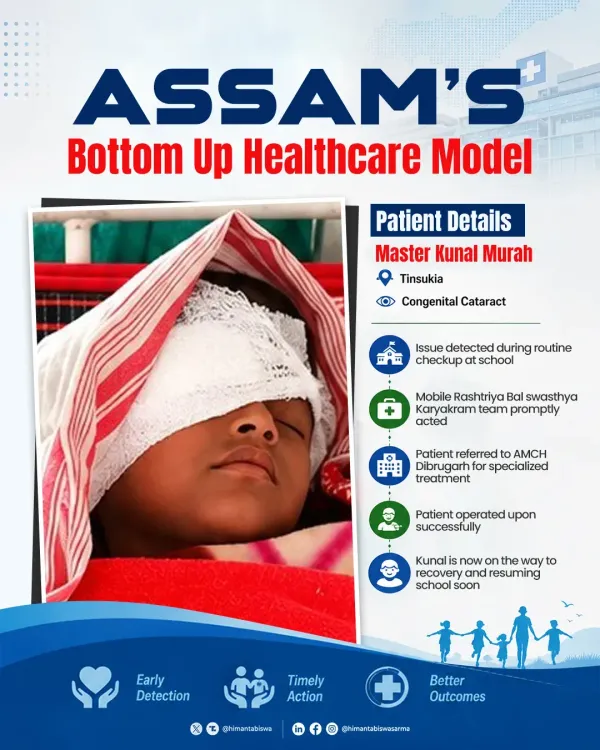
Assam Chief Minister Himanta Biswa Sarma highlighted the case of 7-year-old Kunal, whose congenital cataract was caught during a routine school health check-up and treated at AMC Dibrugarh, underscoring the state's push for early detection in public healthcare.
Key Takeaways
Assam CM Himanta Biswa Sarma shared the case of 7-year-old Kunal on 21 July 2026 to advocate for early detection in public healthcare.
Kunal's congenital cataract was identified through a routine school health check-up and he was referred to AMC Dibrugarh for surgery.
The referral pipeline falls under the Rashtriya Bal Swasthya Karyakram (RBSK) , a national scheme launched in 2013 to screen children aged 0–18 for birth defects and developmental conditions.
AMC Dibrugarh , established in 1947 , is a key tertiary referral centre for ophthalmology in eastern Assam and the broader Northeast.
Untreated congenital cataracts can cause irreversible vision loss; early surgery, ideally before age 10 , is critical for normal visual development.
The case aligns with the National Health Policy 2017 shift toward preventive and community-level care for reducing preventable blindness in India.
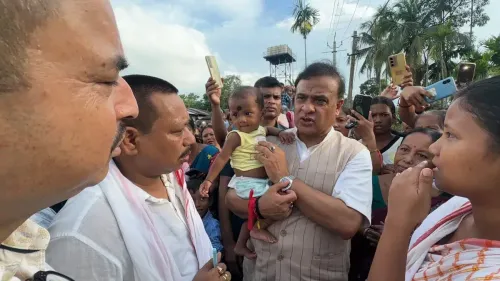
Assam Chief Minister Himanta Biswa Sarma on Tuesday, 21 July 2026, highlighted the case of a 7-year-old child named Kunal whose congenital cataract was detected during a routine school health check-up and successfully treated at a government medical college, citing it as proof that early detection in public healthcare saves lives and sight.
Context
Sarma stated that Kunal's congenital cataract was identified during a school health screening, after which he was promptly referred to Assam Medical College, Dibrugarh (AMC Dibrugarh) for surgery. The Chief Minister noted that the child 'is now recovering well,' framing the outcome as a direct result of the state's emphasis on early detection in public healthcare.
Congenital cataracts, if left untreated in early childhood, can cause irreversible vision loss or amblyopia. Early surgical intervention — ideally before age 10 — is considered critical for preserving normal visual development.
Policy Backdrop
The screening that identified Kunal's condition falls under the Rashtriya Bal Swasthya Karyakram (RBSK), a national child health programme launched in 2013 by the Ministry of Health and Family Welfare to screen children aged 0–18 for birth defects, diseases, and developmental delays, including congenital cataracts. Assam integrated RBSK screening with district-level referral pathways to government medical colleges as part of its state health policy updates after 2016.
The case also aligns with the National Programme for Control of Blindness and Visual Impairment, a central scheme operational since 1976 that supports school-level eye screening and free cataract surgeries at public hospitals. The National Health Policy 2017 further reinforced this preventive-care-first approach, urging states to strengthen community and school outreach for early detection of visual impairment.
Stakeholders and Impact
AMC Dibrugarh, established in 1947, is one of the oldest and most significant tertiary referral centres in Northeast India, with a well-regarded ophthalmology department that handles complex cases referred from across eastern Assam and neighbouring districts. Its role as the receiving end of the referral chain underscores the importance of functional linkages between school-level screening and institutional surgical capacity.
The primary beneficiaries of such programmes are school-going children in rural and semi-urban Assam, where access to private ophthalmology care is limited. For families without the means to seek specialist care independently, the school-to-hospital referral pipeline often represents the only pathway to timely diagnosis and treatment.
What's Next
Sarma's post is likely to renew attention on the coverage and outcomes of school health screening referrals across Assam's districts in the current academic year. Analysts will watch whether the state follows up with expanded ophthalmology capacity at government medical colleges or allocates fresh budget to scale RBSK outreach in underserved blocks.
Multiple northeastern states have been strengthening referral linkages between schools and medical colleges to address congenital eye conditions before vision loss becomes permanent — a trend that Assam's case reinforces and that may inform regional health policy discussions in the months ahead.
Point of View
Reinforcing the government's messaging around upgrading legacy institutions in eastern Assam. If backed by district-level data on screening coverage and surgical outcomes, such communication could translate into genuine policy momentum; without it, it risks remaining anecdotal advocacy.
NationPress
20 Oct 2026
Frequently Asked Questions
What is the Rashtriya Bal Swasthya Karyakram and how does it help children like Kunal?
The Rashtriya Bal Swasthya Karyakram (RBSK) is a national child health screening programme launched in 2013 that covers children aged 0–18 for birth defects, diseases, and developmental delays including congenital cataracts. Children identified during school or anganwadi screenings are referred to government medical colleges for free treatment, as happened in Kunal's case.
What is congenital cataract and why does early detection matter?
Congenital cataract is a clouding of the eye's lens present at birth or developing in early childhood. If untreated, it can lead to permanent vision loss or amblyopia; early surgical intervention, ideally before age 10, is essential for normal visual development.
Which hospital treated Kunal for his congenital cataract in Assam?
Kunal was referred to Assam Medical College, Dibrugarh (AMC Dibrugarh), one of the oldest medical colleges in Northeast India established in 1947, which serves as a major ophthalmology referral centre for eastern Assam.
What has Assam CM Himanta Biswa Sarma said about public healthcare and early detection?
CM Himanta Biswa Sarma has consistently stated that public healthcare must emphasise early detection. He cited 7-year-old Kunal's recovery from congenital cataract surgery — identified through a school health check-up — as a 'heartening example' of this approach working in practice.
How does school health screening work for eye conditions in Assam?
Under the RBSK programme, trained health teams visit schools and anganwadis to screen children for a range of conditions including vision problems. Children flagged during screening are referred through a district-level mechanism to government medical colleges like AMC Dibrugarh for specialist assessment and free surgery.