CM Himanta Eyes Makhana Village in Assam's Darrang

Synopsis
Assam CM Himanta Biswa Sarma announced NEFSA's proposed Makhana Village in Darrang, targeting 100 bighas and 100 farmers across Mangaldai and Sipajhar — scaling a successful two-hectare pilot to diversify the state's agriculture beyond rice, tea, and jute.
Key Takeaways
Assam CM Himanta Biswa Sarma announced NEFSA's Makhana Village proposal for Darrang district on 17 October 2026 .
The plan targets approximately 100 bighas (~33 acres) of farmland and around 100 farmers across Mangaldai and Sipajhar .
The proposal builds on a successful two-hectare pilot that demonstrated makhana's viability in Assam's floodplains.
Makhana ( Euryale ferox ) is a high-value aquatic crop historically concentrated in Bihar's Mithila region.
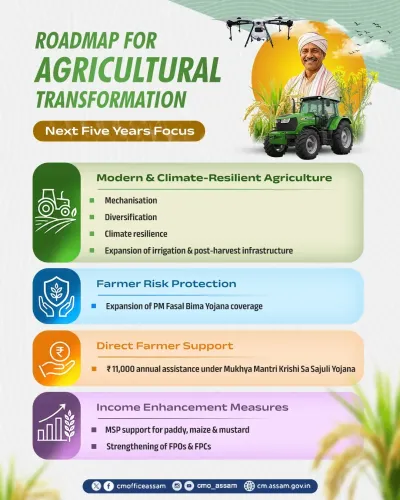
The initiative is part of Assam's broader crop-diversification push beyond its traditional rice, tea, and jute base.
Key next steps include formal state funding, technical support, and market-linkage arrangements for the expanded programme.
A crop long synonymous with Bihar's Mithila wetlands is quietly taking root in the floodplains of central Assam — and Assam Chief Minister Himanta Biswa Sarma wants to scale it fast. On Saturday, 17 October 2026, the CM announced that NEFSA's proposed Makhana Village in Darrang aims to pull nearly 100 bighas of farmland and around 100 farmers across Mangaldai and Sipajhar into makhana cultivation — building on a two-hectare pilot that has already shown the crop can thrive here.
A two-hectare pilot that changed the question
The announcement did not come from thin air. A small but significant two-hectare trial — the kind of low-risk proof-of-concept state agriculture departments run before committing larger resources — produced results encouraging enough for NEFSA to propose a dedicated Makhana Village. That shift, from cautious pilot to named village concept, is the real signal here: Assam is no longer asking can makhana grow here but how fast can we expand it.
Makhana (Euryale ferox), the aquatic fox-nut prized in Indian kitchens and Ayurvedic tradition alike, thrives in shallow, still water bodies — exactly the kind of landscape Darrang district's seasonal floodplains provide in abundance. The crop has historically been a near-monopoly of Bihar, particularly the Mithila belt, where it commands premium domestic and export prices. Bringing it to Assam's wetlands is a crop-diversification play with real income upside for farmers who currently cycle through rice, jute, and seasonal vegetables.
Mangaldai and Sipajhar: why these two blocks?
Mangaldai, the sub-divisional headquarters of Darrang, and Sipajhar, a development block to its south-west, sit in a stretch of the Brahmaputra valley where floodwaters deposit nutrient-rich silt each monsoon — conditions makhana historically prefers. Bringing both administrative units under one 'Makhana Village' umbrella also makes logistical sense: shared processing infrastructure, common market-linkage arrangements, and unified extension services become more viable at scale.
The ambition of reaching 100 farmers across roughly 100 bighas (approximately 33 acres) represents a meaningful jump from a two-hectare start. For individual smallholders in Darrang, where per-hectare returns on paddy remain modest, even a partial switch to a high-value aquatic crop could materially change household income — provided downstream market linkages hold.
Assam's broader push beyond rice, tea, and jute
The Makhana Village idea slots into a wider pattern under Chief Minister Sarma's tenure since May 2021: systematic efforts to coax Assam's agriculture sector away from its traditional three-crop dependency and toward niche, high-value commodities suited to the state's distinctive geography. Wetland aquaculture, spice cultivation, and floriculture have all featured in this diversification drive at various points.
What the Makhana Village still needs — formal state budget allocation, technical support from agricultural universities, and guaranteed off-take arrangements — will determine whether the momentum carries beyond the announcement. A GI tag for Assam-grown makhana, should volumes justify it, would add further premium power for farmers down the line. The pilot proved possibility. The village plan tests scale. The market will decide staying power.
Point of View
Evidence-first approach that tends to outlast headline-driven scheme launches. For CM Sarma, it reinforces a consistent political narrative around Assam as an innovation-friendly agricultural state under BJP governance, building farmer-income credentials ahead of what will eventually be an election cycle. The broader significance, however, lies in what it signals for the North-East: if Assam can establish commercial-scale makhana production, it opens a template other wetland-rich states in the region could follow, potentially reshuffling India's specialty-crop geography away from its current Bihar-centric concentration.
NationPress
17 Oct 2026
Frequently Asked Questions
What is the NEFSA Makhana Village in Assam?
NEFSA's proposed Makhana Village in Darrang district aims to bring nearly 100 bighas of land and around 100 farmers across Mangaldai and Sipajhar in Assam into makhana cultivation, scaling up a successful two-hectare pilot.
Can makhana be grown in Assam?
Yes. A two-hectare pilot in Assam's Darrang district produced encouraging results, prompting the proposal for a dedicated Makhana Village. The district's seasonal floodplains provide shallow, still water conditions that makhana cultivation requires.
What is makhana and why is it valuable?
Makhana, or fox-nut (Euryale ferox), is an aquatic crop prized in Indian cuisine and Ayurvedic tradition. It commands premium domestic and export prices and has historically been produced almost exclusively in Bihar's Mithila region.
Which areas in Darrang are targeted for makhana farming?
The proposed Makhana Village targets farmers in Mangaldai, the sub-divisional headquarters of Darrang, and Sipajhar, a development block in the same district in central Assam.
How does this fit Assam CM Himanta Sarma's agricultural agenda?
Since taking office in May 2021, CM Himanta Biswa Sarma has pushed Assam's agriculture toward high-value niche crops suited to the state's wetlands and floodplains, moving beyond traditional dependence on rice, tea, and jute.