CM Himanta Reflects on Chhath at Brahmaputra Ghats

Synopsis
Assam Chief Minister Himanta Biswa Sarma observed Chhath Mahaparv on the banks of the Brahmaputra, calling the ancient sun-worship festival the finest expression of Sanatan Sanskriti and praising its ecological philosophy as a lesson the world needs today.
Key Takeaways
Assam CM Himanta Biswa Sarma attended Chhath Mahaparv observances on the Brahmaputra banks on 16 November 2026 .
He described Chhath as 'the finest expression of Sanatan Sanskriti ,' rooted in worship of both the setting and rising sun.
Sarma highlighted the festival's core bond between Vyakti (individual) and Prakriti (nature) as an ancient ecological philosophy.
He cited the festival's unbroken generational continuity as evidence of the durability of Indian civilisation.
BJP leaders in the Northeast have consistently framed traditional Hindu festivals within a broader cultural and ecological discourse, particularly under Sarma's leadership.
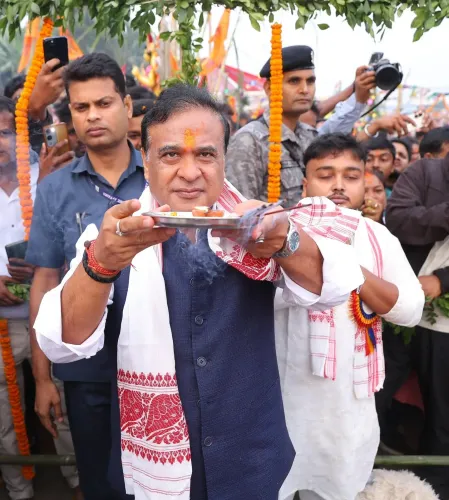
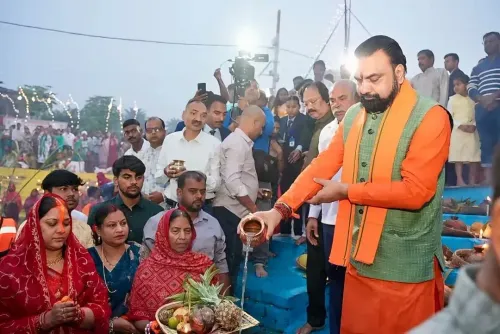
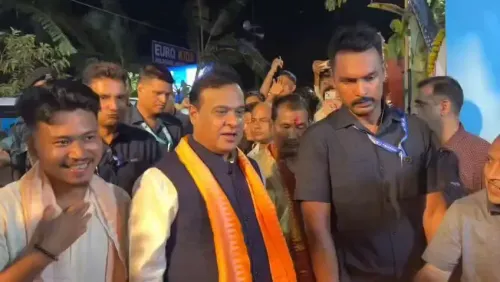
At the edge of the Brahmaputra at dawn on Monday, 16 November 2026, Assam Chief Minister Himanta Biswa Sarma stood among Chhath devotees and found in their rituals something larger than a festival — a civilisational argument made in silence, sunlight, and still water.
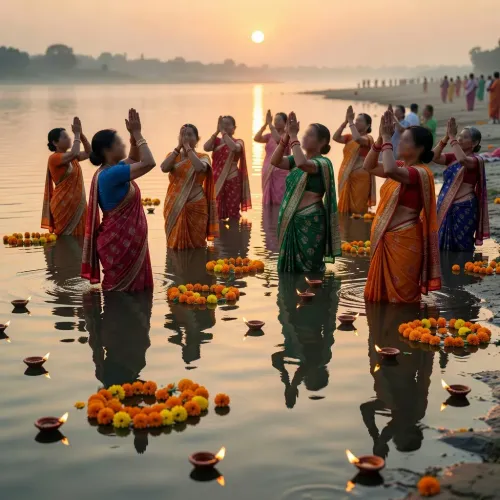
Sarma described the occasion as a reminder that Chhath Mahaparv is 'the finest expression of Sanatan Sanskriti,' drawing a direct line between the festival's ancient choreography — devotees bowing first to the astha surya (setting sun) and then to the uday surya (rising sun) — and a philosophy of human harmony with the natural world. 'Our ancestors created a direct bond between Vyakti aur Prakriti,' he wrote, using the Sanskrit pairing of individual and nature.
Four days, one river, an unbroken tradition
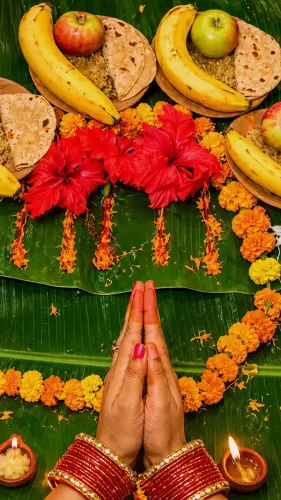
Chhath is among Hinduism's most demanding festivals — four days of strict fasting, ritual bathing, and prolonged standing in river water at precise solar moments. It is dedicated to Surya, the Sun God, and to Chhathi Maiya, and its rituals are performed without a priest as intermediary, an unusual feature that lends the festival its distinctive directness. No idol, no temple, just the river and the sky.
That architecture — devotee, water, sun — is exactly what Sarma pointed to as the festival's quiet lesson. 'Its simplicity is its strength,' he wrote, 'and its harmony with nature is a lesson the world needs today.' On the Brahmaputra, one of Asia's mightiest rivers and the pulse of Assam's cultural geography, that message landed with particular weight.
A BJP cultural outreach with an ecological edge
BJP leaders in the Northeast have made a deliberate practice of marking traditional Hindu festivals — and of framing them not merely in devotional terms but in the language of ecological wisdom and civilisational durability. Sarma, as both Chief Minister of Assam and convenor of the North-East Democratic Alliance (NEDA), occupies a position where cultural messaging travels across a diverse, multi-ethnic region that includes significant non-Hindu populations.
Describing Chhath's survival across generations as proof of 'how lasting our civilisation is' threads the needle between devotional pride and a broader claim about Indic knowledge systems — the kind of framing that resonates well beyond the festival's traditional heartland in Bihar, Jharkhand, and eastern Uttar Pradesh, now observed with growing fervour in Assam's urban centres and along its river ghats.
The Brahmaputra ghats are not a footnote here. They are the stage — and Sarma's presence on them on Chhath morning was itself a political and cultural statement, one photograph-ready moment that ties the ruling dispensation to one of Hinduism's most ecologically grounded rituals.
When a civilisation teaches its children to fold their hands before a river at sunrise, it is writing its own constitution — one that has outlasted empires. That is the case CM Sarma made from the banks of the Brahmaputra this morning, and the festival's sheer staying power makes it difficult to argue otherwise.
Point of View
Sarma's cultural signals carry weight across eight states, making such messaging as much regional alliance management as it is devotional expression.
NationPress
16 Nov 2026
Frequently Asked Questions
What is Chhath Mahaparv and why is it significant?
Chhath Mahaparv is an ancient Hindu festival dedicated to the Sun God, observed over four days with rituals including worship of both the setting and rising sun from river banks. It is notable for requiring no priestly intermediary, emphasising a direct, personal bond with nature.
Why did Himanta Biswa Sarma attend Chhath on the Brahmaputra?
Assam CM Himanta Biswa Sarma joined devotees at the Brahmaputra ghats for Chhath observances, using the occasion to reflect on the festival's philosophical message of human harmony with nature and its expression of Sanatan Sanskriti.
What did Himanta Biswa Sarma say about Chhath 2026?
Sarma described Chhath as 'the finest expression of Sanatan Sanskriti,' praising its simplicity, its ecological wisdom rooted in the bond between Vyakti (individual) and Prakriti (nature), and its civilisational durability across generations.
Is Chhath Puja celebrated in Assam?
Yes, Chhath Puja is observed in Assam, particularly in urban centres with significant Bihari-origin and Hindi-speaking communities. River ghats on the Brahmaputra serve as prominent venues for the festival's sunrise and sunset rituals.
What is the BJP's approach to Hindu festivals in Northeast India?
BJP leaders in the Northeast, including CM Sarma, have consistently highlighted traditional Hindu festivals and their ecological dimensions as part of broader cultural outreach, framing them within narratives of civilisational continuity and Sanatan traditions.