CM Himanta Outlines Key Provisions of Assam's Civil Code

Synopsis
Assam Chief Minister Himanta Biswa Sarma on 27 May 2026 publicly outlined five pillars of a proposed civil code for the state, covering marriage registration, court-only divorce, equal inheritance, live-in relationship registration, and a minimum marriage age — signalling imminent legislative action.
Key Takeaways
Assam CM Himanta Biswa Sarma announced on 27 May 2026 that a proposed Code will address five key societal issues in the state.
The Code proposes making divorce applicable only through a court of law , replacing informal dissolution of marriages.
It would grant equal inheritance rights to sons and daughters , overriding existing religion-specific personal laws.
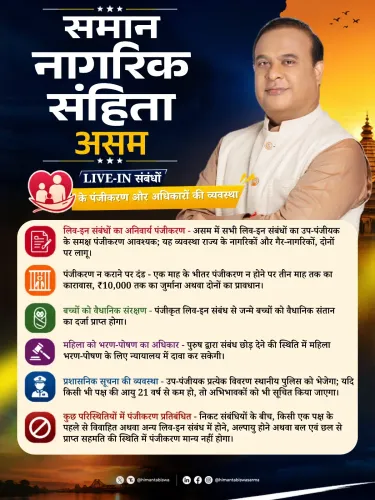
Registration of live-in relationships would be made mandatory — a provision already tested in Uttarakhand since 2024 .
Uttarakhand enacted India's first state-level Uniform Civil Code in February 2024 , providing the legislative template Assam appears to be following.
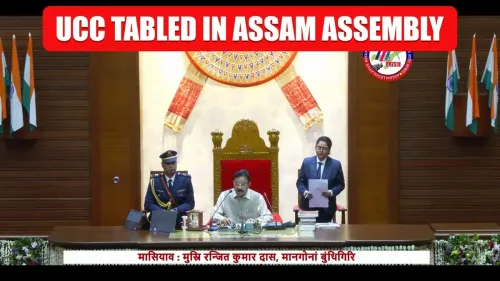
The bill is expected to be tabled in the Assam Legislative Assembly ; its exact text and enactment date have not yet been officially notified.
Assam Chief Minister Himanta Biswa Sarma on Wednesday, 27 May 2026 outlined the key societal objectives of a proposed civil code for Assam, listing five core provisions the legislation is intended to address — from mandatory marriage registration to equal inheritance rights for sons and daughters.
Context
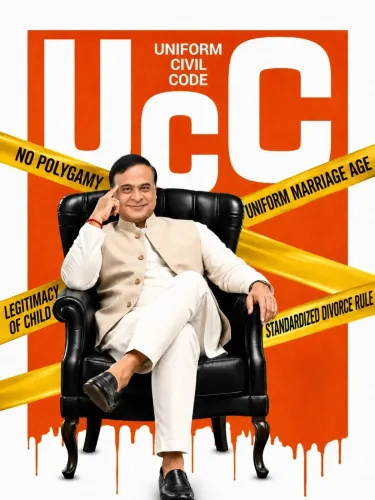
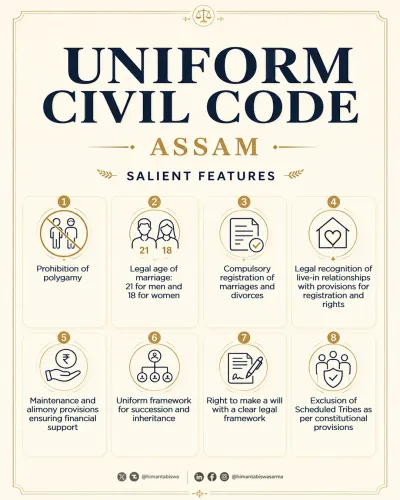
In a post on X, CM Sarma stated that the Code will 'cater to key societal issues' and enumerated five pillars: regulating marriage registration, making divorce applicable only through a court of law, giving equal inheritance rights to sons and daughters, making registration of live-in relationships mandatory, and fixing a minimum age of marriage. The post signals the Assam government's intent to move forward with comprehensive personal law reform in the state.
The announcement follows years of groundwork. The Assam government had announced as early as 2022 its intention to introduce legislation regulating marriage, divorce, and inheritance across communities, making this post a significant public reaffirmation of that agenda.
Policy Backdrop
Uttarakhand became the first Indian state to enact a Uniform Civil Code (UCC) in February 2024, covering registration of marriages, divorces, live-in relationships, and equal inheritance — provisions that closely mirror those now articulated by CM Sarma for Assam. That precedent has emboldened other BJP-ruled states to pursue similar legislation.
The constitutional basis for such a code lies in Article 44 of the Constitution of India, which lists a Uniform Civil Code among the Directive Principles of State Policy — aspirational goals that successive governments have debated but rarely enacted at scale. The BJP has consistently championed the UCC as a vehicle for gender-equal personal laws, citing earlier reforms such as the abolition of triple talaq and bans on polygamy as precursors.
In the northeast, Assam has been a frontrunner in social-reform legislation under CM Sarma's leadership. A state-level civil code would mark the most sweeping intervention yet, touching the personal laws of every community in the state.
Stakeholders and Impact
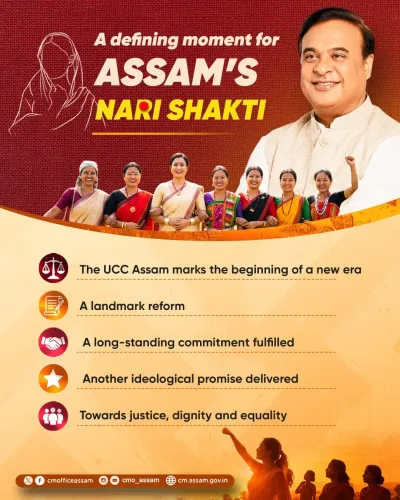
Women stand to be among the most directly affected beneficiaries. Equal inheritance rights for sons and daughters would override personal laws — across Hindu, Muslim, Christian, and tribal communities — that currently disadvantage daughters in property succession. Mandatory court-only divorce and a fixed minimum marriage age are framed as protections against informal dissolution of marriages and child marriage respectively.
Religious communities are likely to scrutinise the proposals closely, as any unified code would supersede religion-specific personal law statutes that have governed family matters since before independence. The mandatory registration of live-in relationships is a particularly novel provision that has already drawn debate in Uttarakhand, where similar rules were challenged in court. The Assam Legislative Assembly will be the arena where these provisions are debated and, if approved, enacted into law.
What's Next
The immediate watch-point is the tabling of a formal bill in the Assam Legislative Assembly. The exact title, final text, and enactment timeline of the Code have not yet been officially notified. Once tabled, the bill will face scrutiny from opposition benches, civil society groups, and potentially constitutional courts.
If passed, Assam would become the second Indian state after Uttarakhand to operationalise a comprehensive civil code — a development that could accelerate similar moves in other BJP-governed states and sharpen the national debate on a federal UCC ahead of future electoral cycles.
Point of View
Foregrounding inheritance equality and child-marriage prevention over the more contentious live-in registration clause. By mirroring Uttarakhand's 2024 template almost point-for-point, the Assam government is borrowing legal credibility from an already-enacted precedent, reducing the risk of the bill being dismissed as untested. The move fits squarely into the BJP's broader pattern of advancing UCC-adjacent reforms at the state level as a stepping stone toward a national code. How Assam's diverse tribal and minority communities respond will determine whether this becomes a governance landmark or a prolonged legal and political flashpoint.
NationPress
11 Oct 2026
Frequently Asked Questions
What is the Assam civil code announced by CM Himanta Biswa Sarma?
It is a proposed state law that would create uniform rules on marriage registration, divorce, inheritance, live-in relationships, and the minimum age of marriage for all communities in Assam, regardless of religion.
Will the Assam civil code make live-in relationships mandatory to register?
Yes, CM Sarma's post explicitly states that registration of live-in relationships will be made mandatory under the proposed Code, similar to a provision already in force in Uttarakhand since 2024.
How does Assam's proposed civil code compare to Uttarakhand's UCC?
Uttarakhand enacted India's first state-level Uniform Civil Code in February 2024, covering marriage, divorce, inheritance, and live-in registration — the same five areas outlined by CM Sarma for Assam, making Uttarakhand the closest legislative precedent.
What happens to divorce under the Assam civil code?
Under the proposed Code, divorce would be applicable only through a court of law, meaning informal or community-level dissolution of marriages would no longer be legally recognised.
When will the Assam civil code bill be tabled in the Assembly?
The exact tabling date has not been officially announced. The next key milestone to watch is the introduction of a formal bill in the Assam Legislative Assembly, after which its text and timeline will become public.