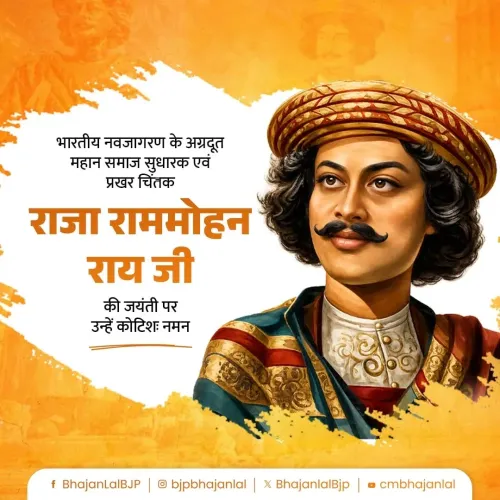
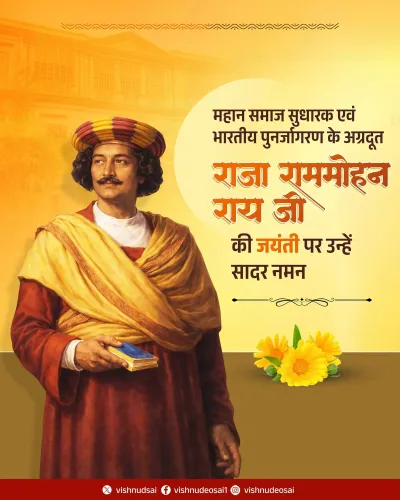
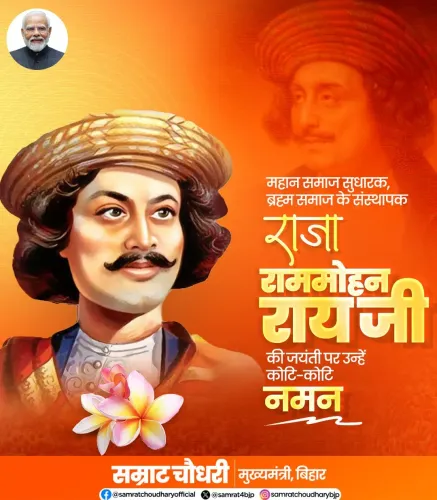
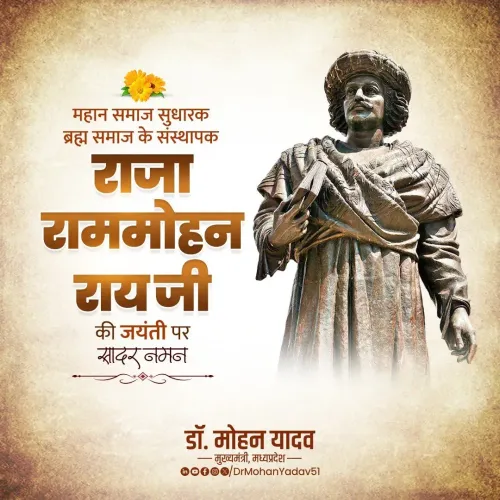
CM Mohan Yadav pays tribute to Raja Ram Mohan Roy on death anniversary
Synopsis
Madhya Pradesh CM Dr. Mohan Yadav marked Raja Ram Mohan Roy's death anniversary on September 27, 2026, honouring the Brahmo Samaj founder's landmark campaigns against Sati and for women's education as pillars of India's social progress.
Key Takeaways
Madhya Pradesh CM Dr.
Mohan Yadav paid tribute to Raja Ram Mohan Roy on his death anniversary, September 27, 2026 .
Roy founded the Brahmo Samaj in 1828 , a movement championing rationalism, social equality, and opposition to Sati and child marriage.
His advocacy led directly to the Bengal Sati Regulation of 1829 , one of the earliest civil-society-driven colonial law reforms in India.
Yadav credited Roy with making 'the right to knowledge and equality the foundation of the nation's development.' Indian political leaders across parties regularly invoke 19th-century reformers to connect contemporary governance with India's deep reformist tradition.
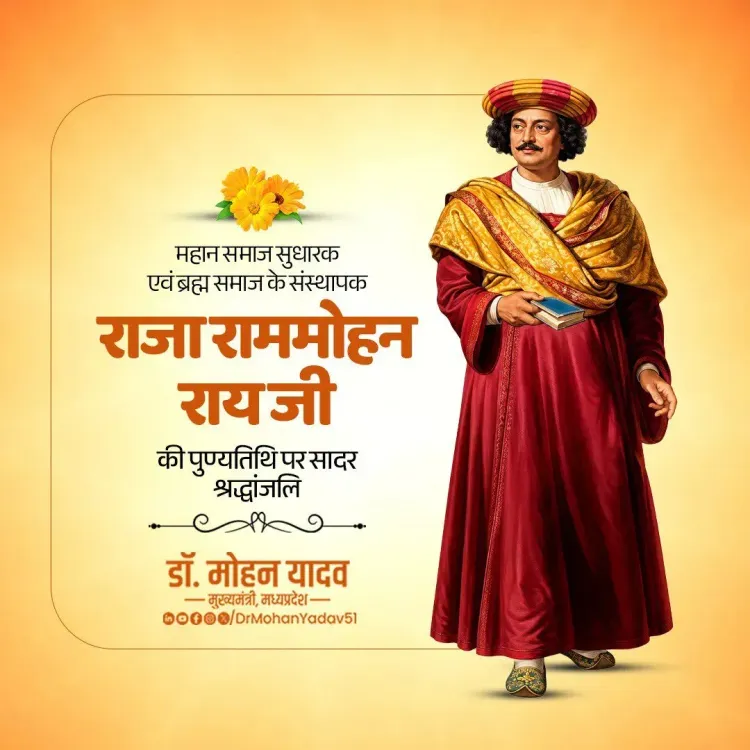
Nearly two centuries after he dismantled one of colonial India's cruellest institutions, Raja Ram Mohan Roy is remembered not merely as a reformer but as the architect of modern India's social conscience — and on his death anniversary, Sunday, September 27, 2026, Madhya Pradesh Chief Minister Dr. Mohan Yadav paid solemn tribute to the man who made that conscience possible.
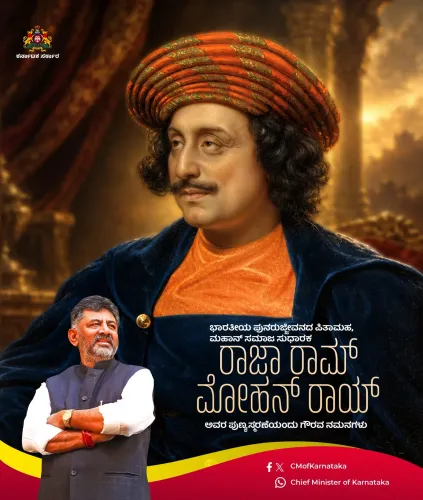
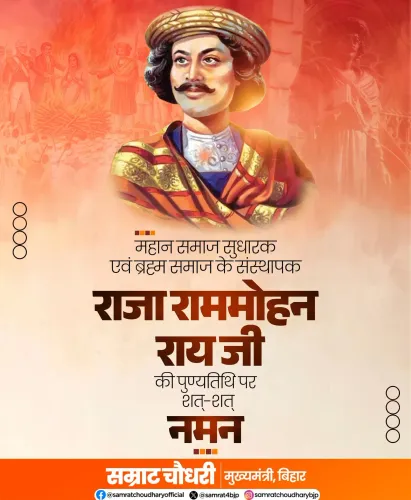
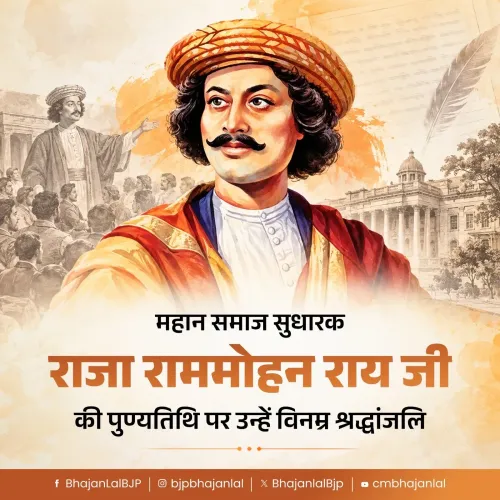
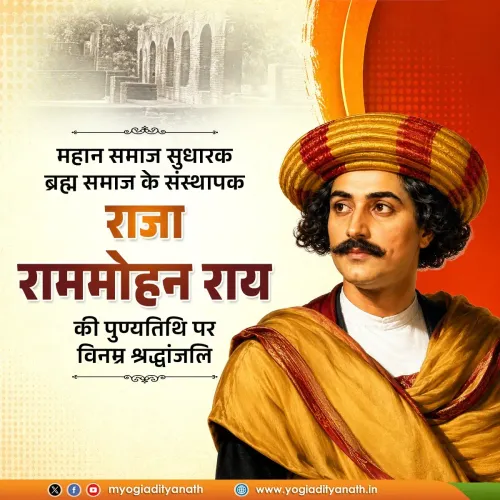
Writing in Hindi on X, Dr. Yadav offered his respects — 'सादर श्रद्धांजलि' (reverential homage) — to the 'great social reformer and founder of Brahmo Samaj,' crediting Roy with charting a path out of bondage: from the horrors of Sati to the exclusion of girls from education. 'He made the right to knowledge and equality the foundation of the nation's development,' Dr. Yadav wrote, 'and gave the country a new direction through women's education.'
The man who bent a colonial empire toward reform
Raja Ram Mohan Roy was born in 1772 in Bengal and spent his life waging a campaign that few of his contemporaries dared attempt: dismantling caste rigidity, religious superstition, and the violent oppression of women from within Indian society itself. His most consequential victory came in 1829, when sustained advocacy — directed at both Indian opinion and British colonial authorities — produced the Bengal Sati Regulation, which legally prohibited the practice of burning widows alive on their husbands' funeral pyres.
That single act of legislative reform, won through argument rather than arms, reoriented the relationship between social activism and state power in India. It remains one of the earliest examples of a civil-society campaign successfully changing colonial law.
Brahmo Samaj and the long shadow of 1828
Roy founded the Brahmo Samaj in 1828 — one year before the Sati ban — as a platform for rational inquiry, monotheistic reform, and social equality. The organisation rejected idol worship and the caste system, and championed women's right to education at a time when both ideas were considered radical. Its influence radiated across Bengal and beyond, seeding the intellectual climate from which later nationalist and reformist movements would grow.
Roy died in Bristol, England, in 1833, having travelled abroad to advocate for Indian interests. He never saw the full arc of the transformation he started.
Why Indian politicians still invoke Roy in 2026
Chief Ministers and Prime Ministers across parties mark Roy's birth and death anniversaries with regularity — and the pattern is not accidental. Connecting contemporary governance to Roy's legacy is a way of anchoring current education and gender-equality programmes to a reformist lineage that predates political parties. For a state like Madhya Pradesh, which has invested in schemes targeting girls' education and women's welfare, invoking Roy situates that work in a continuum stretching back nearly two hundred years.
The tribute also carries an implicit civic message: that the constitutional values of equality and access to education have deep Indian roots — roots Roy helped plant long before independence.
A reformer who changed the law of an empire with nothing but argument and evidence. That legacy does not age.
Point of View
Aligning with Roy's legacy — associated with anti-Sati activism and women's education — signals continuity with a broader reformist narrative that transcends ideological lines. The tribute also subtly deflects questions about contemporary gender-equality gaps by anchoring the party's commitments to a two-century-old moral lineage. Whether state programmes on girls' education and women's welfare translate that symbolic alignment into measurable outcomes is the sharper question Roy's legacy ultimately demands.
NationPress
27 Sept 2026
Frequently Asked Questions
When is Raja Ram Mohan Roy's death anniversary?
Raja Ram Mohan Roy died on 27 September 1833 in Bristol, England, making September 27 his annual death anniversary.
Who was Raja Ram Mohan Roy and what did he do?
Raja Ram Mohan Roy (1772–1833) was a Bengali social reformer who founded the Brahmo Samaj in 1828 and successfully campaigned for the Bengal Sati Regulation of 1829 , which banned the practice of Sati, while also advocating for women's education and social equality.
What is the Brahmo Samaj?
The Brahmo Samaj is a religious and social reform movement established by Raja Ram Mohan Roy in 1828 in Calcutta. It promoted monotheism, rationalism, opposition to caste discrimination, and equal rights for women.
Why did Mohan Yadav pay tribute to Raja Ram Mohan Roy?
Madhya Pradesh Chief Minister Dr. Mohan Yadav paid tribute on Roy's death anniversary, September 27, 2026 , honouring his legacy of fighting Sati, promoting women's education, and establishing knowledge and equality as pillars of national development.
What was the Bengal Sati Regulation of 1829?
The Bengal Sati Regulation of 1829 was a colonial law that formally prohibited the practice of Sati — widows being burned on their husbands' funeral pyres — passed following years of sustained advocacy by Raja Ram Mohan Roy .