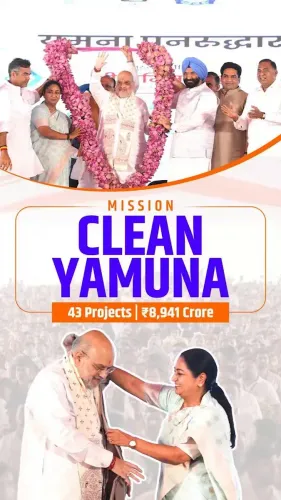
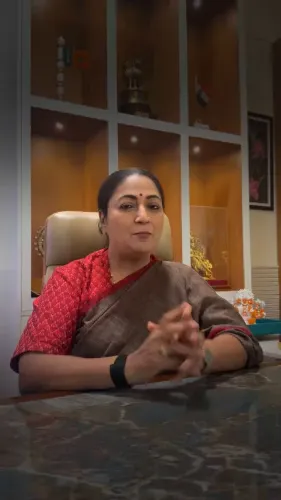
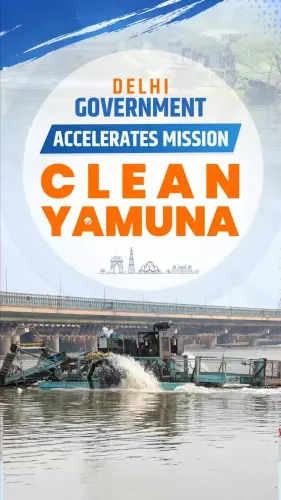
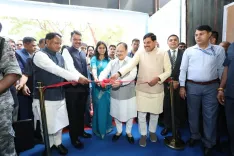
CM Rekha Gupta Vows Zero Sewage Into Yamuna
Synopsis
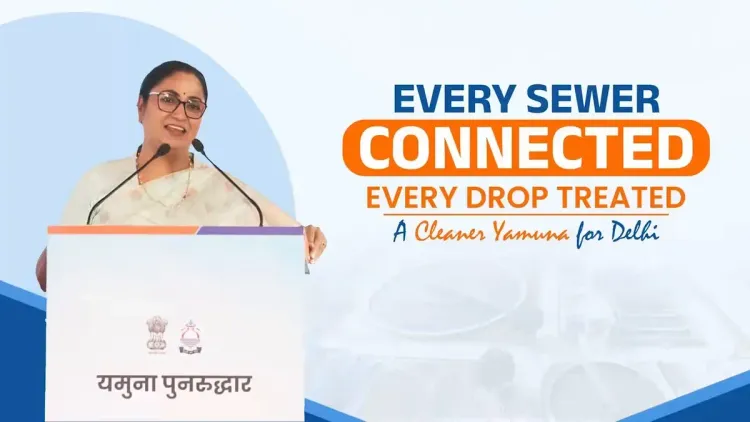
Delhi Chief Minister Rekha Gupta pledged on 22 October 2026 that every home and colony will be connected to sewage treatment plants, eliminating untreated discharge into the Yamuna — framing the drive as a coordinated push with PM Modi's national urban sanitation agenda under #ViksitDelhi.
Key Takeaways
CM Rekha Gupta on 22 October 2026 publicly committed to linking every Delhi household and colony sewer line to a Sewage Treatment Plant (STP).
The explicit goal is zero untreated wastewater entering the Yamuna river from Delhi's residential areas.
The pledge operates as a three-step infrastructure chain: household connection → colony sewer line → STP linkage.
The drive aligns with the Swachh Bharat Mission (launched 2014 ) and the multi-decade Yamuna Action Plan framework.
PM Narendra Modi's leadership and central guidance were cited by Gupta as enabling forces behind Delhi's urban infrastructure push.
Key metrics to watch: STP connectivity rates across Delhi's colonies and pace of last-mile household sewer connections.
Every home connected to a sewer line. Every sewer line tied to a treatment plant. Not a drop of untreated wastewater reaching the Yamuna. Delhi Chief Minister Rekha Gupta laid out an unambiguous infrastructure promise on Thursday, 22 October 2026, anchoring her government's clean-river agenda in hard, sequential engineering logic.
Posting under the hashtag #ViksitDelhi ('Developed Delhi'), CM Gupta wrote: 'Every house will be connected to a sewer. Every colony will have a sewer line and every sewer line will be linked to an STP, so that not even a trace of dirty water reaches the Yamuna.' The statement is direct — and deliberately measurable. Three links in a single chain: household, colony line, Sewage Treatment Plant (STP). Break any one and the river pays the price.
Why Delhi's Sewage Problem Keeps Defying Easy Fixes
The Yamuna has been the subject of cleanup drives for over three decades. The Yamuna Action Plan, launched in the 1990s, brought billions of rupees and successive government pledges — yet large stretches of the river still receive untreated or partially treated discharge. The structural reason is consistent: gaps in the last-mile connection. Colonies, particularly unauthorised or semi-regularised settlements, were never networked into the city's sewer grid. Wastewater flowed into storm drains and eventually the river.
Sewage Treatment Plants exist, but their capacity is only meaningful when feeder lines actually reach them. CM Gupta's framing — 'every sewer line linked to an STP' — targets precisely this disconnect. The ambition is not new infrastructure for its own sake; it is closing the loop on infrastructure that already exists but sits underutilised.
The National Frame: Swachh Bharat and PM Modi's Urban Push
Gupta invoked Prime Minister Narendra Modi explicitly, crediting his leadership alongside the guidance she cited for driving Delhi's turnaround. That framing is deliberate. The Swachh Bharat Mission, launched in 2014, made urban sanitation coverage a national metric — and the pressure to show tangible Yamuna improvement in the capital carries symbolic weight well beyond Delhi's borders. A clean Yamuna is, in BJP's political vocabulary, proof that governance at every level is working in coordination.
The BJP-led state government has consistently positioned full sewerage connectivity as the structural answer to what it frames as years of incomplete action by previous administrations. Colony-by-colony STP linkage is the operational centrepiece of that argument.
What the Rollout Actually Depends On
The pledge is clear; the test is in the sequencing. Laying colony-level sewer lines in Delhi's dense, mixed-tenure urban fabric — where road widths are narrow and land-ownership records are contested — is an engineering and administrative challenge that timelines alone cannot resolve. The critical metrics to watch will be reported STP connectivity rates across Delhi's colonies and whether household-level connections keep pace with the trunk infrastructure.
Gupta's government has staked political credibility on visible urban improvement. The Yamuna is the most public, most photographed indicator of whether that promise lands — and in Delhi, it flows through the heart of the city's imagination as much as its geography.
Delhi's sewers are being mapped to a clean-river finish line. The infrastructure is there; the question now is whether execution matches the ambition drawn in a single, three-link chain.
Point of View
Politically sensitive failure — the Yamuna's persistent pollution — into a concrete, sequential infrastructure promise that can be tracked and credited. By invoking PM Modi's leadership alongside her own government's effort, she embeds Delhi's cleanup within the national Swachh Bharat arc, shielding the agenda from purely local criticism. The three-link framing (house → colony → STP) is also strategically smart: it sets a measurable audit trail, which is both a governance commitment and a political risk if timelines slip. Yamuna pollution has been a live electoral issue in Delhi for years; whoever credibly claims ownership of its solution holds significant political capital.
NationPress
22 Oct 2026
Frequently Asked Questions
What did Delhi CM Rekha Gupta say about the Yamuna on 22 October 2026?
CM Rekha Gupta pledged that every house in Delhi will be connected to a sewer line, every colony sewer line will be linked to a Sewage Treatment Plant (STP), so that no untreated wastewater reaches the Yamuna river.
What is the Yamuna Action Plan and has it worked?
The Yamuna Action Plan was launched in the 1990s to reduce sewage pollution in the Yamuna through treatment infrastructure. Despite multiple phases and significant investment, large stretches of the river still receive untreated discharge, largely due to gaps in last-mile colony sewer connectivity.
What is the connection between the Swachh Bharat Mission and Delhi's sewer plans?
The Swachh Bharat Mission, launched by PM Narendra Modi in 2014, set national targets for urban sanitation coverage including sewer networks. Delhi's full-STP-connectivity drive is framed as part of this national urban sanitation push.
Why is STP linkage important for Yamuna cleanup?
Sewage Treatment Plants can only treat wastewater they receive. When colony sewer lines are not connected to STPs, raw sewage flows into drains and eventually the Yamuna. Full STP linkage closes this gap and prevents untreated discharge.
What does #ViksitDelhi mean?
'Viksit' means 'developed' in Hindi, so #ViksitDelhi translates to 'Developed Delhi' — a campaign hashtag used by CM Rekha Gupta's government to frame urban infrastructure improvements as part of a broader development agenda for the capital.