CM Rio highlights Nagaland food safety authority's public health role
Synopsis
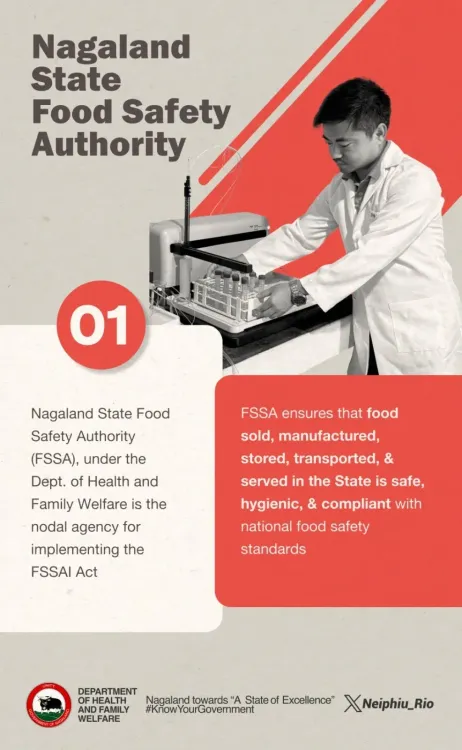
Nagaland Chief Minister Neiphiu Rio on 9 July 2026 highlighted the Nagaland State Food Safety Authority's work in testing, inspections, awareness, and capacity building, calling food safety fundamental to public health under the #KnowYourGovernment initiative.
Key Takeaways
CM Neiphiu Rio posted on 9 July 2026 spotlighting the Nagaland State Food Safety Authority under the #KnowYourGovernment hashtag.
The authority operates under the Department of Health and Family Welfare, Nagaland and focuses on testing, inspections, awareness, and capacity building.
Its mandate is grounded in the Food Safety and Standards Act, 2006 , which established FSSAI as the national regulator and mandated state-level enforcement bodies.
The four-pronged approach targets food safety for consumers, vendors, and processors across Nagaland , including in the informal food sector.
Upcoming compliance reports and state budget allocations for laboratory upgrades will be key indicators of the authority's operational strength.
Nagaland Chief Minister Neiphiu Rio on Thursday, 9 July 2026, spotlighted the work of the Nagaland State Food Safety Authority, underlining that food safety is foundational to public health and that the authority operates through testing, inspections, awareness drives, and capacity-building programmes to ensure food is safe, hygienic, and compliant with established standards.
Context
Posting under the hashtag #KnowYourGovernment, CM Rio drew public attention to the role of the Nagaland State Food Safety Authority, which functions under the Department of Health and Family Welfare, Nagaland (tagged as @HealthNagaland on X). The post is part of a broader pattern of the Chief Minister using social media to explain state institutions and their mandates to citizens.
The authority is the state-level enforcement arm responsible for carrying out the objectives set by national food regulation. Its work spans laboratory testing of food samples, surprise inspections of food establishments, consumer awareness campaigns, and training of food handlers and officials.
Policy Backdrop
The institutional foundation for this work lies in the Food Safety and Standards Act, 2006, which consolidated a cluttered set of earlier food laws and established the Food Safety and Standards Authority of India (FSSAI) as the national regulator. The Act mandates that each state constitute its own food safety authority to implement standards at the ground level.
FSSAI, operational since 2008, sets science-based standards that state bodies are required to enforce. Across India, states have progressively built out their enforcement infrastructure — upgrading testing laboratories, training food safety officers, and running outreach in informal food sectors. The Northeast, with its diverse food ecosystem and significant informal food trade, has been a focus of these decentralised public health efforts.
The Nagaland authority's four-pronged approach — testing, inspections, awareness, and capacity building — mirrors the national framework designed to reduce food-borne illnesses and bring informal vendors into compliance with hygiene and quality norms.
Stakeholders and Impact
The primary beneficiaries of a robust food safety regime are consumers, who are protected from adulterated, contaminated, or substandard food products. Food vendors, processors, and restaurant operators across Nagaland are directly subject to the authority's inspections and are expected to align their practices with prescribed standards.
Public health officials and food safety officers form the operational backbone of the authority, and their capacity is directly shaped by the training and infrastructure investments the state makes. Strengthening this layer is critical to translating regulatory intent into on-the-ground compliance, particularly in smaller towns and rural markets.
What's Next
Observers will watch for the release of annual food safety compliance reports by the Nagaland State Food Safety Authority, which would provide measurable data on inspection numbers, sample testing outcomes, and enforcement actions. State budget allocations for laboratory upgrades and officer training programmes will also signal the government's commitment to moving beyond awareness into systematic enforcement.
CM Rio's public communication on the authority's mandate may also precede fresh policy announcements or a campaign targeting specific food safety concerns in the state, consistent with the #KnowYourGovernment series of outreach posts.
Point of View
Which is itself a governance signal. It reflects a wider trend among state governments of using executive social media to build public trust in enforcement agencies that typically operate below the public radar. For Nagaland, where informal food trade is substantial and enforcement capacity has historically been limited, amplifying the authority's mandate could be a precursor to a more assertive compliance push. The timing and framing suggest the state is positioning food safety as a public health priority ahead of potential budgetary or policy announcements.
NationPress
8 Oct 2026
Frequently Asked Questions
What is the Nagaland State Food Safety Authority?
The Nagaland State Food Safety Authority is a state-level body under the Department of Health and Family Welfare, Nagaland, responsible for enforcing food standards through testing, inspections, consumer awareness, and capacity-building programmes in line with national FSSAI norms.
What did Nagaland CM Neiphiu Rio say about food safety?
On 9 July 2026, CM Neiphiu Rio stated that food safety is fundamental to public health and highlighted that the Nagaland State Food Safety Authority works to ensure food is safe, hygienic, and standard compliant through testing, inspections, awareness drives, and capacity building.
What is FSSAI and how does it relate to Nagaland's food safety authority?
FSSAI, the Food Safety and Standards Authority of India, is the national regulator established under the Food Safety and Standards Act, 2006. It sets science-based standards that state food safety authorities like Nagaland's are mandated to enforce at the ground level.
What does the #KnowYourGovernment hashtag mean in CM Rio's post?
#KnowYourGovernment is a communication initiative used by CM Rio to inform citizens about state institutions, their functions, and their relevance to everyday life, in this case focusing on the food safety authority.
Why is food safety important in Northeast India?
Northeast India has a diverse and largely informal food trade ecosystem, making regulatory oversight critical to reducing food-borne illnesses and ensuring that vendors and processors meet hygiene and quality standards set by national and state authorities.