CM Sai Declares Bastar Entering New Era of Peace and Development
Synopsis
Chhattisgarh Chief Minister Vishnu Deo Sai declared on 15 July 2026 that Bastar has entered a new era of peace, security, and development, attributing the shift to the BJP's double-engine government and pledging continued efforts toward a prosperous, self-reliant Bastar.
Key Takeaways
CM Vishnu Deo Sai declared on 15 July 2026 that Bastar has entered a new era of peace, security, and development.
He credited the 'double-engine government' — aligned BJP administrations at the state and central levels — for the transformation.
Bastar is a seven-district division in southern Chhattisgarh with a large tribal population and a long history of Maoist insurgency.
The Integrated Action Plan for Left Wing Extremism districts (2010) and the Aspirational Districts Programme (2018) form the policy backbone of development efforts in the region.
The CM pledged to continue building a 'prosperous, secure, self-reliant, and developed Bastar.' Updated security and development indicators from the state home department are expected to follow as benchmarks for the administration's claims.
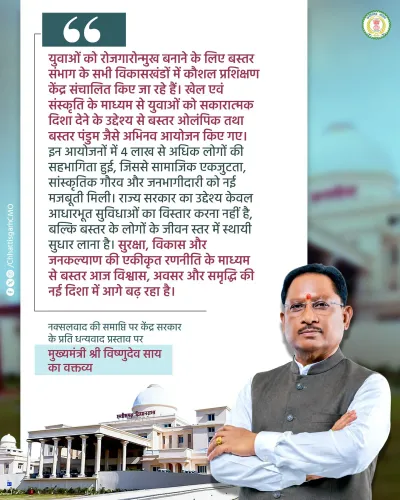
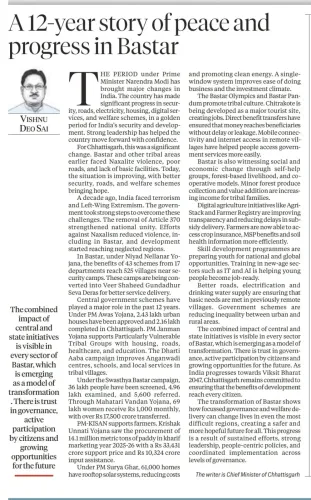
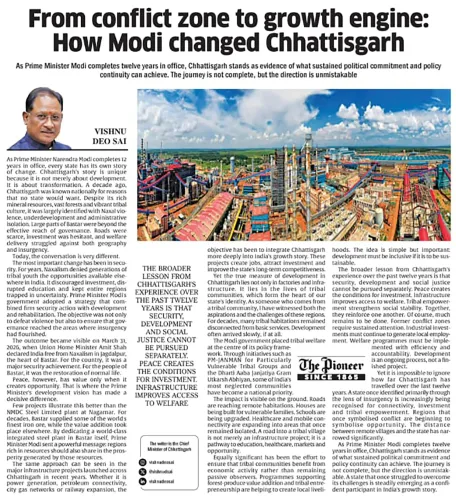
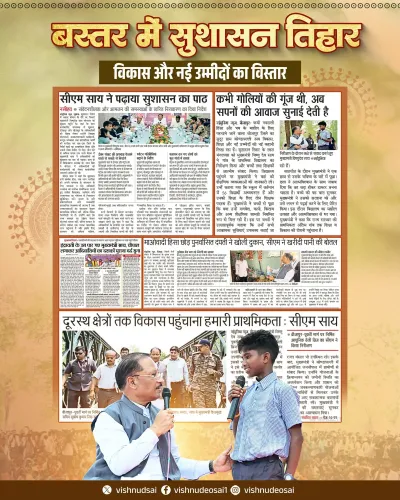
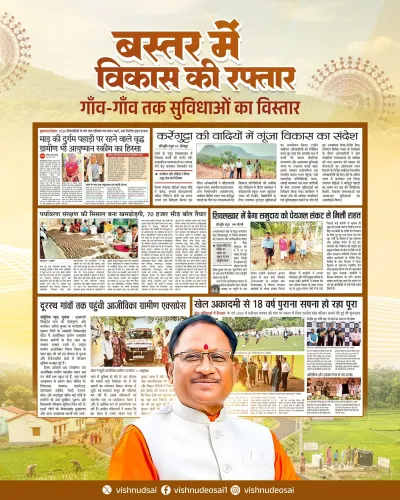
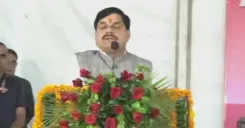
Chhattisgarh Chief Minister Vishnu Deo Sai declared on Wednesday, 15 July 2026 that Bastar has entered a new era of peace, security, and development, crediting sustained efforts by the 'double-engine government' — the aligned BJP administrations at the state and central levels — for the transformation underway in the long-insurgency-affected southern Chhattisgarh division.
Context
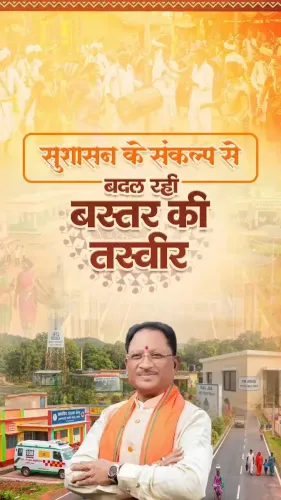
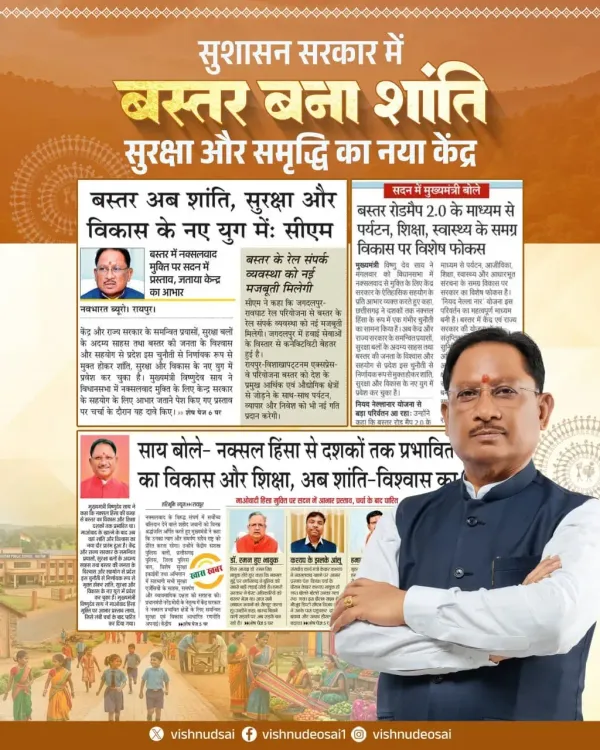
In a post on X, CM Sai wrote: 'बस्तर आज शांति, सुरक्षा और विकास के नए युग में प्रवेश कर चुका है' — 'Bastar has today entered a new era of peace, security, and development.' He added that a new chapter of transformation is being written through the firm resolve and continuous efforts of the double-engine government, and that the commitment to building a 'prosperous, secure, self-reliant, and developed Bastar' is being steadily advanced.
Bastar is a seven-district division in southern Chhattisgarh with a large tribal population. It has been one of the most severely Maoist-affected regions in India for several decades, making any governance claim about peace and development there politically and administratively significant.
Policy Backdrop
The central government launched the Integrated Action Plan for Left Wing Extremism districts in 2010 to channel development funds into violence-affected blocks, including those across Bastar. After 2014, Chhattisgarh's state government rolled out targeted Bastar development packages and road connectivity projects, which were later expanded under the Aspirational Districts Programme from 2018 onwards.
The BJP's broader counter-insurgency framework has consistently paired intensified security operations with infrastructure investment and welfare delivery, a dual-track approach applied across Left Wing Extremism-affected states in central and eastern India. CM Sai, who took office in December 2023 after the BJP's return to power in Chhattisgarh, has tribal outreach and Naxal-affected-area governance as stated priorities of his administration.
Stakeholders and Impact
The primary stakeholders in Bastar's transformation are its tribal communities, who have borne the brunt of decades of insurgency-related violence, displacement, and restricted access to public services. Improved security conditions, if sustained, directly affect access to schools, health centres, roads, and markets for these populations.
Security forces operating across the Bastar division — including central paramilitary units and the Chhattisgarh Police — are the operational backbone of the anti-Naxal campaign. Their continued deployment and the pace of infrastructure rollout will determine whether the administration's stated vision of a self-reliant Bastar translates into measurable ground-level change.
What's Next
Observers will watch for the release of updated security and development indicators for Bastar's districts by the state home department, as well as any formal announcements of new road, skill-development, or welfare projects under central schemes. The state government is expected to use Bastar's trajectory as a key governance benchmark ahead of future electoral cycles.
Whether the administration can sustain the momentum it is claiming — and back it with verifiable data on violence incidents, infrastructure completion, and economic indicators — will determine how durable this 'new era' narrative proves to be.
Point of View
He ties Bastar's progress directly to BJP alignment between Raipur and Delhi, reinforcing a narrative the party has used consistently since 2014 across Left Wing Extremism-affected states. The post arrives as the BJP seeks to consolidate its 2023 electoral gains in Chhattisgarh by demonstrating governance dividends in its most symbolically challenging territory. Bastar has long been the litmus test for any Chhattisgarh government's credibility on security and tribal welfare, making such public declarations as much about political positioning as administrative progress. The administration's credibility will ultimately rest on whether it can produce verifiable data to substantiate the 'new era' claim.
NationPress
15 Jul 2026
Frequently Asked Questions
What did Chhattisgarh CM Vishnu Deo Sai say about Bastar?
CM Vishnu Deo Sai declared on 15 July 2026 that Bastar has entered a new era of peace, security, and development, crediting the BJP's double-engine government for the transformation and pledging to build a prosperous, self-reliant Bastar.
What is the double-engine government in Chhattisgarh?
The 'double-engine government' refers to the alignment of BJP administrations at both the state level in Chhattisgarh and the central government in Delhi, which the party argues enables faster policy implementation and funding for development schemes.
Why is Bastar significant in Indian politics?
Bastar is a seven-district division in southern Chhattisgarh that has been one of India's most severely Maoist-affected regions for decades. It is home to large tribal communities and has been a long-standing test case for the government's ability to combine security operations with development delivery.
What government schemes are driving development in Bastar?
Key schemes include the central government's Integrated Action Plan for Left Wing Extremism districts, launched in 2010, and the Aspirational Districts Programme from 2018, both of which channel funds into infrastructure, connectivity, and welfare in Bastar's blocks.
Who is Vishnu Deo Sai?
Vishnu Deo Sai is a BJP leader and the Chief Minister of Chhattisgarh since December 2023. He has prior experience as a Union Minister and has focused on tribal welfare and governance in Naxal-affected areas.